
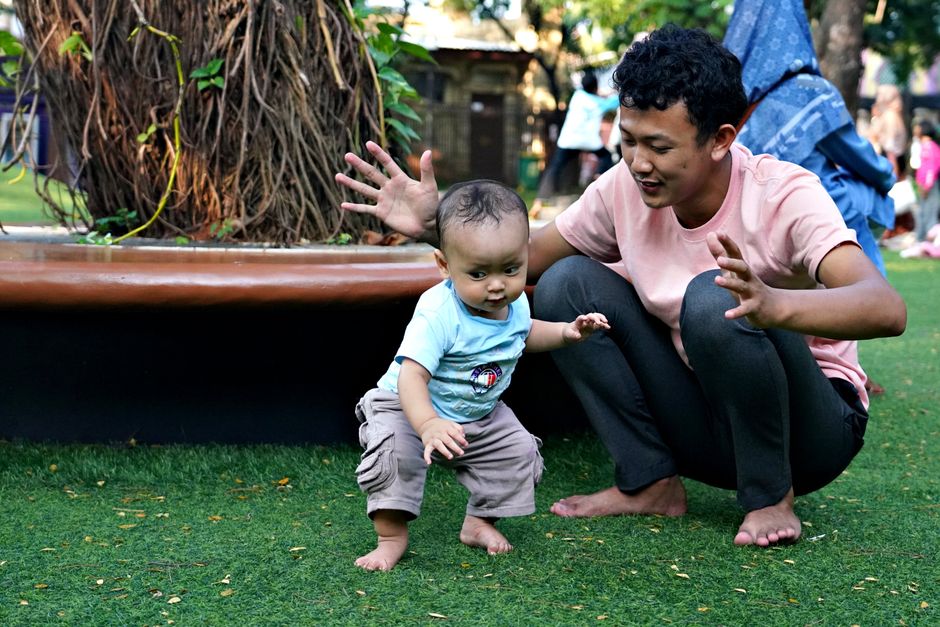
Most babies take their first independent steps sometime between 9 and 15 months, and the average is right around 12 months. That range is wide because walking is a milestone with a normal spread, not a deadline. If your baby is not walking by 15 months, that is worth a conversation with your pediatrician, but it is not automatically a sign that anything is wrong.
What matters more than the exact month is the pattern. Babies build toward walking through a predictable sequence of skills, and the timing of those skills varies from child to child. Some walk at 9 months. Some walk at 16 months and are perfectly healthy. The window is broad on purpose.
When Do Babies Usually Start Walking?
Roughly half of babies take their first steps by their first birthday. By 15 months, the large majority are walking at least a few steps on their own. These figures come from widely used developmental screening tools and pediatric growth references, and they have been stable for decades.
The 9-to-15-month range is not a guess. It reflects how infant motor development actually unfolds across large populations. A baby who walks at 10 months and a baby who walks at 14 months can both be developing typically.
What doctors watch for is not just the calendar but the trajectory. A baby who is pulling to stand, cruising along furniture, and taking steps while holding hands is on the path. A baby who shows none of those skills by 12 months may need a closer look.
What Skills Come Before Walking?
Walking does not appear out of nowhere. It sits at the end of a chain of motor milestones, and each one builds strength, balance, and coordination for the next.
The general sequence looks like this:
- Rolling over — usually by around 6 months
- Sitting without support — usually by around 6 to 8 months
- Pulling to stand — often around 9 months
- Cruising (walking while holding furniture) — often around 9 to 12 months
- Standing alone briefly — often around 11 to 13 months
- First independent steps — typically 9 to 15 months
These ages are approximate. A baby might skip a stage or move through them in a different order. What tends to matter is that progress is happening over weeks and months, not that each skill lands on a specific date.
One detail many parents miss: cruising and standing alone are often better predictors of readiness than age. A baby who cruises confidently and lets go for a second or two is usually close.
Why Do Some Babies Walk Later Than Others?
The range is normal, and a lot of it comes down to individual differences in temperament, muscle tone, and body proportions. A baby with a heavier build may take longer to balance on two legs than a lighter baby. A cautious baby may wait until balance feels very secure before letting go.
Opportunity matters too. Babies who spend time on the floor, exploring and pulling up, get more practice. Babies who are frequently in containers — seats, swings, and similar devices — may have fewer chances to build those skills during waking hours.
Some of the variation is simply genetic. If you or your partner walked late, your baby may follow a similar pattern.
Premature babies often reach motor milestones on a corrected timeline, meaning their age is adjusted from their original due date rather than their birth date. A baby born two months early may walk two months later than a full-term peer and still be right on track.





When Should You Talk to a Doctor?
Talk to your pediatrician if your baby is not taking any independent steps by 15 months, or if you notice a loss of skills they previously had. Losing a milestone is different from reaching one slowly, and it always warrants a medical evaluation.
Other signs worth raising:
- Not bearing weight on the legs by around 9 months
- Not sitting without support by around 9 months
- Stiff or very floppy muscle tone
- Using only one side of the body to move
- Persistent toe-walking that does not resolve
These signs do not confirm a diagnosis on their own. Many have simple explanations. But they are the kind of thing a doctor should assess rather than something to watch indefinitely at home.
Early evaluation is not about labeling a child. It is about catching things that respond well to early support, such as certain motor delays or conditions affecting muscle tone. Some children who walk late need no intervention at all. Others benefit from physical therapy. A doctor can help tell the difference.
Does Anything Speed Up Walking?
No product or technique has been shown to reliably make a baby walk sooner. The evidence for baby walkers, in particular, points in the opposite direction — they have been associated with delayed motor development and are a known cause of infant injuries. Several health organizations have called for them not to be used.
What does seem to help is simple and free: giving babies safe floor time to move, reach, and pull up. Tummy time builds the core and neck strength that supports later skills. Plenty of waking hours on a firm surface with interesting things to reach for gives a baby the practice they need.
Bare feet on a safe surface help too. Shoes are mainly for protection outdoors, not for learning to walk. A baby learning to walk benefits from feeling the floor with their feet.
Holding a baby’s hands to “practice” walking is fine as play. It does not appear to accelerate the milestone, and it is not necessary.
What Does the First Year of Walking Look Like?
First steps are usually wobbly, wide, and short. A new walker holds their arms out for balance and falls often. Over the following weeks and months, the gait gradually narrows and steadies.
Most toddlers are fairly stable walkers by around 18 months, though they still fall. Running, climbing, and navigating uneven ground come later. Falling is a normal part of learning to walk, which is one reason childproofing a home matters well before the first steps happen.
Some toddlers walk with their feet turned out or with a slightly unusual pattern at first. Most of these patterns resolve as balance and strength improve. A pattern that persists, or that affects only one side, is worth mentioning to a doctor.
Key Takeaways
- Most babies walk between 9 and 15 months, with an average around 12 months.
- Not walking by 15 months is a reason to check in with a doctor, not a reason to panic.
- The skills before walking — sitting, pulling up, cruising — matter as much as the timing of first steps.
- No product has been shown to speed up walking, and baby walkers are linked to delays and injuries.
- Losing a skill a baby already had is always a reason to seek medical advice.
Frequently Asked Questions
What is the average age for a baby to start walking?
The average is around 12 months, with most babies taking first steps between 9 and 15 months. That range is considered normal, so there is no single “right” month.
Is it normal for a baby not to walk at 15 months?
It can be, but 15 months is the point where doctors typically recommend an evaluation. Many late walkers are perfectly healthy, and an assessment helps rule out anything that needs support.
Do baby walkers help babies walk sooner?
No. Research has linked baby walkers to delayed motor development and to infant injuries, and several health organizations advise against them. Floor time is more useful.
Should I worry if my baby walked and then stopped?
Yes, losing a skill they already had is a reason to contact your pediatrician. A loss of milestones is different from a slow pace and should always be checked.
