
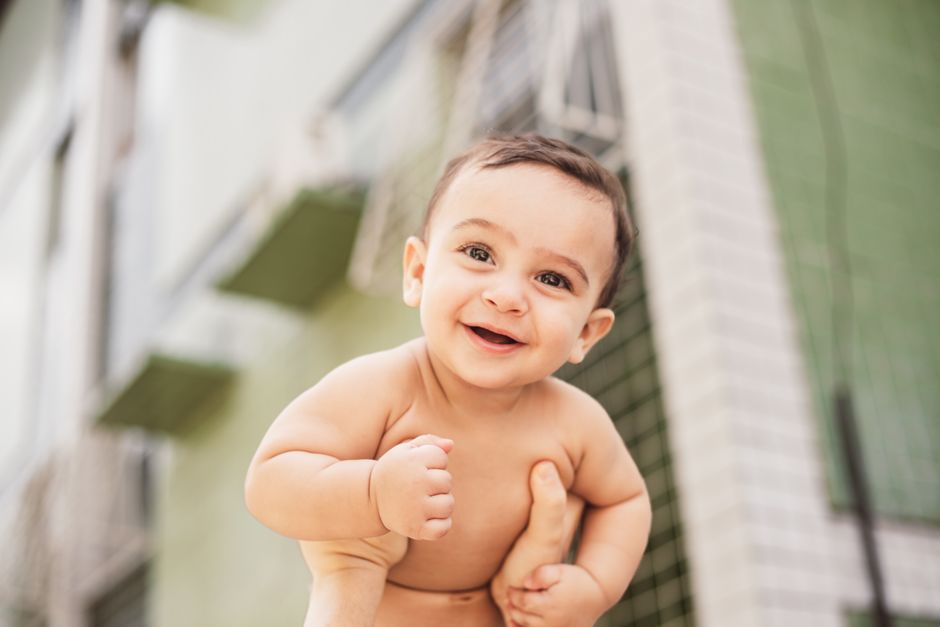
A baby’s first smile usually appears around 6 to 8 weeks of age, and the first real laugh typically follows between 3 and 4 months. These are the social smiles and belly laughs — the ones that respond to your face and voice, not the fleeting smiles that happen during sleep in the newborn weeks. The timing varies from baby to baby, and a range of a few weeks in either direction is normal.
Watching for that first smile is one of the most anticipated moments of early parenthood. It is also one of the earliest visible signs that a baby’s brain is beginning to connect social contact with a positive feeling. Here is what the timeline looks like, what each stage means, and when a delay is worth mentioning to a pediatrician.
When Do Babies Smile And Laugh? The Full Timeline
Smiling and laughing develop in stages, and each stage reflects a different part of a baby’s growing nervous system and social awareness. The chart below shows the typical range for each milestone.
| Age | What You May See | What It Means |
|---|---|---|
| Birth to 4 weeks | Smiles during sleep or while drowsy; grimaces | Reflex smiles. Not social. They do not respond to your face. |
| Around 6–8 weeks | First social smile in response to a face or voice | The brain is beginning to link social contact with pleasure. |
| Around 3 months | Smiling becomes frequent and easy to trigger | Baby is actively seeking interaction and responding to familiar people. |
| Around 3–4 months | First laugh or chuckle, often at physical play or funny sounds | Vocal and emotional systems are coordinating. Laughter is a more complex response than smiling. |
| Around 4–6 months | Big, open-mouthed laughs; smiling at other babies and familiar adults | Social awareness is broadening beyond the primary caregiver. |
| Around 6–12 months | Laughing at silly behavior, peekaboo, and anticipation | Baby understands humor and expects outcomes. This is a sign of developing memory and prediction. |
These ranges come from widely used developmental milestones and pediatric guidance. Your baby may hit each stage a few weeks early or late and still be developing typically.
What Is the Difference Between a Reflex Smile and a Social Smile?
A reflex smile is not a sign of happiness. It is a spontaneous muscle movement that happens mostly during sleep or light dozing in the first few weeks. Newborns also grimace and twitch as their nervous systems settle.
A social smile is different in a way you can see. It happens while your baby is awake and alert. It is triggered by something — your face, your voice, a familiar caregiver. It is a response, not a random movement.
This distinction matters because it tells you what the smile means. A reflex smile is simply the brainstem and facial muscles doing their early work. A social smile is the first sign that your baby recognizes you as a person and feels something positive about that recognition.
Many parents mistake early reflex smiles for the real thing. That is understandable, and it does not mean anything is wrong. It just means the social milestone is still ahead.
Why Do Babies Start Smiling Around 6 to 8 Weeks?
The timing lines up with rapid development in the brain’s social and visual systems. In the first two months, a baby’s vision sharpens enough to focus on a human face at close range. At the same time, brain circuits that process emotion and social reward are coming online.
Research on early social development has found that infants begin to prefer faces over other visual patterns very early. By around two months, many babies show a clear, consistent response to a face — the social smile.
This is also when babies start to make eye contact more reliably and to coo. The smile, the eye contact, and the cooing tend to arrive together because they all depend on the same underlying social development.
One detail that surprises many parents: the social smile is not just the baby responding to you. It is also the baby learning that their own behavior gets a reaction. When you smile back and talk to them, you are reinforcing that connection. That back-and-forth is one of the earliest forms of communication.





When Do Babies Start Laughing?
Most babies laugh for the first time between 3 and 4 months. Laughter is a more complex response than smiling, which is why it comes later. It requires a baby to coordinate breathing, vocal cords, and facial muscles in a controlled way, and it requires a slightly more developed sense of what is funny or surprising.
The first laughs are often triggered by physical play — gentle bouncing, tickling, or a game of peekaboo. Some babies laugh first at a funny sound or a raspberry blown on their belly. Others laugh at a parent’s exaggerated facial expression.
Before the first real laugh, you may hear a series of breathy “ha” sounds or a squeal that sounds close to a laugh. These are often the early stages of laughter. They usually build into a full laugh within a few weeks.
Some babies are simply more reserved. A baby who does not laugh until closer to 5 months can still be developing typically. Temperament plays a role — some babies are quieter observers and laugh less readily, even when they are happy and engaged.
What If My Baby Is Not Smiling or Laughing on Schedule?
A delay of a few weeks is usually not a concern. Developmental milestones have a range, and healthy babies hit them at different times. A baby who smiles at 10 weeks instead of 8 is still within a normal range.
There are some situations where it is worth raising the question with a pediatrician:
- No social smile by around 3 months
- No laughing or vocal play by around 6 months
- No eye contact or response to a familiar face by 3 months
- Loss of a skill your baby previously had
- Other developmental concerns alongside the missing smile or laugh
These are general guideposts, not diagnostic rules. A pediatrician can assess the whole picture, including hearing, vision, muscle tone, and social interaction. In some cases, a lack of smiling or laughing can be linked to a hearing issue, a vision problem, or a developmental condition. In many cases, there is no underlying problem at all.
If you are worried, say so at the next well-child visit. You do not need to wait for a specific age. A pediatrician would rather hear a concern early than have a parent sit with it alone.
How Can Parents Encourage Smiling and Laughing?
You cannot speed up a milestone, but you can create the conditions that make smiling and laughing more likely to happen. Babies learn social responses through interaction, so the more face-to-face time they get, the more opportunities they have to practice.
Try these approaches:
- Get close and make eye contact. Hold your baby about 8 to 12 inches from your face — roughly the distance at which newborns can focus most clearly.
- Talk and sing in a warm, animated voice. Babies respond to the rhythm and pitch of speech long before they understand words.
- Mirror their expressions. When your baby makes a face, make it back. This teaches the back-and-forth of communication.
- Use gentle physical play. Bouncing, tickling, and peekaboo are common first triggers for laughter.
- Give them time to respond. Pause after you smile or talk. Some babies need a few seconds to process and react.
Do not worry if your baby does not respond every time. Babies have short attention spans and varying moods. A baby who is tired, hungry, or overstimulated may not smile even if they usually do.
What Do Smiling and Laughing Tell Us About Development?
Smiling and laughing are more than cute moments. They are early markers of social, emotional, and cognitive development. A baby who smiles in response to a face is showing that they can recognize a person, process that recognition, and produce a coordinated emotional response.
Laughter adds another layer. It suggests that a baby can anticipate an outcome — for example, that a game of peekaboo will end with a reappearing face — and find that outcome funny or surprising. That is a sign of memory and prediction working together.
These milestones are also part of how babies bond with caregivers. When a baby smiles and a parent responds with warmth, the interaction strengthens the attachment relationship. That bond supports later social and emotional development.
It is worth saying clearly: a baby who smiles late or laughs late is not automatically at risk for problems. Milestones are guideposts, not tests. The overall pattern of interaction, eye contact, vocalization, and responsiveness matters more than any single date on a calendar.
Frequently Asked Questions
When do babies first start smiling?
Most babies show their first social smile around 6 to 8 weeks of age. Smiles before that time are usually reflex smiles that happen during sleep and are not a response to people.
When do babies laugh for the first time?
Most babies laugh for the first time between 3 and 4 months. Some laugh a little earlier, and some do not laugh until closer to 5 months, which can still be within a normal range.
Is it normal for a 2-month-old to smile?
Yes. A social smile at 2 months is within the typical range, which starts around 6 to 8 weeks. A smile at this age often appears in response to a familiar face or voice.
When should I worry if my baby is not smiling?
Talk to a pediatrician if your baby shows no social smile by around 3 months or no laughing by around 6 months. A delay of a few weeks is usually not a concern, but a pediatrician can assess the whole picture.
