
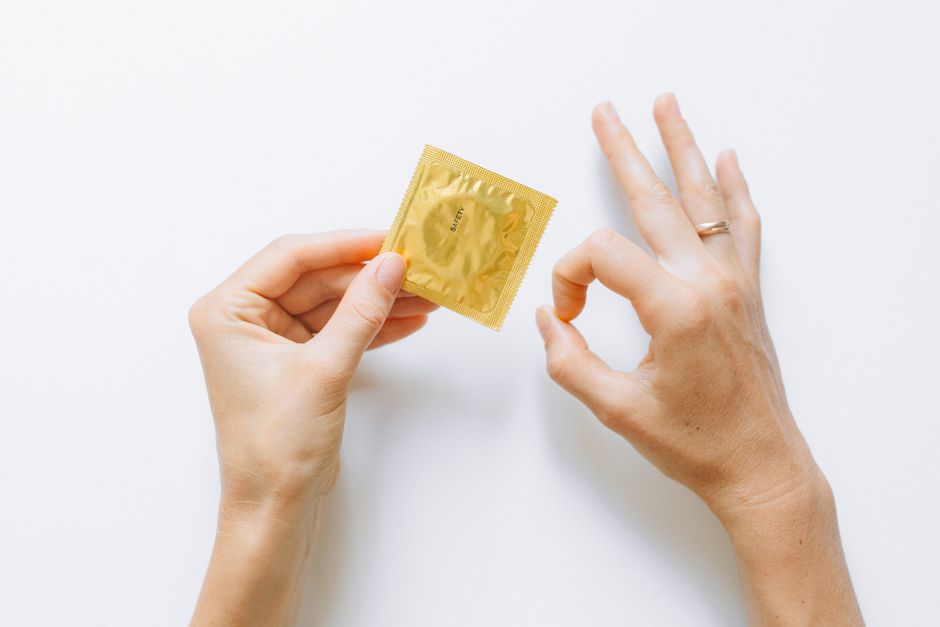
Menopause does not automatically mean you can stop using condoms. The decision depends on two separate questions: whether you still need protection from pregnancy, and whether you still need protection from sexually transmitted infections (STIs). Those two answers are not the same, and they do not change at the same time.
Pregnancy becomes essentially impossible only after you have gone a full 12 months without a menstrual period. Until that point, ovulation can still happen, even if your cycles are irregular or have stopped for several months. STI risk, on the other hand, does not end with menopause at all — and for many women it actually rises in the years after.
Can I stop using condoms after menopause for pregnancy prevention?
You can stop relying on condoms for birth control only after 12 consecutive months without a period. That 12-month mark is the clinical definition of menopause, and it is the point at which pregnancy is considered no longer possible through natural conception.
The trap is the transition period. Perimenopause — the years leading up to that final period — is marked by unpredictable cycles. You might go three months without bleeding and then ovulate. You might have a light period you barely notice that was actually the last one. During this window, fertility is lower than it was in your twenties or thirties, but it is not zero. Pregnancies do occur in the late forties and even into the early fifties.
This is why the “12 months” rule matters so much. It is not a guess or a rough guideline. It is the standard used by clinicians to define when menopause has actually occurred, and it is the point at which contraception for pregnancy prevention is generally no longer needed.
One clarification worth knowing: if you had a hysterectomy but kept your ovaries, you will not have periods, so the 12-month rule cannot be applied the usual way. In that situation, hormone testing or a conversation with your clinician is the more reliable way to determine where you are.
Does menopause protect you from STIs?
No. Menopause has no effect on your risk of catching or passing on a sexually transmitted infection. Age does not make anyone immune, and the viruses and bacteria that cause these infections do not care how old you are.
What does change is the tissue. After menopause, estrogen levels fall, and the lining of the vagina becomes thinner, drier, and more fragile. Small tears and micro-abrasions during sex become more likely. Those tiny breaks in the tissue give infections an easier route in. Some research suggests that older women may be more vulnerable to certain infections for exactly this reason, though the evidence is not uniform across all infections.
There is also a practical gap. Women over 50 are less likely to be tested for STIs, and less likely to be asked about their sexual history by a doctor. Many assume they are past the age where it matters. That assumption is wrong, and it means infections can go undiagnosed for longer.
Common STIs in this age group include chlamydia, gonorrhea, syphilis, genital herpes, human papillomavirus (HPV), and HIV. Several of these can be present without obvious symptoms, which is another reason testing matters more than symptoms.
Why are STI rates rising in women over 50?
Diagnoses of several STIs have been increasing in older adults for years. There are a few reasonable explanations, and they tend to overlap.
- Divorce and widowhood later in life lead many people to start dating again after decades with a single partner.
- Condom use is often lower in this group, partly because pregnancy is no longer a concern.
- Many older adults were never given the kind of sex education that younger generations received, particularly around STI prevention.
- Erectile dysfunction medications have extended sexual activity for some men well past the age when it might otherwise have declined.
- Doctors often do not bring up STI testing with older patients, and patients often do not bring it up either.
The result is a group with real risk and low awareness. If you are sexually active with a new partner, that risk applies to you regardless of your age.





When is a condom still the right choice after menopause?
A condom remains the only method that protects against both pregnancy and STIs at the same time. Once pregnancy is off the table, the STI question is what remains — and the answer depends on your situation, not your age.
Condoms are generally recommended if any of the following apply:
- You have a new partner whose STI status you do not know.
- You or your partner have other sexual partners.
- Your partner’s STI status is unknown or has not been recently tested.
- You have not been tested yourself and are unsure of your status.
If you are in a long-term, mutually monogamous relationship and both partners have tested negative for STIs, the risk is low. That is a conversation to have with your partner and, if you want certainty, with a clinician. It is not something to assume.
For women who find that vaginal dryness makes condoms uncomfortable, lubricant can help. Water-based or silicone-based lubricants are generally compatible with condoms; oil-based products can weaken latex and should be avoided with latex condoms.
What if you want to stop using condoms with a new partner?
The honest answer is that stopping condoms with a new partner is a decision about testing, not about menopause. The conversation should happen before, not after.
Both partners getting tested is the most reliable way to know where you stand. Some infections take time to show up on a test after exposure, so a single negative result immediately after a new partner is not always conclusive. A clinician can explain the timing that applies to specific tests.
There is no age at which this stops mattering. A woman in her sixties with a new partner has the same fundamental question as a woman in her twenties: what is my risk, and what do I want to do about it?
Does hormone therapy change any of this?
Hormone therapy can ease vaginal dryness and thinning, which may make sex more comfortable and reduce the small tears that make infection easier. It does not prevent pregnancy, and it does not prevent STIs.
If you are using hormone therapy and still having periods, the 12-month rule for menopause still applies. Hormone therapy does not reset or replace that timeline, and it does not mean you can stop contraception early.
Local estrogen — applied directly to the vagina — is sometimes used for dryness and discomfort. It is a different thing from systemic hormone therapy and works mainly on local tissue. Whether it is appropriate for you is a conversation with your clinician, not a decision to make on your own.
Frequently Asked Questions
Can I stop using condoms after menopause?
You can stop using condoms for pregnancy prevention after 12 consecutive months without a period. You may still need them for STI protection depending on your partner situation.
How long after my last period am I safe from pregnancy?
Pregnancy is considered no longer possible after 12 full months without a menstrual period. Until that point, ovulation can still occur even with irregular or missed cycles.
Can you get an STI after menopause?
Yes. Menopause does not protect against STIs, and the thinning of vaginal tissue after menopause may make infection easier. Risk depends on your sexual activity and your partner’s status, not your age.
Do I need condoms if I am in a monogamous relationship after menopause?
If both partners are in a mutually monogamous relationship and have tested negative for STIs, the risk is generally low. Testing is what makes that judgment reliable, not the length of the relationship.
