
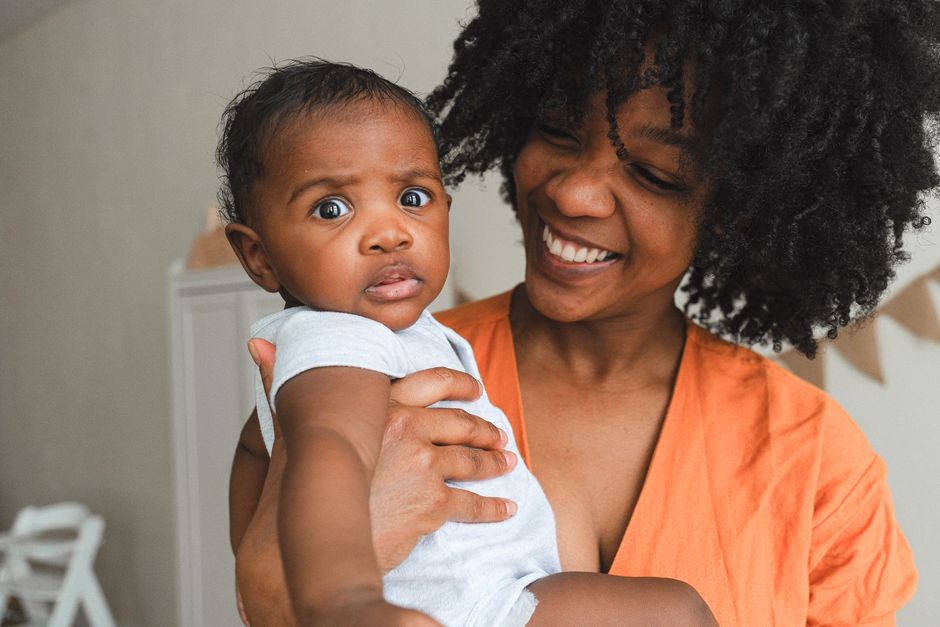
When two people create a baby, that child gets half of their DNA from each parent. This means your baby will inherit a unique mix of your traits, but the exact outcome is not something anyone can predict with certainty. Some features like eye color follow predictable patterns, while others like height and personality depend on hundreds of genes working together. The short answer is that your baby will look like a blend of both of you, but also like no one else on Earth.
What Determines a Baby’s Physical Features?
Every physical trait your baby has comes from genes passed down from both parents. Each parent contributes 23 chromosomes, which together form a complete set of 46. These chromosomes carry thousands of genes that contain the instructions for everything from hair texture to foot size.
Some genes are dominant, meaning they only need one copy to show up. Others are recessive, meaning they need two copies — one from each parent — to appear. This is why a baby can have traits that neither parent displays. Both parents can carry a recessive gene silently and pass it on without knowing it.
There is also a concept called polygenic inheritance. Most visible features are not controlled by a single gene. Height, skin tone, and facial structure each involve dozens or even hundreds of genes. This is why predicting a baby’s appearance is more like a complex calculation than a simple coin flip.
Will the Baby Look More Like Mom or Dad?
Newborns often look more like their fathers, according to some evolutionary research. One theory suggests this is an ancient biological mechanism to encourage paternal investment. When a father sees his own features in a baby, he may be more likely to care for and protect the child.
However, this effect fades. By the time a child reaches toddlerhood, most babies show a fairly even mix of both parents’ features. Some studies have shown that strangers cannot reliably match babies to their parents at higher rates than chance would predict.
The truth is that a baby inherits an equal amount of genetic material from each parent. But genes are not always expressed equally. Some genes are imprinted, meaning they are switched on or off depending on which parent they came from. This can cause certain traits to favor one side of the family.
How Are Eye Colors Inherited?
Eye color is one of the most commonly asked questions about baby appearance. The old rule that blue-eyed parents always have blue-eyed babies is not entirely accurate. Eye color involves multiple genes, though the main one is called OCA2.
Here is what the basic genetics show:
- Brown eyes are generally dominant over blue and green
- Green eyes are generally dominant over blue but recessive to brown
- Blue eyes are recessive to both brown and green
Two blue-eyed parents will almost always have a blue-eyed baby. But rare genetic variations can produce unexpected outcomes. If either parent carries a hidden brown-eye gene from their own parents, the baby could have brown eyes.
Many babies are born with blue or gray eyes that change color in the first year. Melanin production ramps up over time. A baby’s final eye color is usually settled between 6 and 12 months of age.





What About Hair Color and Texture?
Hair color works similarly to eye color. Brown and black hair are dominant over blonde and red. But hair color can also change dramatically during childhood. Many children born with light hair darken as they get older because pigment production increases with age.
Red hair is the most predictable. It requires two copies of a recessive gene variant called MC1R. If both parents have red hair, their baby will almost certainly have red hair. If neither parent has red hair but both carry the recessive gene, they have a 25 percent chance of having a red-haired baby.
Hair texture is controlled by multiple genes. Curly hair is not strictly dominant over straight hair, as was once believed. The reality is that hair shape falls on a spectrum from straight to tightly coiled, and the genetics are complex. Your baby may have hair that is completely different from both of yours.
Can You Predict Height or Body Type?
Height is about 80 percent genetic, according to research on twins and families. The remaining 20 percent is influenced by nutrition, health during childhood, and other environmental factors.
A common method for estimating a child’s adult height is the mid-parental height calculation. For a boy, you add both parents’ heights in inches, add 5 inches, then divide by 2. For a girl, you add both parents’ heights, subtract 5 inches, then divide by 2. This gives a rough estimate, but the actual result can vary by several inches in either direction.
Body type is also strongly inherited. A child’s natural tendency toward being lean, muscular, or stocky follows family patterns. But lifestyle choices like diet and exercise play a major role in how that body type develops.
What Facial Features Get Passed Down?
Facial features are among the most visible inherited traits. The shape of the nose, the distance between the eyes, the fullness of the lips, and the contour of the jaw all follow genetic patterns. Many of these features are polygenic, meaning they are shaped by many genes with small effects.
Some facial features are strongly dominant. A cleft chin, for example, tends to be dominant over a smooth chin. Attached earlobes are recessive to free-hanging earlobes. Widow’s peak hairline is dominant over a straight hairline.
But here is a non-obvious detail: recent research has found that certain facial features are inherited from specific parents more than others. For example, some studies suggest that the shape of the tip of the nose is more likely to be inherited from the father. The evidence here is still emerging, though, so treat these patterns as general tendencies rather than firm rules.
Do Babies Resemble Grandparents or Other Relatives?
Yes, and this is not just a family myth. Recessive genes can skip generations. A baby may look like a grandparent because both parents carried and passed down that grandparent’s recessive traits.
This happens most visibly with traits like red hair, blue eyes, and certain facial structures. If neither parent shows a trait but both carry the gene for it, the baby can display that trait even though it has not appeared in either parent.
Genetic recombination also plays a role. When eggs and sperm are formed, the chromosomes from your own parents get shuffled together. This means you pass on a mix of your mother’s and father’s genes, not an exact copy of either one. Your baby could inherit a combination that resembles a grandparent more than you or your partner.
Can Ultrasound or AI Predict the Baby’s Face?
Ultrasound images can show basic anatomy but cannot reliably predict what a newborn will look like. The images are low resolution, and babies in the womb have features that change as they develop. Soft tissue like cheeks and lips are especially hard to assess on ultrasound.
Some companies now offer AI-generated images that claim to predict a baby’s face from photos of the parents. These tools are entertainment, not science. No algorithm can accurately forecast the outcome of hundreds of interacting genes. The images may look plausible, but they have no predictive accuracy.
If you want to know what your baby will look like, the honest answer is that you will have to wait. Even then, newborns look different from how they will appear in a few months. Swelling from birth, the shape of the head during delivery, and newborn jaundice all temporarily affect appearance.
What Traits Are Not Inherited?
Many things people assume are genetic are actually not. Birthmarks, for example, are not inherited in most cases. They form randomly during fetal development.
Fingerprints are also not determined by genes alone. The ridges form in the womb based on pressure and movement. Even identical twins have different fingerprints.
Personality, interests, and intelligence are influenced by genes but also heavily shaped by environment. A baby may inherit a tendency toward certain temperaments, but parenting, education, and life experiences play enormous roles in who that child becomes.
Frequently Asked Questions
Will my baby look more like me or my partner?
Newborns may briefly favor the father, but by toddlerhood most children show a fairly even mix of both parents’ features. The genetic contribution is equal from both parents, though some genes are expressed differently depending on which parent they came from.
Can two brown-eyed parents have a blue-eyed baby?
Yes, if both parents carry a hidden recessive blue-eye gene. Each parent would need to pass on that recessive gene for the baby to have blue eyes.
When will we know our baby’s final eye color?
Most babies reach their permanent eye color between 6 and 12 months of age. Melanin production continues after birth, so early eye color often changes.
Are there accurate ways to predict what my baby will look like?
No reliable method exists to predict a baby’s exact appearance. Genetic calculations can estimate probabilities for certain traits, but the combination of hundreds of genes makes precise prediction impossible.
