
Every vegetable contains some carbohydrate. There is no such thing as a zero-carb vegetable. The real question is how much, and whether that carbohydrate comes packaged with fiber or mostly as starch and sugar. That difference is what separates a green bean from a potato.
Vegetables fall along a wide carbohydrate range. Leafy greens, cucumbers, and radishes sit near the bottom. Corn, peas, and potatoes sit near the top. Understanding where each one lands helps you build meals that match your goals, whether you are managing blood sugar, watching calories, or simply eating well.
This guide breaks down which vegetables are high in carbohydrate, which are low, and how the type of carbohydrate matters as much as the amount.
What Vegetables Are Carbohydrate? The Basic Answer
All vegetables contain carbohydrate, but the amount varies enormously. A cup of raw spinach has roughly 1 gram of carbohydrate. A medium baked potato has around 35 to 40 grams. Both are vegetables. Both contain carbohydrate. The gap between them is more than thirtyfold.
Carbohydrate in vegetables comes in three main forms:
- Fiber — indigestible plant material that slows digestion and feeds gut bacteria. Most vegetables are rich in it.
- Starch — a storage carbohydrate found in potatoes, corn, peas, and winter squash. It breaks down into glucose during digestion.
- Sugar — naturally present in carrots, beets, tomatoes, and sweet peppers. Usually a small fraction of total carbohydrate.
What matters for blood sugar and calorie counting is the split between fiber and the starch-and-sugar portion. Fiber does not raise blood sugar because the body cannot break it down into glucose. The other two do.
This is why a cup of broccoli and a cup of corn can both be called “a vegetable serving” but behave very differently in your body. Broccoli delivers about 6 grams of carbohydrate, most of it fiber. Corn delivers roughly 30 grams, much of it starch.
Which Vegetables Are Highest in Carbohydrate?
Starchy vegetables are the carbohydrate leaders. These are the ones that grow as storage organs — roots, tubers, and kernels — where the plant packs away energy for later use.
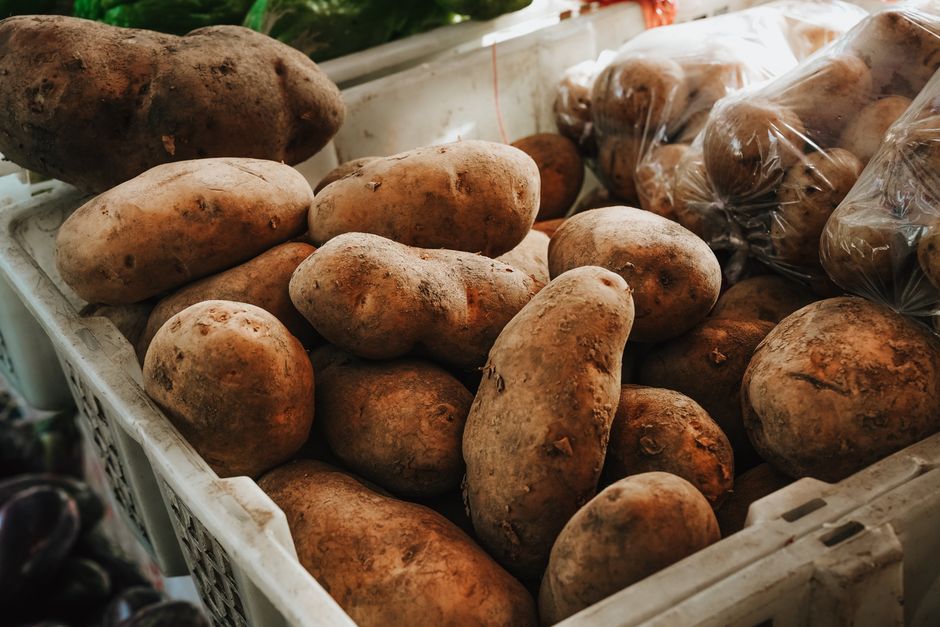
Potatoes are the most concentrated common vegetable source of carbohydrate. A medium baked potato with skin contains roughly 35 to 40 grams of carbohydrate, mostly starch. Sweet potatoes are similar, around 25 to 30 grams per medium potato, with some natural sugar added to the starch.
Corn is close behind. One cup of cooked corn kernels provides about 30 grams of carbohydrate. Peas deliver around 20 to 25 grams per cup. Winter squash such as butternut and acorn falls in the 15 to 20 gram range per cup when cooked.
Beets, parsnips, and turnips round out the higher end, generally landing between 12 and 18 grams per cup cooked. Carrots sit lower, around 10 to 12 grams per cup raw.
Here is a comparison of common vegetables by carbohydrate content. Values are approximate and drawn from standard USDA nutrient data for cooked vegetables unless noted.
| Vegetable (1 cup) | Total Carbohydrate | Fiber |
|---|---|---|
| Potato, baked with skin (medium) | ~35–40 g | ~4 g |
| Corn, cooked | ~30 g | ~3.5 g |
| Sweet potato, baked (medium) | ~25–30 g | ~4 g |
| Peas, cooked | ~20–25 g | ~8 g |
| Butternut squash, cooked | ~15–20 g | ~5 g |
| Beets, cooked | ~15 g | ~4 g |
| Carrots, raw | ~10–12 g | ~3.5 g |
| Broccoli, cooked | ~6 g | ~2.5 g |
| Spinach, raw | ~1 g | ~0.7 g |
One clarification worth making: the net carbohydrate figure — total carbohydrate minus fiber — is what many people tracking blood sugar or following low-carb diets actually count. For starchy vegetables, net carbs stay high because fiber is a small share. For leafy greens, net carbs are close to zero.
Which Vegetables Are Lowest in Carbohydrate?
Non-starchy vegetables are your lowest-carbohydrate options, and they make up the majority of the vegetable kingdom. Most of them contain fewer than 10 grams of carbohydrate per cup, and many contain fewer than 5.
Leafy greens lead the low-carb group. Spinach, lettuce, arugula, kale, and Swiss chard all deliver between 1 and 7 grams of carbohydrate per cup, with a meaningful portion of that being fiber. Celery, cucumber, radishes, and zucchini are similarly low.
Other low-carbohydrate vegetables include:
- Bell peppers (about 6–9 g per cup)
- Cauliflower (about 5 g per cup cooked)
- Green beans (about 8 g per cup)
- Asparagus (about 4 g per cup)
- Mushrooms (about 3 g per cup)
- Tomatoes (about 5–7 g per medium tomato)
- Cabbage (about 5 g per cup)
These vegetables are the backbone of low-carbohydrate eating patterns because you can eat a large volume for very little carbohydrate. They also tend to be high in water and fiber, which helps with fullness.
It is worth noting that “low carbohydrate” is a relative term. Even cauliflower has some carbohydrate. The distinction between low and high is about degree, not presence versus absence.
Does the Type of Carbohydrate Matter More Than the Amount?
For blood sugar, the type of carbohydrate matters a great deal. Fiber slows the release of glucose into the bloodstream. Starch breaks down quickly into glucose. Two vegetables with identical total carbohydrate can produce very different blood sugar responses depending on how much of that carbohydrate is fiber.
Take peas and white rice as a comparison. A cup of peas has roughly 20 to 25 grams of carbohydrate, but about 8 grams of that is fiber. White rice has more total carbohydrate and very little fiber. The peas produce a slower, smaller rise in blood sugar.
This is why dietary guidance consistently encourages non-starchy vegetables over starchy ones for people managing diabetes or prediabetes. The American Diabetes Association’s plate method, for example, fills half the plate with non-starchy vegetables. That is not because starchy vegetables are forbidden — they contain real nutrients — but because portion size needs more attention with them.
Fiber also feeds gut bacteria, which produce short-chain fatty acids that support colon health. Most Americans fall short of recommended fiber intake, and vegetables are one of the most efficient ways to close that gap.
Are Starchy Vegetables Bad for You?
No. Starchy vegetables are not bad for you. Potatoes, corn, peas, and squash provide potassium, vitamin C, B vitamins, and fiber. A potato with skin is one of the better dietary sources of potassium, a mineral most people do not get enough of.
The problem is rarely the vegetable itself. It is what gets added to it. A baked potato is nutritious. A potato loaded with butter, sour cream, and cheese is a different nutritional picture. French fries are a different picture again. The preparation changes the carbohydrate load, the fat content, and the calorie density.
For people with diabetes or insulin resistance, starchy vegetables are not off-limits, but portion size and pairing matter. Eating a smaller portion of potato alongside protein and non-starchy vegetables blunts the blood sugar spike compared with eating the potato alone.
Some clinicians recommend cooling cooked potatoes before eating them. This increases resistant starch — a form of starch that resists digestion and behaves more like fiber. The effect is real but modest. It is not a reason to treat a potato as a low-carb food.
How Do Vegetables Fit Into Low-Carbohydrate Diets?
Vegetables fit into low-carbohydrate diets easily, as long as you choose the right ones. Non-starchy vegetables are central to nearly every low-carbohydrate eating pattern, from moderate low-carb to ketogenic diets.
The practical approach most clinicians and dietitians describe is straightforward: build meals around non-starchy vegetables, and treat starchy vegetables as portion-controlled additions rather than free foods. A cup of broccoli or a large salad adds volume, fiber, and micronutrients with minimal carbohydrate. A cup of corn adds 30 grams.
For people following very low-carbohydrate or ketogenic diets, starchy vegetables are usually limited or avoided because the carbohydrate budget is tight. That is a dietary choice, not a health requirement. Starchy vegetables can be part of a healthy diet for most people.
One point that gets lost in diet debates: the carbohydrate content of a vegetable is not a measure of its nutritional value. A potato and a head of lettuce both belong on a healthy plate. They just play different roles.
How Can You Tell Which Vegetables Are High in Carbohydrate?
The simplest rule of thumb is botanical. Vegetables that grow underground as roots or tubers, or that develop as starchy seeds, tend to be high in carbohydrate. Vegetables that grow above ground as leaves, stems, or flowers tend to be low.
Potatoes, sweet potatoes, carrots, beets, parsnips, and turnips grow underground. Corn and peas are seeds. These are your higher-carbohydrate vegetables. Spinach, lettuce, broccoli, cauliflower, peppers, and green beans grow above ground. These are your lower-carbohydrate vegetables.
There are exceptions. Winter squash grows above ground but is starchy. Tomatoes grow above ground and are low in carbohydrate. The rule is a starting point, not a law.
The most reliable method is to check nutrient data. The USDA FoodData Central database provides carbohydrate and fiber content for thousands of foods, and most packaged foods carry a nutrition label. For whole vegetables, a quick reference table or a nutrition app works well.
Reading labels on frozen and canned vegetables is worth the habit. Plain frozen broccoli has the same carbohydrate as fresh. Frozen broccoli in a cheese sauce does not. Canned corn with added sugar is different from plain canned corn.
Frequently Asked Questions
Are there any vegetables with zero carbohydrates?
No vegetable contains zero carbohydrate. Leafy greens and cucumbers come closest, with about 1 to 3 grams per cup, most of it fiber.
Is corn a carbohydrate or a vegetable?
Corn is botanically a grain and culinarily treated as a starchy vegetable. It is high in carbohydrate, around 30 grams per cup cooked, mostly starch.
Can diabetics eat potatoes and corn?
Yes, people with diabetes can eat starchy vegetables in appropriate portions. Pairing them with protein and non-starchy vegetables helps blunt the blood sugar rise compared with eating them alone.
Which vegetables have the most carbs per serving?
Potatoes, corn, and sweet potatoes are the highest, generally ranging from about 25 to 40 grams of carbohydrate per medium potato or cup of corn.
