
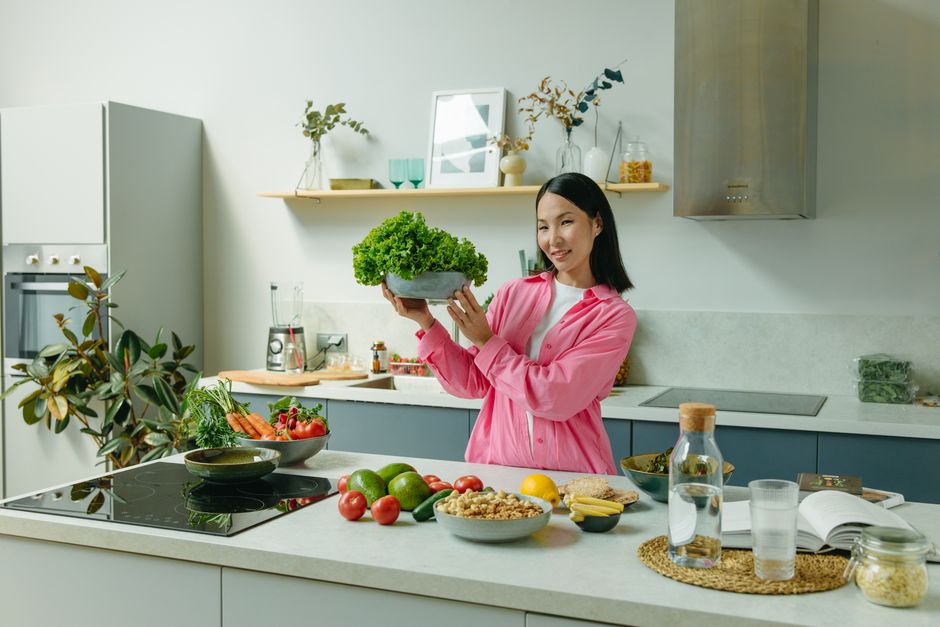
What to cook healthy starts with a simple shift: build most meals around vegetables, beans or lentils, whole grains, and a modest portion of protein, then add fat and salt at the end where you can taste them. That pattern — not any single “superfood” — is what nutrition research consistently links to better long-term health. The rest is learning a few practical habits so healthy cooking stops feeling like a separate project from dinner.
What Does “Healthy Cooking” Actually Mean?
Healthy cooking is a method, not a menu. It means choosing ingredients that carry fiber, protein, vitamins, and minerals, and preparing them in ways that add flavor without adding large amounts of saturated fat, sodium, or refined sugar.
Most major health authorities — including the World Health Organization and the U.S. dietary guidelines — converge on the same broad picture. Eat plenty of vegetables and fruit. Favor whole grains over refined ones. Choose beans, lentils, fish, eggs, poultry, and lean meats as protein sources. Keep added sugar, salt, and heavily processed foods modest.
That is the whole framework. Everything else is technique.
One clarification worth making: “healthy” is not the same as “low-calorie” or “low-fat.” Olive oil, nuts, and avocado are calorie-dense, and they fit comfortably within a healthy pattern. The goal is the overall pattern across weeks, not the perfection of any single plate.
How Do You Build a Healthy Plate Without Overthinking It?
The plate method is the most practical tool most dietitians teach, and it holds up because it does not require calorie counting. Fill roughly half your plate with vegetables and fruit. Give about a quarter to whole grains or starchy vegetables. Give the remaining quarter to protein.
That ratio naturally pushes fiber up and calorie density down, without banning anything. It also works across almost every cuisine — a bowl of beans and rice with salsa, a stir-fry with tofu and brown rice, or a piece of fish with roasted vegetables and farro all fit.
The plate method is a teaching tool, not a clinical prescription. It is a reasonable default for most adults. People with specific medical conditions — kidney disease, diabetes managed with insulin, or a history of disordered eating — should get individualized guidance rather than applying a general template.
Which Cooking Methods Make the Biggest Difference?
How you cook matters as much as what you cook. Roasting, grilling, steaming, sautéing, poaching, and pressure cooking all let you control added fat and salt. Deep-frying and heavy cream-based sauces add calories quickly and are best treated as occasional rather than default.
A few reliable techniques:
- Roast at high heat. Vegetables tossed in a modest amount of oil and roasted at around 425°F (220°C) develop sweetness and browning without much fat.
- Steam or blanch. Preserves texture and water-soluble vitamins. A quick blanch keeps green vegetables bright.
- Sauté with a little liquid. Start with a small amount of oil, then add water, broth, or wine as it cooks. You use less fat and still get flavor.
- Poach or bake protein. Fish, chicken, and eggs cook well in liquid or a moderate oven, which limits the need for added fat.
- Use acid and aromatics. Lemon, vinegar, garlic, ginger, citrus zest, herbs, and spices carry flavor that salt and fat would otherwise have to do.
One practical note that surprises people: charring and high-heat browning create flavor, but very heavy charring on meat — particularly well-done or blackened meat — forms compounds called heterocyclic amines and polycyclic aromatic hydrocarbons. These are classified as probable human carcinogens based on animal and epidemiological evidence. Occasional browning is fine. Habitually eating heavily charred meat is not something to make a routine.



What Should You Keep in the Kitchen to Cook Healthy on a Weeknight?
The single biggest predictor of whether you cook healthy on a Tuesday night is what is already in your kitchen. Convenience beats intention almost every time.
Stock these and most weeknight meals become assembly rather than a project:
- Canned or dried beans and lentils (rinse canned beans to reduce sodium)
- Whole grains that cook quickly — quinoa, farro, brown rice, oats
- Frozen vegetables and fruit (nutritionally comparable to fresh in most cases, and they do not spoil)
- Eggs, plain yogurt, canned fish, tofu
- Olive oil, vinegar, canned tomatoes, garlic, onions
- Dried herbs, spices, and citrus
Frozen vegetables deserve a specific defense. They are picked and frozen at peak ripeness, and most vitamins survive the process well. For anyone who has thrown away a slimy bag of spinach, frozen is not a compromise — it is often the more reliable choice.
How Do You Cook Healthy on a Budget or a Busy Schedule?
Beans, lentils, eggs, oats, cabbage, carrots, onions, potatoes, frozen vegetables, and whole grains are among the most affordable and nutrient-dense foods available. A healthy diet does not require salmon and specialty produce every night.
Batch cooking helps more than any single recipe. Cook a large pot of grains and a pot of beans or lentils once, roast a tray of vegetables, and assemble meals from those components across several days. This is how most people who cook healthy consistently actually do it.
Two honest limits on the batch-cooking approach: cooked rice and grains should be cooled quickly and refrigerated promptly, because cooked rice left at room temperature can grow Bacillus cereus, a bacterium that causes vomiting and diarrhea. Refrigerate within about two hours of cooking and eat within a few days. And “meal prep” is not a requirement — some people do better cooking fresh each night. Both work.
What Are the Most Common Myths About Healthy Cooking?
“Fresh is always better than frozen.” Not reliably true. Frozen produce is nutritionally close to fresh, and sometimes higher in certain vitamins because it is processed at harvest rather than shipped over days.
“Fat makes you fat.” This idea dominated dietary advice for decades and has not held up well. Total calorie intake and overall dietary pattern matter more than fat content alone. Diets high in unsaturated fats — olive oil, nuts, seeds, avocado — are associated with better cardiovascular outcomes in large observational studies.
“You need to cut out carbs.” Whole grains are consistently associated with lower risk of cardiovascular disease and type 2 diabetes in large studies. The distinction that matters is between whole and refined grains, not between carbs and no carbs.
“Detox cooking is a thing.” The liver and kidneys manage detoxification continuously. No food, juice, or cleanse has been shown to accelerate this in a way that improves health. The evidence for commercial detox products is essentially absent.
“Cooking healthy takes too long.” A can of beans, a bag of frozen vegetables, and a pot of rice make a complete meal in about fifteen minutes. The time barrier is real for some people, but it is usually about planning, not cooking time itself.
What Does a Week of Healthy Cooking Actually Look Like?
Variety across a week matters more than any single meal. Aim to rotate through different vegetables, different protein sources, and different grains so you cover a wider range of nutrients.
A realistic week might include beans or lentils three or four times, fish once or twice, eggs and poultry on other days, and at least one meal built entirely around vegetables. Fruit as snacks. Nuts in modest amounts. Nothing forbidden.
The point is not a perfect week. It is a pattern you can repeat without resentment, because the diet you actually follow is the only one that helps you. Research on long-term weight and health outcomes consistently shows that adherence — not the specific macronutrient ratio — is what predicts results.
Frequently Asked Questions
What is the healthiest way to cook vegetables?
Steaming, roasting, and sautéing with a small amount of oil preserve most nutrients and add little fat. Boiling in large amounts of water can leach water-soluble vitamins like vitamin C and B vitamins into the cooking liquid.
Is it healthy to cook with olive oil?
Yes, olive oil is a good choice for most cooking, especially when used in moderation. Extra-virgin olive oil is high in monounsaturated fat and is associated with better cardiovascular outcomes in large studies.
Can you eat healthy without cooking every day?
Yes, healthy eating does not require daily cooking from scratch. Canned beans, frozen vegetables, pre-cooked grains, and simple assembled meals can form a healthy pattern with minimal cooking.
Is frozen food as healthy as fresh?
For most vegetables and fruit, frozen is nutritionally comparable to fresh and sometimes higher in certain vitamins. Frozen produce is typically processed at peak ripeness, which preserves nutrient content well.
