
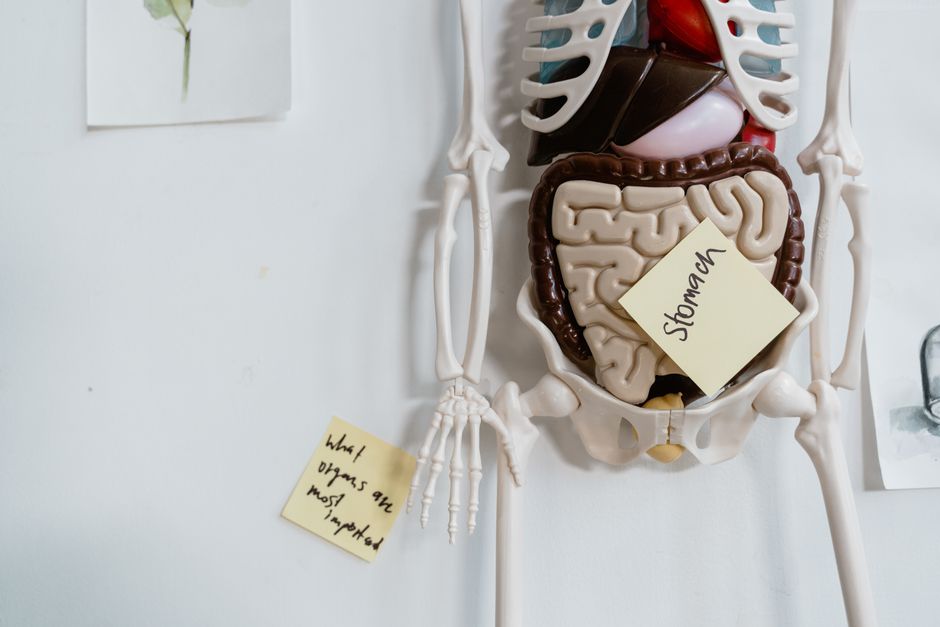
The large intestine is the final major section of your digestive tract. It is roughly five feet long and forms the last stretch of the pipe that processes everything you eat. Its main jobs are to absorb water and salts from what remains after the small intestine has done its work, and to turn that leftover material into solid stool. The large intestine also houses trillions of bacteria that break down undigested fiber and produce some vitamins. Without it, your body would lose too much water and you would not be able to form or pass solid waste normally.
Where Is the Large Intestine and What Does It Look Like?
The large intestine sits in the abdominal cavity, framing the small intestine like a picture frame. It begins at the lower right side of the belly, where it connects to the small intestine at a structure called the cecum. From there it travels upward on the right side as the ascending colon, crosses the upper abdomen as the transverse colon, and descends on the left side as the descending colon. It ends with the sigmoid colon, which connects to the rectum.
Unlike the small intestine, which is coiled and compact, the large intestine has a wider diameter. Its inner surface is not covered with the tiny finger-like projections, called villi, that you find in the small intestine. Instead, its surface is relatively smooth, with small pouches called haustra that give it a segmented appearance. The outer muscular layer is arranged in bands called taeniae coli, which help create those pouches.
Blood flow to the large intestine comes from branches of the superior and inferior mesenteric arteries. Nerves from the autonomic nervous system control its movement and secretions. The tissue layers are the same four layers found throughout the digestive tract: mucosa, submucosa, muscularis externa, and serosa.
What Does the Large Intestine Do in the Digestive System?
The large intestine does three primary jobs in the digestive system: it absorbs water and electrolytes, it ferments undigested material, and it stores and eliminates waste. Each of these functions is essential for maintaining fluid balance and completing digestion.
When food leaves the small intestine, it is a liquid mixture of undigested food particles, water, bile, and digestive juices. The small intestine absorbs most nutrients and a large amount of water, but the material that enters the large intestine is still quite fluid. The large intestine absorbs most of the remaining water and salts, particularly sodium and chloride. This process is what turns the liquid contents into semi-solid stool.
The large intestine also absorbs some vitamins. Bacteria living in the colon ferment undigested carbohydrates, mainly fiber, and produce short-chain fatty acids that the colon cells use for energy. These bacteria also synthesize vitamin K and some B vitamins, which the body can absorb. The amount absorbed is generally small compared to what you get from food, but it contributes to your total vitamin status.
Finally, the large intestine stores waste until it is time to eliminate it. Muscular contractions, called mass movements, push the contents toward the rectum. When the rectum fills and stretches, nerve signals trigger the urge to defecate. This is a coordinated process involving voluntary and involuntary muscles.
How Does the Large Intestine Move Waste?
Movement in the large intestine is slower than in the small intestine. This is intentional. The colon needs time to absorb water and allow bacteria to ferment fiber. Transit time through the entire large intestine typically takes anywhere from 12 to 48 hours, though this varies widely between individuals.
Two types of contractions move material through the colon. The first are segmental contractions, which mix the contents and help with water absorption. They do not move material forward much. The second are mass movements, which are strong contractions that push stool forward over longer distances. Mass movements usually happen a few times per day, often after a meal. This is called the gastrocolic reflex, and it is why many people feel the need to use the bathroom shortly after eating.
When stool reaches the rectum, the rectal walls stretch. This activates sensory nerves that signal the brain. You then have a choice to relax the external anal sphincter and allow stool to pass, or to keep it contracted and delay elimination. Holding stool for long periods can lead to constipation because the colon continues to absorb water, making the stool harder and drier.


What Role Do Gut Bacteria Play in the Large Intestine?
The large intestine contains the highest concentration of bacteria in the human body. Estimates suggest there are trillions of bacterial cells in the colon, representing hundreds of different species. This community is called the gut microbiota.
These bacteria ferment undigested carbohydrates, mainly dietary fiber, that your own enzymes cannot break down. The fermentation produces short-chain fatty acids, including butyrate, acetate, and propionate. Butyrate is particularly important because it is the main energy source for the cells lining the colon. Research consistently shows that a diet rich in fiber supports a healthy microbiota and promotes butyrate production.
The bacteria in the large intestine also produce gases, including hydrogen, methane, and carbon dioxide. This is a normal part of fermentation. Excess gas can cause bloating and flatulence, especially after eating foods high in certain fibers or sugars that are poorly absorbed, such as beans, broccoli, or artificial sweeteners.
The composition of your gut bacteria is influenced by your diet, medications, stress, and other factors. Antibiotics can significantly reduce bacterial diversity, which is why antibiotic-associated diarrhea is common. Most people recover their normal bacterial balance within weeks, but some research suggests that repeated antibiotic use may have longer-term effects on gut health.
What Happens When the Large Intestine Does Not Work Well?
When the large intestine malfunctions, symptoms usually involve changes in stool frequency, consistency, or comfort. Constipation and diarrhea are the two most common problems.
Constipation occurs when stool moves too slowly through the colon, allowing too much water to be absorbed. The stool becomes hard, dry, and difficult to pass. Common causes include low fiber intake, inadequate fluid intake, lack of physical activity, and certain medications. Some research also suggests that ignoring the urge to defecate can contribute to chronic constipation.
Diarrhea occurs when stool moves too quickly, and not enough water is absorbed. This can be caused by infections, food intolerances, medications, or conditions like irritable bowel syndrome. In severe or prolonged diarrhea, the body can lose significant amounts of water and electrolytes, which can be dangerous, especially in older adults and young children.
Inflammation of the large intestine, called colitis, can occur due to infections, autoimmune conditions like ulcerative colitis, or reduced blood flow. Symptoms may include abdominal pain, bloody stool, and urgency. Irritable bowel syndrome is a functional disorder that affects the large intestine without visible inflammation, causing pain, bloating, and alternating bowel habits.
Colorectal cancer is the most serious disease of the large intestine. It often begins as polyps, which are small growths on the inner lining. Regular screening, typically starting at age 45 for average-risk adults, can detect polyps before they become cancerous. Screening methods include colonoscopy, stool-based tests, and flexible sigmoidoscopy.
How Can You Keep Your Large Intestine Healthy?
A diet high in fiber is the most consistently supported way to support large intestine health. Fiber adds bulk to stool, softens it, and speeds up transit time. Good sources include whole grains, legumes, fruits, vegetables, and nuts. The general dietary recommendation is about 25 to 30 grams of fiber per day for adults, though most people in the United States eat far less than this.
Adequate fluid intake is also important. Fiber works best when it absorbs water. If you increase your fiber intake without increasing fluids, you may actually worsen constipation. Aim for enough fluids to keep urine pale yellow.
Regular physical activity stimulates bowel movements and may reduce the risk of colon cancer. Some studies suggest that moderate exercise, such as brisk walking for 30 minutes most days, is associated with a lower risk of colorectal cancer. The evidence is strongest for reducing the risk of colon cancer specifically.
Limit processed meats and red meat. Research has linked high consumption of processed meats to an increased risk of colorectal cancer. The World Health Organization has classified processed meats as carcinogenic to humans, based on evidence from observational studies. This does not mean occasional consumption is dangerous, but regular intake should be limited.
If you take antibiotics, be aware that they can disrupt your gut bacteria. Some evidence suggests that eating fermented foods, like yogurt or kefir, during and after antibiotics may help restore bacterial diversity. However, the evidence for probiotic supplements is mixed, and results vary by strain and individual.
Frequently Asked Questions
How long is the large intestine?
The large intestine is about five feet long in adults. It is shorter than the small intestine, which is roughly 20 feet long.
Can you live without your large intestine?
Yes, the large intestine can be surgically removed. People can live without it, but they may experience more frequent and looser stools because less water is absorbed.
What foods are hardest on the large intestine?
Highly processed foods, excessive red meat, and artificial sweeteners can be hard on the colon. Low-fiber diets are the most common cause of poor large intestine function.
How long does food stay in the large intestine?
Food material typically stays in the large intestine for 12 to 48 hours. The exact time varies based on diet, activity, and individual differences.
