
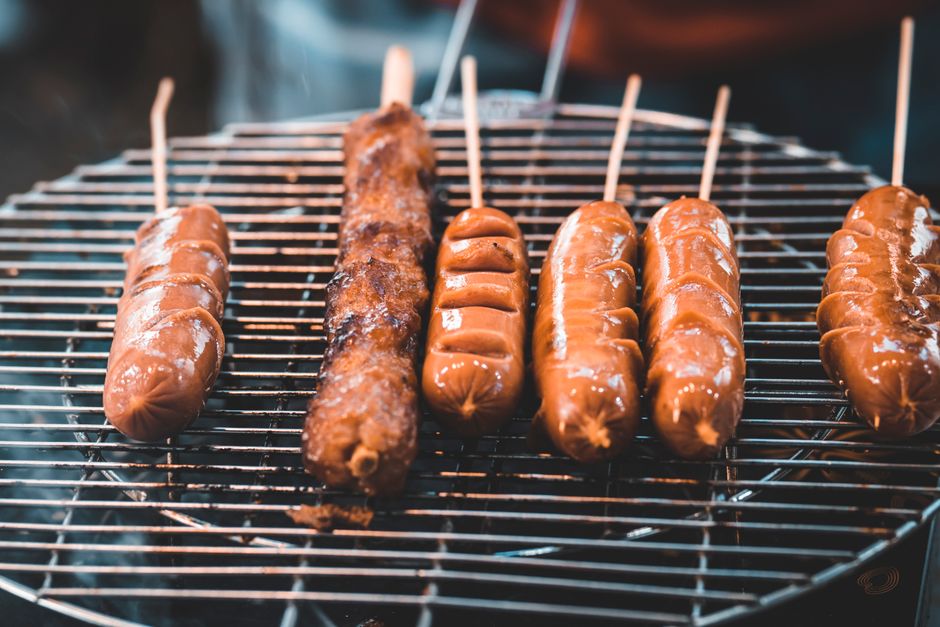
The only way to know a sausage is safely done is to check its internal temperature with a food thermometer. For most sausages, that means cooking until the center reaches 160°F (71°C).
This number is not a cooking style preference. It is the temperature at which ground meat is considered safe to eat, according to long-standing food safety guidance from the USDA. Sausages are ground meat, and ground meat carries a higher risk than whole cuts because bacteria that live on the surface get mixed throughout the entire product. That is why the safe target for sausages is higher than the 145°F used for whole steaks or pork chops.
Color, firmness, and cooking time are not reliable ways to judge doneness. A thermometer is.
What Temp Are Sausages Done? The Short Answer
Sausages are done when their internal temperature reaches 160°F (71°C). This applies to fresh pork sausage, Italian sausage, breakfast sausage, bratwurst, and most raw sausages made from pork, beef, or a mix.
There are a few exceptions worth knowing:
- Ground poultry sausage (chicken or turkey) also targets 165°F (74°C), which is the standard for all poultry.
- Pre-cooked or smoked sausages like frankfurters and many kielbasas are already fully cooked. You are reheating them, not cooking them to safety. Heating to 165°F is a common way to make sure they are hot throughout, but the safety step was done at the plant.
- Fermented or dry-cured sausages such as salami and pepperoni are cured, not cooked, and are made safe through a different process.
The 160°F figure exists for one reason: to kill harmful bacteria, mainly Salmonella, E. coli, and Listeria, that can be present in raw ground meat. At that temperature, these organisms are destroyed quickly. Below it, they may survive.
Why Ground Meat Needs a Higher Temperature Than Steak
A whole cut of beef or pork can be safely served at 145°F because harmful bacteria sit mostly on the outside surface, where they are easily killed by heat. The inside of an intact muscle is essentially sterile.
Grinding changes that completely. When meat is ground, the outside surface gets folded into the middle. Bacteria that were only on the exterior are now distributed throughout the patty or link. Now the center has to reach a safe temperature too, because the center is no longer clean.
This is the single most important reason a sausage is not the same as a steak when it comes to doneness. It is also why the USDA sets the target for all ground meat at 160°F, regardless of the animal. The risk comes from the grinding, not the species.
Sausage adds another layer. Most sausages contain salt, spices, and sometimes curing agents. These affect flavor and shelf life, but they do not make raw sausage safe to eat at a lower temperature. Salt does not kill Salmonella at the levels used in typical recipes.
How to Check Sausage Temperature the Right Way
Stick an instant-read thermometer into the thickest part of the sausage, and avoid touching bone, casing, or the pan. Those surfaces heat faster than the meat and will give you a false high reading.
For a link sausage, insert the probe from the end, straight into the center. For a patty, go in from the side. Wait for the reading to stabilize, which usually takes a few seconds on a digital thermometer.
Check more than one sausage. In a pan or on a grill, links cook unevenly. The one nearest the heat source may hit 160°F while the one on the edge is still at 140°F. Testing a single piece can give you false confidence about the whole batch.
If you are cooking a large batch, pull each sausage as it reaches temperature rather than waiting for all of them. Overcooked sausage is dry and rubbery, and it is easy to overshoot while you wait for the last one to finish.
Does Sausage Need to Rest Before You Check It?
Yes, and this step matters more than most people think. When you pull sausage off the heat, the internal temperature continues to rise for a short time as heat moves from the surface toward the center. This is called carryover cooking.
For small links, the rise is modest. For thick sausages or ones cooked in a covered pan, it can be several degrees. If you check the temperature the instant you remove it from the heat, you may read slightly below 160°F even though the sausage will reach it a minute later.
The practical approach: pull the sausage when it reads close to target, let it sit for a minute or two, then check again. If it has reached 160°F, it is done. If not, return it to the heat.
Do not use resting as a substitute for reaching temperature. Resting adds a few degrees at most. It will not take a sausage from 140°F to 160°F.
Common Mistakes That Lead to Undercooked Sausage
Most undercooked sausage happens for predictable reasons. Knowing them helps you avoid the problem.
- Judging by color. Ground pork can look gray or brown before it is safe, and some cured sausages stay pink even when fully cooked. Color is not a safety indicator.
- Judging by firmness. Pressing a sausage tells you about texture, not internal temperature. A sausage can feel firm and still be under 160°F in the center.
- Cooking from frozen. Frozen sausages cook unevenly. The outside can brown while the center stays cold. Thaw first, or cook at a lower heat for longer and verify with a thermometer.
- Crowding the pan. Too many sausages in one pan trap moisture and steam the meat instead of browning it, and the centers cook slowly.
- Trusting a recipe’s time. “Cook for 12 minutes” is a starting point, not a guarantee. Pan thickness, sausage size, and starting temperature all change the actual time needed.
The thermometer removes the guesswork from all of these. It is the one tool that gives you a direct answer.
Temperature Guide for Different Types of Sausage
Different sausages have different safety targets because they are made from different meats or are already cooked. The table below summarizes the common types.
| Sausage Type | Safe Internal Temperature | Notes |
|---|---|---|
| Fresh pork sausage (links, patties, Italian, breakfast) | 160°F (71°C) | Raw ground pork; must be cooked through |
| Fresh beef sausage | 160°F (71°C) | Same rule as all ground beef |
| Ground chicken or turkey sausage | 165°F (74°C) | Poultry standard is higher |
| Bratwurst (raw) | 160°F (71°C) | Often pork or veal; treat as raw ground meat |
| Pre-cooked smoked sausage, frankfurters | 165°F (74°C) for reheating | Already cooked; heat until steaming hot |
| Dry-cured or fermented sausage (salami, pepperoni) | Not cooked; cured | Made safe by curing and drying, not heat |
Note that the 165°F figure for poultry is higher than the 160°F for other meats. This is a well-established food safety standard, not a matter of preference. Ground poultry has historically been linked to a higher rate of Salmonella contamination, and the higher temperature provides a wider margin of safety.
What Happens If You Eat Undercooked Sausage?
Eating undercooked sausage can cause foodborne illness. The most common culprits are Salmonella, E. coli, and Listeria, all of which can be present in raw ground meat.
Symptoms typically appear within hours to a few days and can include nausea, vomiting, diarrhea, stomach cramps, and fever. Most healthy adults recover without treatment, but the illness can be serious. Young children, older adults, pregnant women, and people with weakened immune systems are at higher risk of severe infection.
Listeria is a particular concern during pregnancy. It can cause miscarriage, stillbirth, and serious illness in newborns. Pregnant women are advised to avoid undercooked meat entirely and to reheat pre-cooked sausages until steaming hot.
If you are unsure whether a sausage reached 160°F, the safe choice is to keep cooking it. There is no reliable way to confirm safety after the fact.
Does the Cooking Method Change the Target Temperature?
No. The target internal temperature is the same whether you grill, pan-fry, bake, or boil sausage. Heat is heat. What changes is how long it takes to get there and how evenly the sausage cooks.
Grilling can char the outside before the center is done, especially over high heat. Pan-frying can brown the casing while the middle lags. Boiling or simmering cooks more evenly but can leave the sausage pale and less flavorful. A common approach is to simmer first, then finish on a hot grill or pan for browning.
No matter the method, the final check is the same: insert a thermometer into the center and confirm 160°F for pork, beef, or mixed sausage, or 165°F for poultry sausage.
Can You Tell Doneness Without a Thermometer?
Not reliably. This is one of the most common sources of undercooked sausage. Many people rely on color, firmness, or time, and all three can fail.
Research has shown that people consistently misjudge doneness of ground meat by appearance. A patty can look brown throughout and still be below a safe temperature. A sausage can look pink inside and already be safe, especially if it contains curing salts. Neither visual cue is trustworthy.
An instant-read thermometer costs little and takes seconds to use. For anyone who cooks sausage regularly, it is the most useful kitchen tool for this purpose. If you do not have one, cook sausage longer than you think necessary and cut into the thickest part to check for any raw-looking center. That is a fallback, not a method.
Frequently Asked Questions
What temperature should sausages be cooked to?
Most sausages should reach an internal temperature of 160°F (71°C). Ground poultry sausage should reach 165°F (74°C).
Are sausages done at 145°F?
No. Ground meat, including sausage, needs to reach 160°F to be considered safe. The 145°F target applies to whole cuts like steaks and pork chops, not ground meat.
How do I check if a sausage is fully cooked?
Insert an instant-read thermometer into the thickest part of the sausage, avoiding bone or the pan surface, and wait for the reading to stabilize. It should read 160°F for pork or beef sausage and 165°F for poultry sausage.
Can I eat sausage if it is still pink inside?
Pink color alone does not tell you whether sausage is safe, since some cured sausages stay pink even when fully cooked. The only reliable check is internal temperature, not color.
