
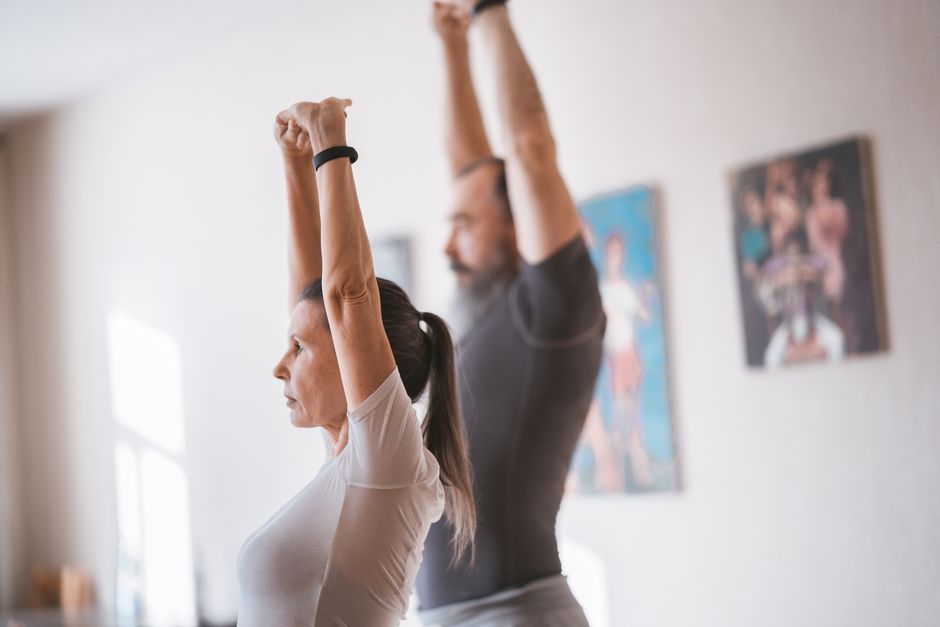
A daily whole-body stretching routine does not need to be long or complicated. Five to ten minutes covering your neck, shoulders, back, hips, hamstrings, calves, and chest is enough to maintain general flexibility in most healthy adults. The key is consistency and holding each stretch long enough to matter.
Below is a practical routine you can do most days, plus an honest look at what stretching can and cannot do.
What Stretches Should I Do Daily For My Whole Body?
A simple daily sequence moves from top to bottom. You can do it in the morning, after a workout, or before bed. Warm muscles stretch more comfortably, so a short walk or a warm shower first is a reasonable idea if you have the time.
Here is one approach:
- Neck side tilt: Gently tip your right ear toward your right shoulder. Hold. Switch sides.
- Shoulder rolls: Roll shoulders forward several times, then backward.
- Cross-body shoulder stretch: Bring one arm across your chest and hold it with the other arm. Switch sides.
- Chest opener: Clasp your hands behind your back and gently lift them, opening the chest.
- Cat-cow: On hands and knees, alternate arching and rounding your spine.
- Child’s pose: Kneel, sit back on your heels, and reach your arms forward along the floor.
- Standing hamstring stretch: Place one heel on a low step with a straight leg and lean forward slightly. Switch sides.
- Quad stretch: Standing, pull one heel toward your buttocks while holding a wall for balance. Switch sides.
- Hip flexor stretch: In a half-kneeling position, gently shift your weight forward until you feel a stretch at the front of the hip. Switch sides.
- Calf stretch: Place your hands on a wall, step one foot back with a straight leg, and press the heel down. Switch sides.
Each stretch can be held for roughly 15 to 30 seconds. Repeat two to four times per side if you have time. This range is widely used in clinical and fitness settings, though the ideal duration for every person is not settled science.
How Long Should You Hold Each Stretch?
Most guidance lands in the 15 to 30 second range per stretch, repeated two to four times. That is a common clinical and fitness standard rather than a magic number.
Holding a stretch for a few seconds and moving on is unlikely to do much for flexibility. Holding too long, or pushing into sharp pain, raises the risk of strain. The useful zone is a mild pull you can breathe through.
If you are stretching to improve flexibility rather than just maintain it, longer holds and more repetitions tend to be used. The evidence here is not strong enough to name a single best duration for everyone.
Should You Stretch Before or After Exercise?
Static stretching right before activities that need power or speed can slightly reduce performance in the short term. That finding is fairly consistent in the research.
For most people doing everyday exercise, this matters little. If you are about to sprint or lift heavy, a dynamic warm-up is generally a better fit than long static holds. Dynamic movements take a joint through its range with control, like leg swings or arm circles.
After exercise, when muscles are warm, static stretching tends to feel better and is a common time to do it.
None of this changes the basic point: a short daily routine done consistently is more useful than a long routine done once a week.





What Does Stretching Actually Do?
Stretching can improve your range of motion. That part is well supported. If you consistently stretch a muscle group, you can often move that joint further over time.
What stretching does not reliably do is prevent injury on its own, fix posture permanently, or “flush” toxins from your body. Those claims show up often online. The evidence for them is weak or absent.
One clarification worth knowing: much of the early gain in flexibility after starting to stretch comes from increased tolerance to the stretch sensation, not only from the muscle physically lengthening. Your nervous system adjusts to the position. This is part of why consistency matters more than intensity.
Stretching also is not a substitute for strength training. Muscles that are strong through a full range of motion tend to serve you better than muscles that are only flexible.
Can Stretching Prevent Injury or Fix Bad Posture?
The evidence that stretching alone prevents injury is limited. Some studies suggest a modest benefit when stretching is part of a broader warm-up, but results vary and no strong consensus exists that stretching by itself lowers injury risk.
Posture is similar. Poor posture is not simply a matter of tight muscles that need pulling. It involves strength, habit, workstation setup, and how you hold yourself through the day. Stretching can be one part of addressing it, but it is rarely the whole answer.
If you have ongoing pain, stiffness, or a specific injury, stretching is not a treatment you should self-prescribe. Talk to a doctor or physical therapist.
Who Should Be Careful With Stretching?
Stretching is generally low risk for healthy adults, but some people should take extra care.
- Anyone with a recent injury, surgery, or joint replacement
- People with conditions that affect connective tissue or joint stability
- Anyone with nerve pain, numbness, or tingling
- Pregnant women, who should check with their doctor about what is appropriate
- People with osteoporosis, who should avoid forceful spinal or hip movements
For these groups, there is no single universal set of daily stretches. Guidance should come from a clinician who knows your situation. No general routine fits everyone.
For everyone, the rules are simple. Never bounce into a stretch. Never push into sharp pain. Stop if something feels wrong.
How Often Do You Need to Stretch to See Results?
Most days is better than a few times a week if flexibility is your goal. Consistency is the single biggest factor.
You do not need a long session. A short routine done most days tends to beat a long one done occasionally. This is true for most flexibility goals.
How fast you see change varies. Some people notice a difference within a few weeks. Others take longer. There is no reliable timeline that applies to everyone, and anyone who promises a specific result by a specific date is overstating what is known.
Frequently Asked Questions
How many minutes a day should I stretch?
Five to ten minutes covering the major muscle groups is enough for most healthy adults. Longer sessions are not automatically better; consistency matters more than length.
Is it bad to stretch every day?
Daily stretching is generally fine for healthy adults when it stays within a comfortable range. If you feel sharp pain or lasting soreness, back off and check with a doctor.
Can stretching alone make me more flexible?
Yes, consistent stretching can improve your range of motion over time. The gains come partly from your nervous system adapting to the stretch, which is why regular practice matters.
Should I stretch before or after a workout?
After a workout is usually the better time for static stretching, when muscles are warm. Before activities that need power or speed, a dynamic warm-up tends to work better than long static holds.
