
A fever in a baby is one of the most common reasons parents seek medical care. It is also one of the most frightening. The first thing to know is that a fever itself is not the illness—it is a sign that the immune system is fighting an infection. Your main job is not to eliminate the fever but to monitor your baby and know when to call the doctor. For babies under 3 months old, any rectal temperature of 100.4°F (38°C) or higher requires immediate medical attention. For older babies, watch their behavior, keep them hydrated, and call your pediatrician if the fever persists, climbs high, or is accompanied by concerning symptoms.
What Temperature Counts as a Fever in a Baby?
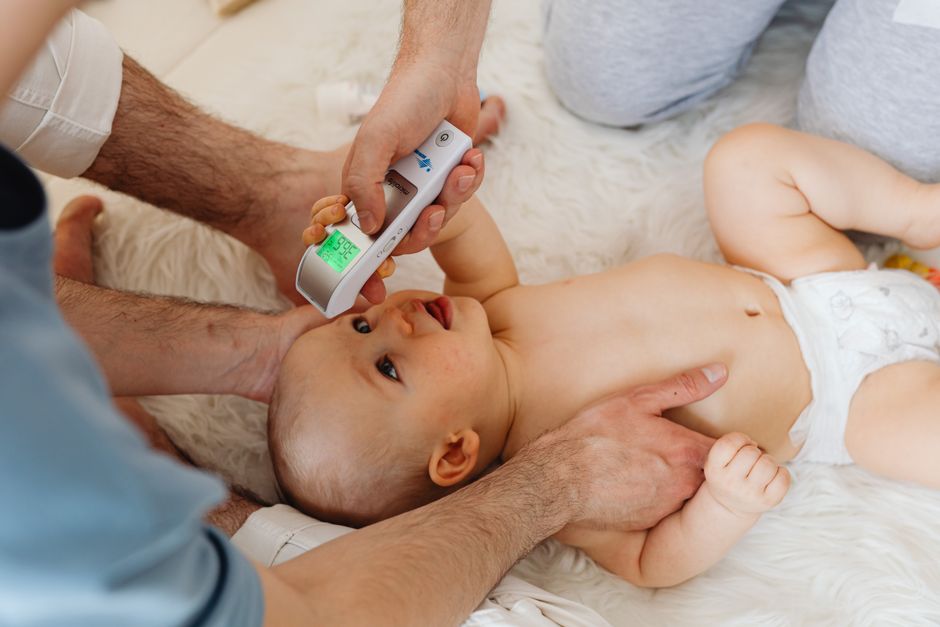
How you take the temperature matters as much as the number you get. The most accurate method for infants is a rectal thermometer. Ear, forehead, and armpit readings are less reliable in babies under 3 months because their small bodies do not regulate heat the same way older children do.
A fever is defined as a rectal temperature of 100.4°F (38°C) or higher. This threshold is not arbitrary—it is the standard clinical definition used by pediatricians and emergency departments. A slightly elevated reading of 99.5°F (37.5°C) is not a fever and does not require treatment.
For babies under 3 months, this threshold is a red line. Their immune systems are still immature, and a fever can be the only sign of a serious bacterial infection. If your newborn has a temperature at or above 100.4°F, call your pediatrician immediately or go to the emergency room. Do not wait to see if it comes down on its own.
What Should I Do If My Baby Has a Fever?
Your response depends entirely on your baby’s age and how they look. For a baby over 3 months who is drinking, sleeping, and playing relatively normally, you can manage the fever at home. The goal is comfort, not a normal temperature.
Remove extra layers of clothing and keep the room at a comfortable temperature. Do not bundle a feverish baby in blankets, and do not use cold baths or rubbing alcohol—both can cause shivering, which actually raises body temperature and can be dangerous. A lukewarm bath may help if your baby seems distressed, but it is not necessary if they are resting comfortably.
Offer fluids frequently. Breast milk, formula, or water (for babies over 6 months) helps prevent dehydration. A fever increases fluid loss, and dehydration can make a sick baby worse. Do not force fluids, but offer them more often than usual.
Watch for dehydration signs: fewer wet diapers than usual, no tears when crying, a dry mouth, or a sunken soft spot on the top of the head. If any of these appear, contact your doctor.
When Should You Give Fever Medication?
Medication is not required just because the thermometer shows a fever. If your baby is over 3 months, comfortable, and drinking well, you can let the fever run its course. Fever helps the immune system fight infection. Suppressing it does not shorten the illness.
Give medication only if your baby is uncomfortable—fussy, crying, unable to sleep, or refusing fluids. Two options are available for infants: acetaminophen (Tylenol) and ibuprofen (Motrin or Advil).
Acetaminophen can be given to babies over 3 months. Ibuprofen is approved for babies over 6 months. Always use the dosing syringe that comes with the medication, and dose by weight, not by age. If you do not know your baby’s weight, ask your pediatrician before giving any dose. Never give aspirin to a child—it is linked to Reye’s syndrome, a rare but serious condition that causes swelling in the brain and liver damage.
Do not alternate acetaminophen and ibuprofen unless your pediatrician has specifically instructed you to. Alternating increases the risk of dosing errors, and there is no evidence it controls fever better than using a single medication correctly.





When Is a Fever an Emergency?
Some fever situations require immediate medical care. You should not wait for the pediatrician’s office to open if your baby experiences any of the following:
- Any fever in a baby under 3 months old (100.4°F / 38°C or higher)
- A fever of 104°F (40°C) or higher in a baby of any age
- Difficulty breathing, fast breathing, or grunting
- Lethargy—your baby is hard to wake or does not respond normally
- A stiff neck, severe headache, or sensitivity to light
- A seizure or convulsion
- Blue or pale lips, tongue, or nail beds
- A rash that looks like small bruises and does not fade when pressed
- Signs of dehydration: no wet diapers for 8 hours, no tears, or a sunken fontanelle
- Your baby is inconsolable or cannot be comforted
Trust your instincts. You know your baby better than anyone. If something feels wrong, call your pediatrician or go to urgent care. It is always better to be checked and sent home than to wait when your baby is seriously ill.
How Long Should a Fever Last Before Calling the Doctor?
For babies over 3 months, a fever that lasts more than 3 days warrants a call to your pediatrician. Most viral fevers resolve within 2 to 3 days. A fever that persists longer may indicate a bacterial infection that requires antibiotics, such as an ear infection, urinary tract infection, or pneumonia.
You should also call if the fever goes away for more than 24 hours and then returns. This pattern can sometimes signal a secondary infection, such as an ear infection following a cold.
Call earlier if your baby has an underlying medical condition, was born prematurely, or has a weakened immune system. These babies may need closer monitoring even with a mild fever.
What Causes Fevers in Babies?
Most fevers in babies are caused by viral infections—colds, flu, and other common childhood illnesses. These infections typically peak and resolve on their own within a few days. Bacterial infections, such as ear infections, urinary tract infections, or pneumonia, are less common but require medical treatment.
Vaccines can also cause low-grade fevers within 24 to 48 hours of immunization. This is a normal immune response and is not dangerous. Teething does not cause a fever above 100.4°F. If your baby has a true fever, look for another cause.
Overdressing a baby—especially in a warm room or with heavy blankets—can cause a mild elevation in temperature. Remove layers and re-check the temperature after 15 to 20 minutes. If the reading drops to normal, your baby was overdressed, not feverish.
What Is a Febrile Seizure?
A febrile seizure is a convulsion triggered by a rapid rise in body temperature. It most commonly occurs in children between 6 months and 5 years of age. About 2 to 4 percent of children will have at least one febrile seizure. They look frightening—your baby may stiffen, shake, roll their eyes, or lose consciousness—but they are almost always harmless.
If your baby has a seizure:
- Place them on their side on a soft surface
- Do not put anything in their mouth
- Do not restrain them
- Time the seizure
- Call 911 if it lasts longer than 5 minutes or your baby does not wake up afterward
Most febrile seizures stop on their own within a minute or two. They do not cause brain damage, and children who have them do not develop epilepsy at higher rates than other children. Even so, call your pediatrician after any seizure—even if your baby seems fine—to determine the cause of the fever.
Frequently Asked Questions
What temperature is considered a fever in a baby?
A rectal temperature of 100.4°F (38°C) or higher is a fever. For babies under 3 months, this requires immediate medical attention.
Can I give my 2-month-old fever medication?
No. Acetaminophen is not recommended for babies under 3 months without a doctor’s explicit instruction. Any fever in a baby this young requires immediate medical evaluation.
Should I wake my baby to give fever medicine?
No. Sleep is more important than a temperature reading. If your baby is sleeping comfortably, let them rest and check on them regularly.
How often should I check my baby’s temperature during a fever?
Check every 2 to 4 hours while your baby is awake. There is no need to wake a sleeping baby just to take a temperature. Focus more on how your baby looks and acts than on the number on the thermometer.
