
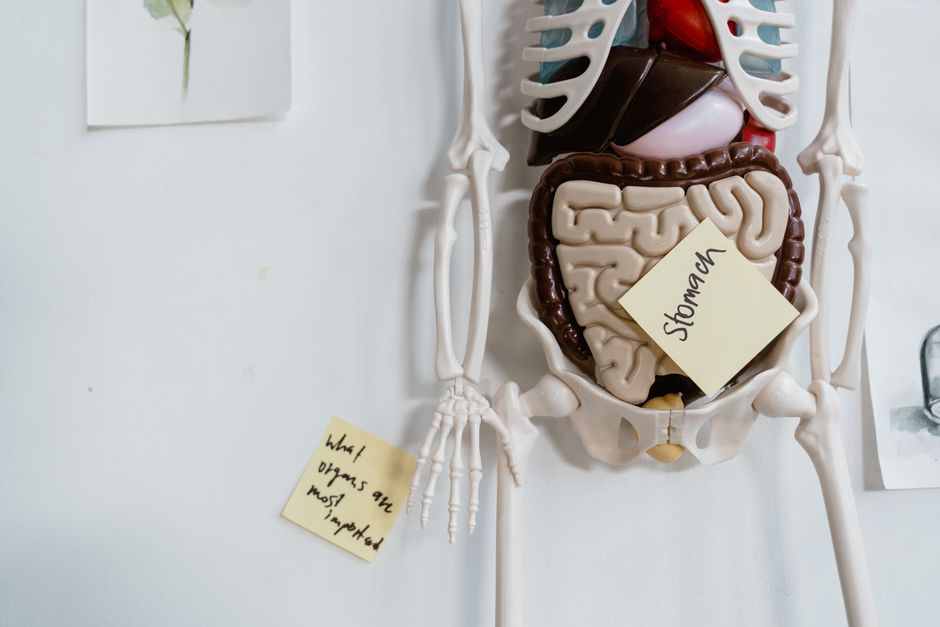
The stomach sits in the upper abdomen, mostly in what clinicians call the epigastric region. That is the area just below the breastbone and above the belly button, slightly toward the left side of the body. In the nine-region system, the stomach occupies the epigastric region and the left hypochondriac region. In the four-region system, it sits in the left upper quadrant. Those two systems divide the abdomen differently, which is why the same organ gets two answers.
That is the short version. The longer version explains why the stomach is not neatly confined to one box, why its position shifts with breathing, posture, and body size, and why doctors still use these maps even though CT scans and ultrasound can show the stomach directly.
What Region Is The Stomach In 4 And 9 Systems?
The stomach is in the left upper quadrant of the four-region system, and in the epigastric plus left hypochondriac regions of the nine-region system.
Both systems are ways of dividing the abdomen into zones so that pain, tenderness, or a mass can be described precisely. They are not anatomical structures. They are grids drawn over the body.
The four-region system is the simpler one. A single vertical line runs down the midline, and a single horizontal line crosses at the belly button. That creates four quadrants:
- Right upper quadrant (RUQ)
- Left upper quadrant (LUQ)
- Right lower quadrant (RLQ)
- Left lower quadrant (LLQ)
The stomach’s main body and its upper curve, called the fundus, sit in the left upper quadrant. Part of the stomach crosses the midline into the right upper quadrant, which is why the four-quadrant map is a rough guide rather than a precise boundary.
The nine-region system is finer. Two vertical lines and two horizontal lines create a three-by-three grid. The regions are the right hypochondriac, epigastric, and left hypochondriac across the top; the right lumbar, umbilical, and left lumbar across the middle; and the right iliac, hypogastric, and left iliac across the bottom.
The stomach’s upper portion lies in the left hypochondriac region. Its central body lies in the epigastric region. The lower part, the pylorus, sits near the midline in the epigastric or umbilical region depending on the person.
Why Does The Stomach Appear In More Than One Region?
The stomach is a curved, J-shaped organ roughly 25 centimeters long, and it does not respect straight lines drawn on the skin. A grid divides space; an organ occupies space. Those two things rarely line up neatly.
The stomach’s shape and position change constantly. When you eat, it expands. When you lie down, it shifts. When you take a deep breath, the diaphragm pushes it downward. When you stand, gravity pulls it lower in the abdomen.
Body size matters too. In people with a higher body mass index, the stomach tends to sit higher and more horizontally. In people who are very thin, it can hang lower and more vertically. This normal variation is called stomach position or gastric ptosis when the stomach drops unusually low, though that term describes an extreme rather than a typical case.
Because of this, the region maps are useful for communication, not for pinpointing an organ. When a doctor says “epigastric pain,” they mean pain in the upper central abdomen. They are not claiming the stomach is the only structure there.
What Other Organs Share These Regions?
The epigastric and left upper quadrant regions contain more than the stomach, and this matters for diagnosis. Pain in those areas does not automatically mean a stomach problem.
Structures that share the epigastric region include:
- The lower esophagus, where it meets the stomach
- The upper part of the duodenum, the first section of the small intestine
- The liver’s left lobe
- The pancreas, which lies behind the stomach
- The gallbladder, usually in the right upper quadrant but sometimes overlapping
- The spleen, tucked under the left rib cage
This overlap is why upper abdominal pain has such a long list of possible causes. Heartburn, gastritis, peptic ulcer, gallstones, pancreatitis, and even heart attack can all produce discomfort in the epigastric area. The location alone does not tell you which organ is involved.
This is a point worth holding onto. The region tells you where to look. It does not tell you what you will find.





How Do The 4 And 9 Region Systems Compare?
The two systems serve different purposes. The four-quadrant map is fast and easy to remember, which is why it dominates emergency medicine and general physical exams. The nine-region map is more precise, which is why it appears in anatomy textbooks and surgical planning.
| Feature | Four-Region System | Nine-Region System |
|---|---|---|
| Number of zones | 4 | 9 |
| Dividing lines | One vertical, one horizontal | Two vertical, two horizontal |
| Stomach location | Left upper quadrant | Epigastric and left hypochondriac |
| Common use | Emergency exams, quick reference | Anatomy study, surgery, detailed imaging |
| Precision | Broad | More specific |
Neither system is more “correct.” They are tools. A paramedic assessing abdominal pain in the field uses quadrants. A surgeon planning an incision may use the nine-region map. A radiologist reading a CT scan uses neither in the same way, because imaging shows the actual organ directly.
How Do Doctors Use These Regions In Practice?
Doctors use the region maps to describe where a patient feels pain, where tenderness is found on examination, and where a mass or swelling appears. The region becomes a starting point for a differential diagnosis, not the answer itself.
For example, epigastric pain that improves after eating may point toward a duodenal ulcer. Epigastric pain that worsens after eating may point toward a gastric ulcer. Pain that radiates to the back may suggest pancreatitis. Pain that comes with shortness of breath and sweating may suggest a heart problem. The region narrows the field, but the pattern of symptoms does the real work.
Imaging has changed how much the maps matter. A CT scan or ultrasound shows the stomach’s actual position in that person’s body. Endoscopy lets a doctor look directly at the stomach lining. These tools give far more information than any grid drawn on the skin.
Still, the region maps remain useful. They are a shared language. When one clinician tells another that a patient has left upper quadrant tenderness, both understand the general area being described without needing to see the patient.
Can Stomach Position Change With Age Or Weight?
Yes. Stomach position is not fixed across a lifetime. It shifts with changes in body weight, posture, pregnancy, and the tone of the muscles and ligaments that hold it in place.
During pregnancy, the growing uterus pushes the stomach upward and backward. This is part of why heartburn is common in later pregnancy. After childbirth, the stomach usually returns to its previous position.
Weight gain can push the stomach higher and more horizontal. Significant weight loss can have the opposite effect, letting it sit lower and more vertically. In older adults, the ligaments and connective tissue that support the stomach can loosen, and the stomach may sit lower than it did decades earlier.
None of this is necessarily a problem. It is normal variation. The region maps describe where the stomach usually sits, not where it must sit in every person.
Frequently Asked Questions
What region is the stomach in the 9-region system?
The stomach is in the epigastric region and the left hypochondriac region of the nine-region system. Its lower portion may extend into the umbilical region depending on the person’s body shape and posture.
What region is the stomach in the 4-region system?
The stomach is in the left upper quadrant. Part of it crosses the midline into the right upper quadrant, which is why the four-quadrant map is a general guide rather than an exact boundary.
Why does the stomach appear in more than one abdominal region?
The stomach is a large, curved organ that shifts with breathing, eating, posture, and body size. The region maps are fixed grids, so a moving organ will naturally overlap more than one zone.
Does stomach pain location tell you the cause?
No. The epigastric and left upper quadrant regions contain the liver, pancreas, spleen, and parts of the intestine, so pain in those areas can come from several organs. The location narrows the possibilities but does not identify the cause on its own.
