
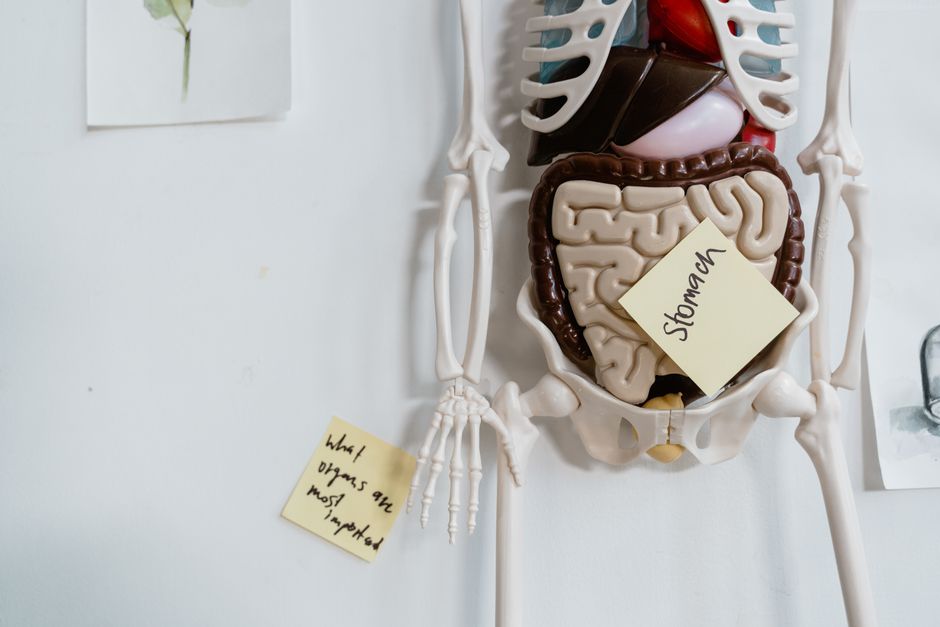
Your digestive system is a team of organs that work in sequence, not a single organ doing all the work. Food travels through a long tube called the gastrointestinal tract, where each section handles a specific job. The mouth, esophagus, stomach, small intestine, and large intestine form the main path, while the liver, gallbladder, and pancreas support the process from the sidelines.
What Organ Digests Food And How Each One Works?
No single organ digests food alone. Digestion is a relay race that starts in the mouth and ends in the large intestine, with each organ breaking food down further or absorbing specific nutrients.
The mouth begins the process mechanically and chemically. Chewing breaks food into smaller pieces, increasing the surface area available for enzymes to work on. Saliva contains amylase, an enzyme that starts breaking down starches into simpler sugars. This is why a piece of bread begins to taste slightly sweet if you hold it in your mouth long enough.
The esophagus is a muscular tube that moves food from your throat to your stomach. It does not digest food. Instead, rhythmic muscle contractions called peristalsis push the food downward. A ring of muscle at the bottom, the lower esophageal sphincter, opens to let food into the stomach and then closes to prevent stomach contents from flowing back up.
The stomach is a muscular sac that churns food and mixes it with gastric juice. This juice contains hydrochloric acid and pepsin, an enzyme that breaks down proteins. The stomach’s lining produces a thick layer of mucus to protect itself from its own acid. By the time food leaves the stomach, it has become a semi-liquid mixture called chyme.
The small intestine is where most digestion and absorption happen. It is roughly 20 feet long and divided into three sections: the duodenum, jejunum, and ileum. Enzymes from the pancreas and bile from the liver enter the duodenum to break down fats, proteins, and carbohydrates. The inner wall of the small intestine is covered in tiny finger-like projections called villi, which absorb nutrients into the bloodstream.
The large intestine, also called the colon, absorbs water and electrolytes from the remaining material. It also houses trillions of bacteria that ferment some undigested fiber and produce certain vitamins, including vitamin K and some B vitamins. What remains after this process is formed into stool and stored in the rectum until it is eliminated.
The liver, gallbladder, and pancreas are accessory organs. They do not have food passing through them, but they produce and store substances essential for digestion. The liver makes bile, the gallbladder stores it, and the pancreas produces digestive enzymes and bicarbonate to neutralize stomach acid.
How Does the Stomach Avoid Digesting Itself?
The stomach produces acid strong enough to dissolve metal, yet it does not digest its own tissue under normal conditions. This is possible because of a protective layer of mucus that lines the stomach wall.
Specialized cells in the stomach lining secrete a thick, alkaline mucus that forms a physical barrier between the acid and the stomach tissue. The stomach also produces new lining cells rapidly, replacing old ones before they can be damaged. If this balance is disrupted, stomach acid can irritate the lining and cause inflammation or ulcers.
Most ulcers are not caused by stress or spicy food, as was once widely believed. Research identified a bacterium called Helicobacter pylori as a major cause of peptic ulcers, and long-term use of nonsteroidal anti-inflammatory drugs (NSAIDs) is another common cause. This discovery changed how ulcers are treated and earned the researchers a Nobel Prize in 2005.
Where Are Most Nutrients Absorbed?
The small intestine absorbs about 90 percent of the nutrients from food. Its structure is designed for maximum surface area, which allows efficient absorption.
The inner lining of the small intestine is not smooth. It is covered in circular folds, which are covered in villi, which are themselves covered in even smaller projections called microvilli. If you could flatten out the entire absorbing surface of the small intestine, it would cover an area roughly the size of a tennis court.
Different nutrients are absorbed at different points along the small intestine:
- The duodenum absorbs iron, calcium, and some vitamins.
- The jejunum absorbs most sugars, amino acids, and water-soluble vitamins.
- The ileum absorbs vitamin B12, bile salts, and fat-soluble vitamins.
This is why certain diseases that affect specific sections of the small intestine can cause specific nutrient deficiencies. For example, Crohn’s disease often affects the ileum, which can lead to vitamin B12 deficiency.




What Does the Large Intestine Do?
The large intestine absorbs water and electrolytes and prepares waste for elimination. It is about 5 feet long and wider than the small intestine, which is where it gets its name.
By the time material reaches the large intestine, most nutrients have already been absorbed. What remains is mostly water, fiber, and some undigested material. The colon absorbs most of that water, turning the liquid chyme into a more solid stool.
The colon also contains a vast community of bacteria, collectively called the gut microbiome. These bacteria ferment some of the fiber that human enzymes cannot break down. This fermentation produces short-chain fatty acids, which are used as fuel by the cells lining the colon and may have other effects on health.
The gut microbiome is an active area of research. Some studies suggest it influences digestion, immune function, and even mood, but the evidence is still developing. No specific microbiome-based treatment is currently established as standard care for most digestive conditions.
How Long Does Digestion Take?
Digestion time varies widely depending on the meal and the person. A typical meal may take between 24 and 72 hours to travel through the entire digestive tract.
The stomach usually empties in about 2 to 4 hours, though fatty meals take longer. The small intestine completes its work in roughly 4 to 6 hours. The large intestine can hold material for 12 to 48 hours before elimination.
These are general ranges, not fixed rules. Many factors affect transit time, including meal composition, hydration, physical activity, medications, and individual variation. Some people naturally have faster or slower digestion than others.
What Can Go Wrong With the Digestive System?
Digestive problems are common and can affect any part of the tract. Some are minor and temporary, while others are chronic and require medical care.
Common issues include:
- Gastroesophageal reflux disease (GERD) — stomach contents flow back into the esophagus, causing heartburn.
- Peptic ulcers — open sores in the stomach or duodenum, often linked to H. pylori infection or NSAID use.
- Irritable bowel syndrome (IBS) — a functional disorder causing cramping, bloating, and changes in bowel habits.
- Inflammatory bowel disease (IBD) — includes Crohn’s disease and ulcerative colitis, both involving chronic inflammation.
- Celiac disease — an autoimmune reaction to gluten that damages the small intestine.
- Gallstones — hardened deposits in the gallbladder that can block bile flow.
Symptoms like persistent abdominal pain, blood in stool, unexplained weight loss, or difficulty swallowing should be evaluated by a doctor. These can signal conditions that need treatment.
How Do the Accessory Organs Help Digestion?
The liver, gallbladder, and pancreas do not receive food directly, but they produce substances that are essential for breaking it down.
The liver produces bile, a fluid that helps emulsify fats. Emulsification breaks large fat droplets into smaller ones, which gives enzymes more surface area to work on. The liver also processes absorbed nutrients and detoxifies harmful substances.
The gallbladder stores and concentrates bile produced by the liver. When you eat a meal containing fat, the gallbladder contracts and releases bile into the small intestine.
The pancreas produces several digestive enzymes, including amylase for carbohydrates, lipase for fats, and proteases for proteins. It also produces bicarbonate, which neutralizes stomach acid as it enters the small intestine. This is important because pancreatic enzymes work best in a neutral or slightly alkaline environment.
Does Digestion Change With Age?
Digestion can slow or change with age, but not everyone experiences the same changes. Some people notice no difference, while others develop new digestive symptoms.
Production of stomach acid and digestive enzymes may decrease with age in some people. This can affect the absorption of certain nutrients, including vitamin B12 and calcium. The risk of conditions like gallstones and diverticular disease also increases with age.
Medications can play a role too. Many common drugs, including NSAIDs, certain antidepressants, and some blood pressure medications, can affect digestion or cause gastrointestinal side effects. If you notice new digestive symptoms after starting a medication, it is worth discussing with your doctor.
Frequently Asked Questions
What is the main organ that digests food?
The small intestine is where most digestion and absorption of nutrients occurs. However, digestion is a team effort that begins in the mouth and involves the stomach, pancreas, liver, and gallbladder before food reaches the small intestine.
How long does food stay in your stomach?
Food typically stays in the stomach for about 2 to 4 hours. Meals high in fat take longer to empty than meals high in carbohydrates.
Does the stomach digest food without help from other organs?
No. The stomach breaks food down mechanically and chemically, but it relies on enzymes from the pancreas and bile from the liver to complete digestion in the small intestine. Without these accessory organs, fats and many other nutrients could not be properly absorbed.
Can you live without a stomach?
Yes, it is possible to live without a stomach, but it requires significant dietary adjustments. People who have had a gastrectomy must eat smaller, more frequent meals and may need vitamin B12 injections because the stomach plays a role in absorbing that vitamin.
