
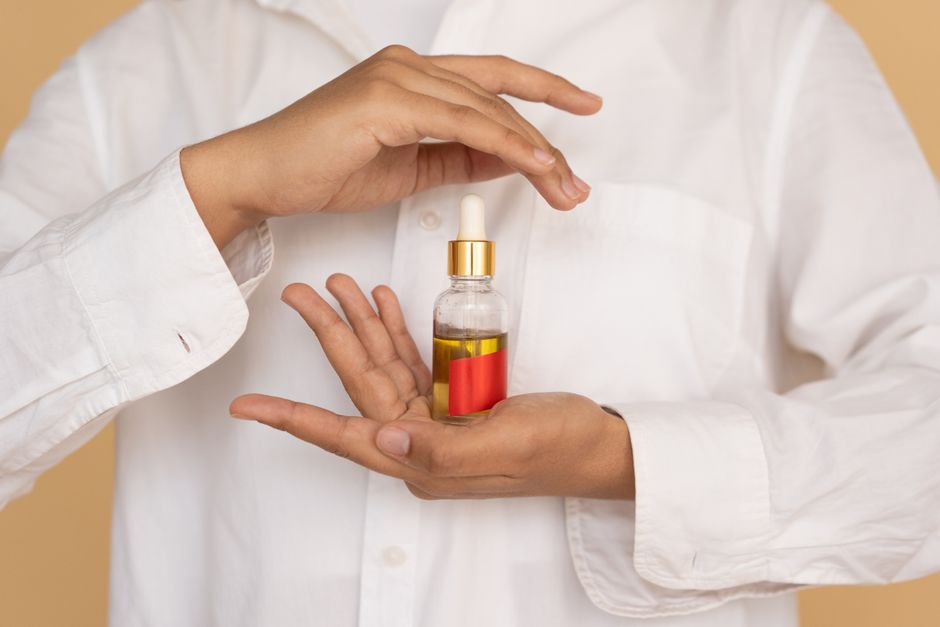
No oil has been proven in clinical trials to grow facial hair or make it thicker. That is the honest answer, and it matters because the internet is full of oil routines that promise a fuller beard. Some oils do have real, documented effects on skin and hair — just not the ones most people assume. If you want to understand what these oils can and cannot do, the science is more interesting than the marketing.
Can Any Oil Actually Grow Facial Hair?
Facial hair growth is driven mainly by genetics and hormones, specifically androgens like testosterone and dihydrotestosterone (DHT). An oil applied to the skin cannot change your genetics or meaningfully alter your hormone levels. That is the core reason no oil can do what a prescription treatment does.
What oils can do is affect the environment where hair grows. They can moisturize the skin, reduce breakage, and in a few cases influence circulation or inflammation. Those effects are real but modest. They do not create new follicles, and they do not change the fundamental thickness of a hair strand once it has formed.
It helps to understand how facial hair actually develops. A beard hair goes through a growth phase, a transition phase, and a resting phase. The length and thickness you see depend on how long the growth phase lasts and how large the follicle is. Neither of those is something a topical oil has been shown to change in controlled human studies.
So when a product says it “supports beard growth,” read that carefully. Supporting the skin is not the same as growing hair. No clinical trial has confirmed that any oil increases facial hair density or thickness.
What Oils Are Good For Facial Hair Growth And Thickness?
The oils most often discussed for facial hair are castor oil, rosemary oil, peppermint oil, jojoba oil, argan oil, and coconut oil. Each has a different reputation, and the evidence behind them varies widely. Some have plausible skin benefits. Only a couple have any human research at all, and that research is mostly about scalp hair, not facial hair.
Here is an honest breakdown of what each oil is and what is actually known about it.
- Castor oil — thick and heavy, used for centuries on hair and skin. It is a good moisturizer and sealant. No human trial has shown it grows facial hair.
- Rosemary oil — the most studied of the group, but for scalp hair, not beards. Some research suggests it may support scalp hair growth, possibly by improving circulation. That finding does not automatically transfer to facial hair.
- Peppermint oil — has shown hair-promoting effects in some animal studies. Human facial hair data does not exist.
- Jojoba oil — chemically similar to human sebum, the oil your skin produces naturally. Good for conditioning and softening hair and skin.
- Argan oil — rich in vitamin E and fatty acids. Popular as a conditioner. No evidence it affects growth.
- Coconut oil — a solid moisturizer that can reduce protein loss from hair. No growth evidence.
The pattern here is consistent. These oils are conditioners and moisturizers first. Any growth claim attached to them is either borrowed from scalp research or extrapolated from animal studies. Neither is strong evidence for facial hair.
What Does the Evidence Actually Show for Rosemary Oil?
Rosemary oil is the one oil in this group with human data worth mentioning, and it is worth being precise about what that data covers. Some research has compared rosemary oil to a common topical hair treatment for pattern hair loss on the scalp. Results have been described as similar in some studies, though the research is limited and not all of it is high quality.
Two important limits apply. First, that research looked at scalp hair loss, not beard growth. Second, pattern hair loss has a different cause than a patchy or slow-growing beard. You cannot assume a scalp finding repeats on the face.
There is also a practical safety point. Rosemary oil is potent and should be diluted in a carrier oil before it touches skin. Undiluted essential oils can cause irritation, redness, and in some people an allergic reaction. Peppermint oil carries the same caution and should never be applied full strength.
If you want to try rosemary oil, the honest framing is this: it may support scalp hair in some people, and it might improve circulation where you apply it. Whether that does anything for your beard is unknown. No study has answered that question.
Why Oils Cannot Change Hair Thickness
Hair thickness is set at the follicle, below the skin surface. The width of a hair strand is determined by the size of the follicle and the genetics that govern it. Once a hair emerges, its diameter is already fixed. Nothing you rub on the surface changes that.
What oils can do is create an illusion of thickness. A coating of oil adds a thin layer to each hair, which can make a beard look slightly fuller and feel softer. It can also smooth down flyaways and reduce the frizz that makes thin patches more obvious. That effect is real but temporary. It washes out.
Reducing breakage is a related and more durable benefit. Dry, brittle hair snaps more easily, and a beard with broken hairs looks thinner than it is. Regular conditioning with oils like jojoba, argan, or coconut can help hair stay flexible, which may help it retain length. That is a genuine benefit, even if it is not growth.
This is the non-obvious part. Many people who think an oil made their beard thicker are actually seeing less breakage and better conditioning. The hair count did not change. The hair quality did.
What Actually Has Evidence for Facial Hair Growth?
If your goal is genuinely more facial hair, the treatments with real evidence are not oils. They are medications, and they require a clinician.
Minoxidil is a topical treatment with documented effects on hair growth, including some use for facial hair. Finasteride is an oral prescription that affects DHT and is used for scalp hair loss. Both have side effects and both should be discussed with a doctor, not self-prescribed from a forum.
For many people, the honest answer is that a patchy or slow-growing beard is simply how their genetics work, and no topical product changes that. Age also matters. Many men see their beard fill in through their twenties and even into their thirties. A beard that looks thin at 22 may look full at 30 without any intervention.
Underlying health issues can also affect facial hair. Low testosterone, thyroid problems, and nutritional deficiencies can all play a role in some cases. If your facial hair has changed suddenly, or you have other symptoms, that is a reason to see a doctor rather than reach for an oil.
How to Use Oils Safely If You Want to Try Them
Using oils as a conditioner is reasonable. Using them as a treatment for a medical condition is not, because the evidence is not there. If you want to try them, a few safety basics apply.
- Always dilute essential oils like rosemary and peppermint in a carrier oil such as jojoba or argan before applying.
- Test a small patch of skin first and wait a day to check for irritation.
- Keep essential oils away from your eyes and do not swallow them.
- Stop if you notice redness, itching, or a rash.
No clinical guidelines exist for using these oils specifically on facial hair, so any routine you read online is someone’s personal experience, not a medical standard. Treat it that way.
The bottom line is simple. Oils can make a beard softer, less brittle, and slightly fuller-looking. They cannot grow new hair or change its thickness. If that is what you need, talk to a doctor about treatments that have actual evidence behind them.
Frequently Asked Questions
Do oils really help facial hair grow?
No oil has been proven in clinical trials to grow facial hair. Oils can condition hair and reduce breakage, which may make a beard look fuller, but they do not create new hair.
Is rosemary oil good for beard growth?
Rosemary oil has some human research for scalp hair, but none for facial hair. It may improve circulation where applied, but no study has confirmed it grows a beard.
Can castor oil make my beard thicker?
Castor oil is a good moisturizer but has no evidence of increasing beard thickness. Any fuller look comes from conditioning and less breakage, not new growth.
What actually grows facial hair?
Prescription treatments like minoxidil and finasteride have documented effects and should be discussed with a doctor. Genetics and age are the biggest factors for most people.
