
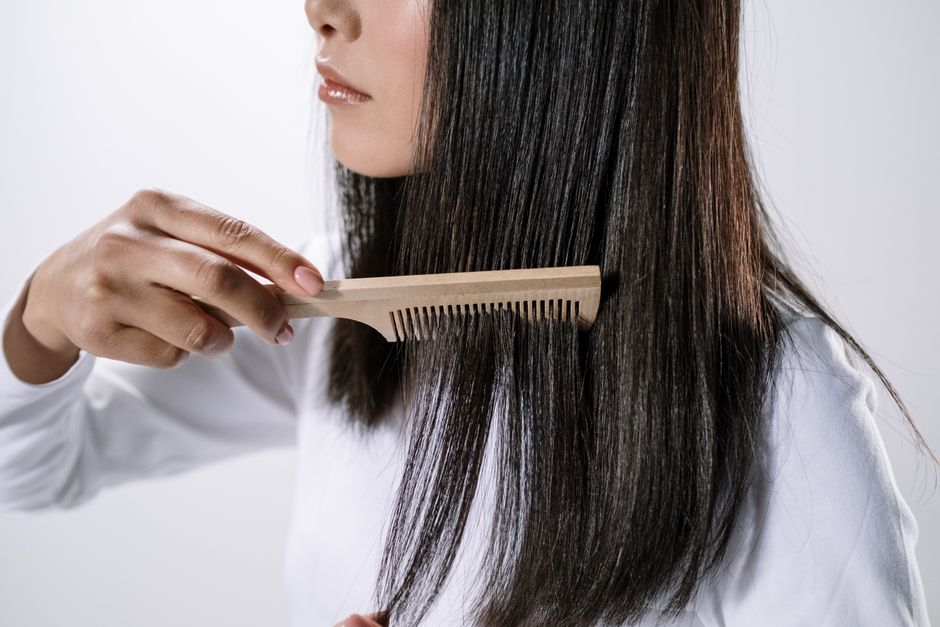
Your hair’s shape starts deep inside the scalp. The follicle — the tube that grows each strand — decides whether your hair comes out straight, wavy, or curly. Genetics determine the follicle’s shape. A straight follicle produces straight hair because the strand grows evenly from a round tube. Curly hair grows from an oval or twisted follicle, which forces the strand to bend as it forms. The bonds between proteins inside the hair shaft then lock that shape in place. Straight hair, curly hair, and everything in between all come down to this combination: the follicle’s architecture and the chemical bonds that hold each strand together.
How Does the Hair Follicle Shape Determine Straight Hair?
The hair follicle is a small pocket in the skin. Each follicle has a specific shape, and that shape is set before you are born. Think of the follicle as a mold. If the mold is perfectly round and straight, the hair that grows through it comes out straight. If the mold is curved or flattened, the emerging hair is forced to bend.
Research consistently shows that the angle of the follicle relative to the scalp surface also matters. A follicle that sits perpendicular — straight up and down — tends to produce straight hair. A follicle that sits at a sharp angle produces hair that grows out at an angle, which contributes to a flatter, less voluminous appearance. The curvature of the follicle itself is the primary physical driver of whether the hair fiber is straight or wavy.
This is not a casual observation. Biologists have documented that the dermal papilla, a cluster of cells at the base of the follicle, sends signals that shape the follicle during development. When those signals produce a straight, cylindrical follicle, the hair grows straight. When they produce a curved follicle, the hair grows curly.
What Role Do Genes Play in Making Hair Straight?
Your genes write the instructions for your follicle’s shape. Specific genetic variants influence the structure of the proteins that make up the hair fiber and the follicle itself. One gene, called trichohyalin (TCHH), has been directly linked to hair shape in some populations. Trichohyalin is a protein involved in the formation of the hair shaft. Variations in this gene are associated with differences in how straight or curly a person’s hair is.
Hair texture is not controlled by a single gene. It is a polygenic trait, meaning many genes contribute to the final outcome. Some genes affect the follicle’s shape. Others affect the thickness of each strand. Others affect how much the hair fiber curves as it hardens. The combination of these genetic inputs determines whether you have fine straight hair, thick straight hair, or loose waves.
Ethnic background influences which genetic variants are common. For example, certain variants associated with straight hair are more frequent in populations of East Asian descent. Variants associated with tightly coiled hair are more common in populations of African descent. But these are population-level patterns, not rules. Straight hair appears in every human population because the genetics of hair shape are complex and vary widely between individuals.
What Are the Chemical Bonds That Make Hair Straight?
Once the follicle produces a hair fiber, the fiber’s internal chemistry holds its shape. Hair is mostly made of a protein called keratin. Keratin proteins link together in long chains, and those chains form the structure of each strand. Two types of chemical bonds are especially important for hair shape: hydrogen bonds and disulfide bonds.
Hydrogen bonds are weak bonds that form between water molecules and the protein chains inside the hair. These bonds are temporary. They break easily when hair gets wet and reform when hair dries. This is why wet hair can be stretched or reshaped, and why it returns to its normal pattern once dry. Humidity disrupts hydrogen bonds, which is why curly hair frizzes in damp air — the bonds are constantly breaking and reforming, allowing the hair fiber to swell and change shape.
Disulfide bonds are much stronger. They form between sulfur atoms in the amino acid cysteine, which is abundant in keratin. These bonds are permanent under normal conditions. They lock the hair fiber into its natural shape. Straight hair has disulfide bonds that line up evenly along the length of the strand. Curly hair has disulfide bonds that are offset, which creates a bend in the fiber.
Heat styling and chemical treatments target these bonds. A flat iron applies heat that temporarily breaks hydrogen bonds, allowing you to pull hair straight. The effect lasts until the hair gets wet again. A chemical relaxer breaks disulfide bonds permanently, which is why relaxed hair stays straight through washing. The hair grows back curly because the new growth has intact disulfide bonds from the follicle.

Why Does Straight Hair Sometimes Become Curly or Change Texture?
Hair texture can change over a person’s lifetime. Hormonal shifts are the most common cause. Pregnancy, menopause, and thyroid conditions can all alter the follicle’s activity. Some women report their straight hair becomes wavy during pregnancy and returns to straight afterward. The mechanism is not fully understood, but hormones influence the growth cycle and the shape of the hair shaft as it is produced.
Aging also changes hair. Follicles can become smaller and produce thinner strands over time. Thinner hair may appear less curly because the fiber has less mass to hold a bend. Conversely, some people develop curlier hair as they age because the follicle itself changes shape with the natural aging process.
Medical conditions can change hair texture. Alopecia areata, an autoimmune condition, sometimes produces regrowth that is different in texture from the original hair. Chemotherapy often causes hair to fall out, and the regrowth can be a different texture — sometimes curly where it was straight before. This is because the follicle was damaged and rebuilt, and the new follicle may not have the exact same shape as the original.
Medication side effects can also alter hair texture. Some drugs, including certain retinoids and anticonvulsants, have been reported to change hair curl pattern. These changes are usually reversible once the medication is stopped, but not always.
Can You Permanently Change Straight Hair to Curly?
No method permanently changes straight hair to curly without altering the follicle itself, and no safe procedure does that. Chemical perms create curls by breaking and reforming disulfide bonds. The hair is wrapped around rods, and a reducing agent breaks the disulfide bonds. An oxidizing agent then reforms them in the curled position. This changes the shape of the existing hair fiber, but the new hair that grows from the follicle will be straight again because the follicle was never changed.
The distinction matters. A perm changes the hair you have on your head right now. It does not change your genetics or your follicle. The curl lasts until the treated hair grows out and is cut off, typically three to six months depending on hair growth rate.
Heat tools create temporary curls by breaking hydrogen bonds. These curls last until the hair is washed or exposed to humidity. They are completely reversible.
No topical product, vitamin, or supplement has been shown in clinical trials to permanently change hair from straight to curly. Marketing claims that suggest otherwise are not supported by evidence.
Does Hair Thickness Affect Whether It Is Straight?
Hair thickness and hair shape are separate traits, but they interact. The cross-section of a hair fiber matters. Straight hair typically has a round cross-section. Wavy and curly hair has an oval or flattened cross-section. The more oval the cross-section, the tighter the curl.
Thickness refers to the diameter of the fiber, not its shape. You can have thick straight hair or thin straight hair. Both are straight because the follicle is round. However, very fine hair — hair with a small diameter — may not hold a curl well because the fiber is too light to maintain the bend. Coarse hair, with a larger diameter, holds styling shapes longer because the fiber has more structural mass.
This is why two people with the same curl pattern can have very different styling results. One has fine curly hair that falls flat within hours. The other has coarse curly hair that holds its shape for days. The curl genes are the same; the thickness genes are different.
Can You Change Your Hair’s Natural Shape Through Diet?
No clinical evidence shows that diet changes the shape of your hair follicles. Hair shape is determined in the follicle, and the follicle’s architecture is established by genetics during fetal development. No nutrient alters that architecture.
Diet does affect hair health. Severe protein deficiency can cause hair to become brittle and break. Iron deficiency can lead to hair shedding. But these conditions affect the quality and quantity of hair, not whether it grows straight or curly.
Biotin supplements are heavily marketed for hair growth and strength. The evidence is limited. Biotin deficiency is rare, and supplementing biotin in people with normal levels has not been shown to change hair texture or growth in large clinical trials. If your hair is suddenly changing texture or falling out, that is a reason to see a doctor, not a reason to buy supplements.
Frequently Asked Questions
Can straight hair become curly naturally?
Yes, hormonal changes, aging, and some medical conditions can alter follicle shape and change hair texture over time. These changes are gradual and are not something you can control.
Is straight hair dominant or recessive?
Hair texture is not a simple dominant or recessive trait. Multiple genes interact to produce the final hair shape, so the inheritance pattern is complex and unpredictable.
Why is my hair straight at the roots but curly at the ends?
Hormonal shifts, aging, or damage to the follicle can change the shape of hair produced over time. The hair at your roots reflects your follicle’s current output, while the ends reflect what your follicle produced months ago.
Does cutting hair make it grow back straighter?
No. Cutting hair does not change the follicle or the genes that determine hair shape. Hair grows back with the same texture it had before the cut.
