
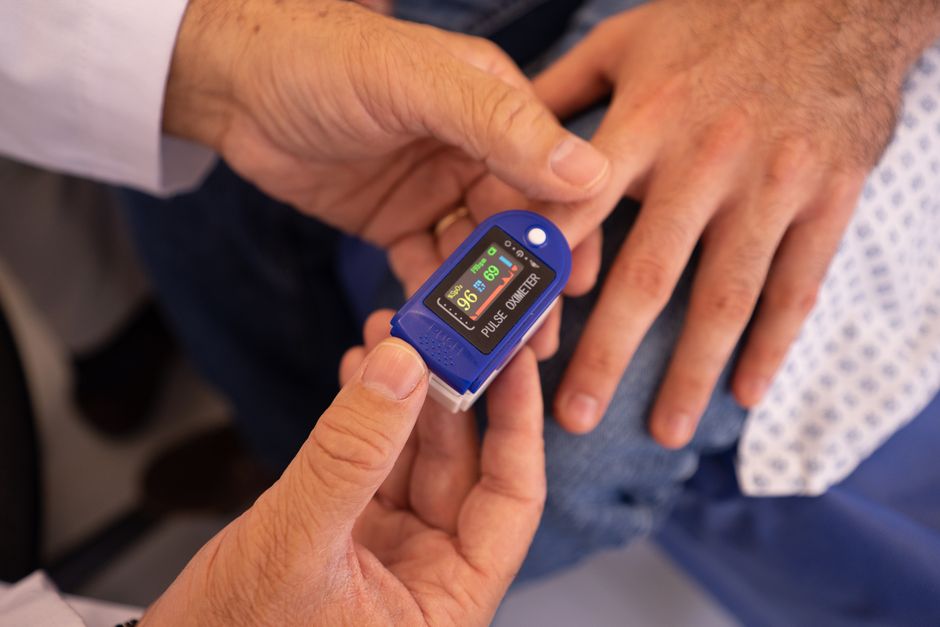
Your oxygen level is supposed to be between 95% and 100% when measured by a pulse oximeter on your finger. That number is called oxygen saturation, or SpO2. A reading of 90% or lower is considered low and needs medical attention right away.
That is the short answer. The longer answer involves understanding what the number actually measures, why it can be wrong, and when a reading matters more than the symptoms you feel.
What Is Your Oxygen Level Supposed To Be?
Oxygen saturation measures how much of your hemoglobin — the protein in red blood cells that carries oxygen — is currently carrying oxygen. A healthy person breathing normal air at sea level typically sits between 95% and 100%.
Some healthy people naturally run at 95% or 96% without any problem. Others sit at 98% or 99%. Both are normal. The exact number within that range is less important than whether it stays stable and whether you feel well.
Doctors generally use these ranges:
- 95% to 100% — Normal for most healthy adults at sea level
- 91% to 94% — Below normal; worth discussing with a doctor, especially if it persists
- 90% or below — Low; this is a medical concern and needs prompt evaluation
These thresholds apply to adults. They do not apply the same way to people with chronic lung disease, who may live at lower baseline levels under a doctor’s care. They also do not apply to infants and children in the same way, since pediatric normal ranges differ.
Altitude changes things too. At high elevation, the air holds less oxygen, and healthy people can have lower readings. What counts as normal in Denver is not the same as what counts as normal in Miami.
How Does a Pulse Oximeter Actually Work?
A pulse oximeter shines two wavelengths of light through your finger. Oxygen-rich blood and oxygen-poor blood absorb that light differently. The device measures the difference and calculates a percentage.
It also detects your pulse, which is why the reading comes with a heart rate number. If the device cannot find a steady pulse, the saturation number is unreliable.
This is a screening tool, not a diagnostic test. It tells you roughly how much oxygen your blood is carrying. It does not tell you how well your lungs are moving air, how well your heart is pumping, or whether your tissues are getting enough oxygen. Those are different questions.
One thing people often miss: pulse oximetry measures oxygen bound to hemoglobin, not the total oxygen content of your blood. If you have severe anemia — too few red blood cells — your reading can look normal while your body is actually short on oxygen delivery. The number can be falsely reassuring in that situation.
What Causes a Low Oxygen Reading?
Many conditions can drop your oxygen saturation. The most common include:
- Lung infections such as pneumonia
- Chronic lung diseases like COPD or pulmonary fibrosis
- Asthma attacks
- Heart conditions that affect blood flow through the lungs
- Blood clots in the lungs (pulmonary embolism)
- Sleep apnea during sleep
- Severe anemia
Low oxygen can also happen without lung disease. Holding your breath, breathing shallowly due to pain, or being at high altitude can all lower your reading.
Sometimes the reading is low but nothing is wrong. Cold hands, poor circulation, dark nail polish, and movement can all interfere with the sensor. If a reading seems off, warm your hands, remove nail polish, and try again on a different finger.
When Should You Worry About Your Oxygen Level?
A single reading of 90% or below is a reason to seek medical care. Do not wait to see if it improves on its own.
But the number alone does not tell the whole story. How you feel matters just as much. Shortness of breath, chest pain, confusion, bluish lips or fingertips, and difficulty speaking in full sentences are all signs that something is wrong — regardless of what the device says.
Here is a point that gets lost: some people with genuinely low oxygen do not feel short of breath. This is called silent hypoxia. It was observed in some patients during the COVID-19 pandemic, where people arrived at hospitals with dangerously low oxygen levels but reported feeling fine. That does not mean everyone with low oxygen feels nothing. It means symptoms and numbers do not always match, and that is why measuring matters when you are sick.
If you are recovering from an illness at home and monitoring your oxygen, a downward trend over several readings is more meaningful than one isolated number. Track it. If it keeps dropping, call your doctor.
Can You Trust a Home Pulse Oximeter?
Home pulse oximeters are useful, but they are not perfect. Research has shown that readings can be less accurate in people with darker skin tones. The light-based technology was largely developed and tested on lighter skin, and melanin can absorb some of the light the device uses.
The FDA has issued guidance noting that pulse oximeter accuracy can be affected by skin pigmentation, and that this can lead to readings that are higher than a person’s actual oxygen level. That means a device might read 92% when the true value is lower.
This does not mean you should ignore your oximeter. It means you should not rely on it alone. If you feel short of breath or unwell, seek care even if the number looks acceptable. A doctor can use a blood draw to measure oxygen directly, which is more accurate.
Other factors that reduce accuracy:
- Cold hands or poor circulation
- Motion during the reading
- Nail polish, especially dark colors
- Very low blood pressure
- Certain medical conditions that affect blood flow
For the most reliable reading, sit still, warm your hands, remove nail polish, and rest your hand on a flat surface. Wait for the number to hold steady for several seconds before trusting it.
What About Oxygen Levels During Sleep?
Oxygen levels can drop during sleep, especially in people with sleep apnea. When breathing pauses repeatedly, oxygen saturation falls. These drops are often brief and may not be noticed.
Normal oxygen saturation during sleep stays above 90% for most healthy adults. Repeated drops below that level may point to sleep apnea or another breathing problem during sleep. A doctor can order a sleep study to measure this properly.
A home oximeter is not designed to diagnose sleep apnea. It can only give a rough picture. If you snore heavily, wake up gasping, or feel exhausted despite a full night’s sleep, talk to a doctor about testing.
How Can You Keep Your Oxygen Level Normal?
For most healthy people, oxygen saturation takes care of itself. You do not need to monitor it daily unless a doctor tells you to.
Things that support healthy oxygen levels are the same things that support lung and heart health in general. Not smoking is the single biggest one. Regular physical activity helps your heart and lungs work more efficiently. Managing conditions like asthma or heart disease with your doctor keeps oxygen delivery steady.
If you live at high altitude, your body adapts over time, and your normal range shifts. There is nothing to fix — it is a normal response to less oxygen in the air.
If you have a chronic lung condition, your doctor may give you a specific target range for your oxygen level. Follow that guidance rather than the general 95% to 100% range, which may not apply to you.
Frequently Asked Questions
What is a normal oxygen level for an adult?
A normal oxygen saturation for a healthy adult at sea level is 95% to 100%. Readings of 90% or below are considered low and need medical attention.
Is 92% oxygen level dangerous?
A reading of 92% is below the normal range and worth discussing with a doctor, especially if it persists or comes with symptoms like shortness of breath. It is not an emergency on its own, but it should not be ignored.
Can a pulse oximeter be wrong?
Yes. Cold hands, movement, nail polish, poor circulation, and darker skin tones can all affect accuracy. If a reading does not match how you feel, seek medical advice rather than trusting the number alone.
When should I go to the hospital for low oxygen?
Go to the hospital if your oxygen level is 90% or below, or if you have symptoms like chest pain, confusion, bluish lips, or severe trouble breathing. Do not wait to see if it improves on its own.
