

Water activity is a measure of how much water in a food is available for chemical reactions and microbial growth — not how much water the food contains. It is expressed on a scale from 0 to 1, where pure water has an activity of 1.0. A food can be mostly water by weight yet have low water activity if that water is bound to sugars, salts, or proteins. This distinction matters because water activity predicts spoilage, safety, and shelf life more reliably than water content alone.
What Is Water Activity In Food And Why It Matters?
Water activity, often written as aw, is the ratio of the vapor pressure of water in a food to the vapor pressure of pure water at the same temperature. In plain terms, it measures the “free” water that microorganisms, enzymes, and chemical reactions can actually use.
Water content tells you how much water is physically present. Water activity tells you how much of that water is available. These are not the same thing. Honey is roughly 17 to 18 percent water by weight, yet its water activity is typically around 0.6. That low value is why honey resists microbial spoilage despite containing water.
This single number drives decisions across food science, food safety regulation, and shelf-life testing. It determines whether bacteria, yeasts, or molds can grow. It influences texture, browning reactions, and vitamin stability. For anyone trying to understand why some foods keep for years on a shelf and others spoil in days, water activity is the underlying mechanism.
How Is Water Activity Different From Water Content?
Water content is a measure of quantity. Water activity is a measure of availability. A food’s water content is expressed as a percentage of its total weight. Water activity is a ratio with no units, running from 0 to 1.
Two foods can have identical water content but very different water activity. Consider a piece of fresh fruit and a piece of dried fruit rehydrated to the same moisture level. If the dried fruit contains high levels of dissolved sugars, much of its water is chemically bound and unavailable to microbes. Its water activity would be lower even at the same total moisture.
This is why food scientists rely on water activity rather than water content when predicting microbial growth. The availability of water, not the amount, determines whether spoilage organisms can thrive.
Temperature also affects water activity. As temperature rises, water activity in most foods increases slightly. This means a food that is shelf-stable at room temperature might not be at higher temperatures — a consideration in warm climates and during shipping.
What Water Activity Level Stops Bacterial Growth?
Most bacteria cannot grow below a water activity of 0.91. This is one of the most well-established thresholds in food microbiology. Below that level, bacteria that cause foodborne illness — including Salmonella, Escherichia coli, and Listeria monocytogenes — generally cannot multiply.
Different organisms have different limits. The thresholds below reflect widely cited values in food science references:
| Organism Group | Approximate Minimum Water Activity for Growth |
|---|---|
| Most spoilage bacteria | 0.90–0.91 |
| Most foodborne pathogens | 0.91–0.93 |
| Most yeasts | 0.88 |
| Most molds | 0.80 |
| Halophilic (salt-tolerant) bacteria | 0.75 |
| Xerophilic (dry-tolerant) molds | 0.65 |
These are minimum values for growth, not kill values. Microorganisms already present in a food do not necessarily die when water activity drops below their growth threshold. They may simply become inactive and wait. If moisture is reintroduced — through condensation, improper storage, or rehydration — they can resume growing.
This is a critical point that is often misunderstood. Lowering water activity controls growth; it does not sterilize. A dried food that was contaminated before drying can still harbor viable organisms.

How Does Water Activity Affect Food Safety and Spoilage?
Water activity is one of the primary tools food manufacturers use to make products shelf-stable without refrigeration. By reducing water activity through drying, salting, sugaring, or adding humectants (substances that bind water), they create an environment where spoilage organisms and pathogens cannot multiply.
Consider some familiar examples:
- Fresh meat has a water activity above 0.99 and spoils quickly without refrigeration.
- Jerky typically has a water activity below 0.85, which is why it keeps at room temperature.
- Jams and jellies rely on high sugar content to bring water activity down to around 0.80–0.85.
- Crackers and dry cereals sit below 0.60, where almost nothing can grow.
Water activity also affects chemical reactions that cause spoilage. Lipid oxidation, enzymatic browning, and non-enzymatic browning (Maillard reactions) all respond to water activity. In many foods, the rate of these reactions is lowest somewhere in the middle of the scale — not at the extremes. This means simply drying a food as much as possible is not always the best approach for quality. There is often a narrow range where both microbial growth and chemical degradation are minimized.
Food safety regulations in the United States recognize water activity as a critical control point. The FDA’s Food Code and related guidance use water activity thresholds to define potentially hazardous foods. Foods with a water activity of 0.85 or below are generally considered non-potentially hazardous with respect to bacterial pathogens, meaning they do not require time-temperature control for safety on that basis alone.
Which Foods Depend on Water Activity for Preservation?
Many traditional preservation methods work by lowering water activity, even if the people using them never used that term. Drying, salting, smoking, and candying all reduce the availability of water.
Modern food manufacturing relies on it constantly. Here are categories where water activity is a defining factor:
- Dried fruits and vegetables: Typically 0.60–0.75. Sulfites are sometimes added not just for color but because they also influence water activity and microbial stability.
- Hard cheeses: Around 0.85–0.90. The combination of salt, acid, and moisture reduction creates a stable product.
- Syrups and honey: 0.55–0.65. High sugar concentrations bind water tightly.
- Peanut butter: Around 0.35–0.50. Low water activity makes it shelf-stable even after opening.
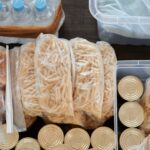
- Pasta and rice: Below 0.60. Dry pasta can last for years if kept dry.
What these foods share is not low water content alone — it is low water activity. The preservation mechanism is the same across all of them: deny microorganisms the water they need to grow.
How Is Water Activity Measured?
Water activity is measured using instruments called water activity meters. The most common approach uses a chilled-mirror dew point sensor. A sample is sealed in a chamber, and the instrument measures the humidity of the air above the sample once equilibrium is reached. That humidity reflects the water activity of the food.
Other methods include capacitive sensors and resistive sensors, though these tend to be less accurate at the extremes of the scale. For regulatory and quality purposes, chilled-mirror instruments are generally considered the reference method.
Measurement requires temperature stability. Water activity readings are sensitive to temperature fluctuations, so most instruments control temperature precisely. A difference of a few degrees can shift the reading enough to matter when you are near a critical threshold like 0.85 or 0.91.
For home cooks and small producers, water activity meters are available but can be expensive. Some cooperative extension services and food science labs offer testing. If you are making a shelf-stable product at home — jerky, dried fruit, or a preserved sauce — getting an accurate water activity reading is one of the few ways to know whether your product is actually safe to store at room temperature.
Does Water Activity Affect Nutrition and Texture?
Yes, and this is an area where the effects are well documented but less widely known outside food science.
Vitamin degradation is influenced by water activity. Vitamin C, for example, degrades more rapidly at higher water activities. In dry foods, keeping water activity low helps preserve heat-sensitive vitamins over long storage periods.
Texture is also directly tied to water activity. The crispness of a cracker depends on it staying below a certain water activity. If it absorbs moisture from the air and rises above roughly 0.4–0.5, it becomes stale and soft. This is why crackers are packaged in moisture-barrier film. The same principle applies to dry pet food, breakfast cereal, and potato chips.
On the other end of the scale, foods like soft baked goods need water activity high enough to stay moist but low enough to resist mold. Bakers and food manufacturers often add humectants like glycerin or sorbitol to hit that target window.
Water activity also influences the rate of Maillard browning, which affects both color and flavor. In some intermediate-moisture foods, the desirable brown color and toasted flavor develop fastest at water activities around 0.6–0.7. Above or below that range, browning slows. This is why some foods are formulated to sit at a specific water activity — not just for safety, but for taste and appearance.
What Are Common Misunderstandings About Water Activity?
The most common mistake is confusing water activity with water content. They are related but not interchangeable. A food can be 50 percent water by weight and still have a water activity below 0.85 if enough of that water is bound.
Another misunderstanding is that low water activity means a food is sterile. It does not. Pathogens like Salmonella can survive in low-water-activity foods for long periods. They just cannot multiply. This is why outbreaks of salmonellosis have been linked to dry products like peanut butter, spices, and powdered infant formula. The bacteria were present before drying or introduced afterward, and they survived because low water activity preserves viability rather than destroying it.
A third misconception is that water activity is only relevant to industrial food production. Anyone who dries, salts, sugars, or smokes food at home is manipulating water activity, whether they realize it or not. Understanding the principle helps explain why some home-preserved foods are safe at room temperature and others are not.
Finally, water activity is not the only factor in food safety. pH, temperature, oxygen availability, and the presence of preservatives all interact. A food with a water activity of 0.90 might still be safe if its pH is low enough to inhibit pathogens. Conversely, a food with a water activity of 0.86 might support mold growth over time. Water activity is one critical variable among several.
Frequently Asked Questions
What is a safe water activity level for food?
A water activity of 0.85 or below is generally considered safe for room-temperature storage because most bacteria, including common pathogens, cannot grow at or below that level. However, molds and some yeasts can still grow at lower water activities, so safety depends on the specific organism and other factors like pH.
Does water activity kill bacteria?
No. Lowering water activity stops bacteria from multiplying but does not necessarily kill them. Many pathogens can survive in a dormant state in dry foods and become active again if moisture is reintroduced.
Is water activity the same as moisture content?
No. Moisture content measures how much water is in a food by weight, while water activity measures how much of that water is available for chemical reactions and microbial growth. Two foods can have the same moisture content but very different water activities.
Why does honey have low water activity?
Honey is about 17 to 18 percent water, but its high sugar concentration binds most of that water, giving it a water activity around 0.6. This low water activity is one reason honey resists spoilage by most microorganisms.
