
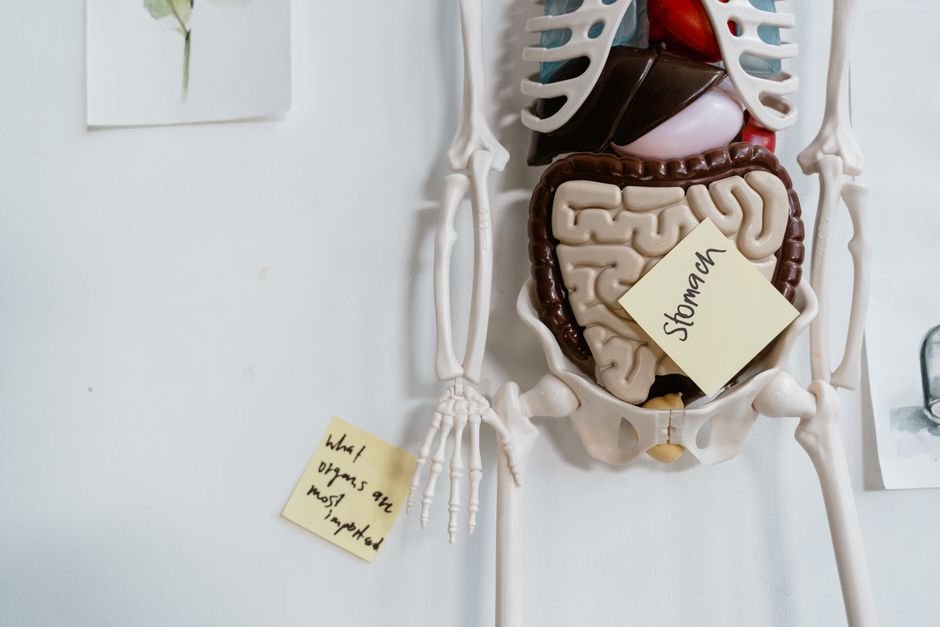
Food takes a long, winding path through your body before it becomes fuel. The order of the digestive tract runs from the mouth, down the esophagus, into the stomach, through the small intestine, into the large intestine, and out the rectum and anus. Along the way, the liver, gallbladder, and pancreas add juices that break food down and help your body absorb it.
That sequence matters more than most people realize. Each organ is built for a specific job, and the steps happen in a set order. When one part of the chain slows down or gets blocked, you feel it — sometimes far from where the problem actually is.
What Is the Order of the Digestive Tract?
The digestive tract is a continuous tube about 30 feet long in adults, running from your mouth to your anus. Doctors call it the gastrointestinal tract, or GI tract. Food moves through it in one direction, and each section does a distinct job.
Here is the order, start to finish:
- Mouth — chewing breaks food into smaller pieces, and saliva starts breaking down starches.
- Esophagus — a muscular tube that pushes food down to the stomach.
- Stomach — churns food and adds acid and enzymes.
- Small intestine — where most digestion and nutrient absorption happen.
- Large intestine (colon) — absorbs water and forms stool.
- Rectum — stores stool until you’re ready to pass it.
- Anus — the exit, controlled by muscles that hold stool in or let it out.
The liver, gallbladder, and pancreas are not part of that tube. They are accessory organs that feed into it. The liver makes bile, the gallbladder stores it, and the pancreas sends enzymes and bicarbonate into the small intestine. They sit outside the main path but are essential to it.
What Happens at Each Stage of Digestion?
Digestion is both mechanical and chemical, and the two work together at every stage. Mechanical means physical breakdown — chewing, churning, squeezing. Chemical means enzymes and acids splitting food into molecules your body can absorb.
Mouth and esophagus
Chewing does more than make food easier to swallow. It increases the surface area that enzymes can work on. Saliva contains an enzyme called amylase that begins breaking down starches right in your mouth. That is why a piece of bread can start tasting sweet if you hold it long enough.
Swallowing triggers a wave of muscle contractions called peristalsis. This wave pushes food down the esophagus and into the stomach. Peristalsis keeps working throughout the entire tract — it is the mechanism that moves contents forward even against gravity.
Stomach
The stomach is a muscular sac that churns food and mixes it with hydrochloric acid and an enzyme called pepsin. The acid is strong — its pH is typically between 1.5 and 3.5 — and it kills many bacteria while helping pepsin break down proteins.
The stomach lining protects itself with a layer of mucus. When that protection fails, acid can damage the lining, which is the mechanism behind peptic ulcers. Food typically stays in the stomach for a few hours before being released into the small intestine in a controlled trickle.
Small intestine
The small intestine is where the real work happens. It is about 20 feet long and divided into three sections: the duodenum, jejunum, and ileum. Most chemical digestion and nearly all nutrient absorption take place here.
Its inner surface is covered in tiny finger-like projections called villi, which are themselves covered in even smaller projections called microvilli. This folds the surface area up enormously — roughly the size of a tennis court, by common estimate. That vast surface is what lets your body pull in sugars, amino acids, fats, vitamins, and minerals efficiently.
Large intestine, rectum, and anus
By the time food reaches the large intestine, most nutrients are gone. What is left is mostly water, fiber, and material your body cannot digest. The colon absorbs water and electrolytes and hosts trillions of bacteria that ferment some of the remaining fiber.
The result is stool, which moves into the rectum for storage. The anus has two rings of muscle — an inner one you cannot control and an outer one you can. That combination is what lets you hold stool in until it is convenient to release it.
How Long Does Food Take to Move Through the Digestive Tract?
Total transit time varies widely between people and is not a fixed number. A commonly cited range is roughly 24 to 72 hours from eating to passing stool, but this is a general estimate, not a rule. Some healthy people move faster and some slower.
Here is a rough sense of where the time goes:
- Mouth and esophagus — seconds to a minute
- Stomach — a few hours, longer after a large or fatty meal
- Small intestine — several hours
- Large intestine — the longest stretch, often a day or more
One detail people rarely hear: transit time is not the same as digestion time. Your body may absorb most nutrients from a meal within a few hours, even though the leftover material can stay in the colon for a day or more. Feeling “full” long after eating is usually about stomach emptying and gut signals, not about food still being digested.
What Do the Liver, Gallbladder, and Pancreas Do?
These three organs do not touch your food directly, but digestion stalls without them. They deliver what the small intestine needs at the moment food arrives.
The liver produces bile, a fluid that helps break fat into droplets small enough for enzymes to act on. The gallbladder stores bile and releases it when fatty food enters the small intestine. The pancreas sends digestive enzymes for proteins, fats, and carbohydrates, plus bicarbonate that neutralizes stomach acid so those enzymes can work.
This is why gallbladder removal changes digestion for some people. Without a gallbladder, bile drips more continuously instead of being released in a concentrated burst. Many people notice no difference at all, while others find fatty meals harder to handle. Both outcomes are common.
Where Can the Digestive Order Go Wrong?
Because the tract is a sequence, problems in one section can affect the ones around it. A blockage in the small intestine, for example, causes backup and vomiting upstream. A weak valve between the stomach and esophagus allows acid to flow backward, which is the mechanism behind acid reflux.
Some common examples of how the order breaks down:
- Reflux — stomach contents move backward into the esophagus.
- Delayed stomach emptying — food lingers longer than usual in the stomach.
- Malabsorption — the small intestine fails to absorb nutrients properly.
- Constipation — the colon absorbs too much water or moves contents too slowly.
The location of a symptom often points to a specific section. Pain in the upper right abdomen may involve the gallbladder. Pain around the navel that later shifts to the lower right can suggest appendicitis. These patterns are useful clues, but they are not diagnoses — only a clinician with tests can confirm what is happening.
Does the Order of the Digestive Tract Change With Age?
The order stays the same throughout life, but the pace and efficiency can shift. Muscle contractions in the gut may slow with age, and the stomach may empty a little more slowly. Production of stomach acid and some digestive enzymes can decline in older adults.
These changes are usually mild and do not cause problems on their own. They can, however, make constipation more common and change how some nutrients are absorbed. Calcium and vitamin B12 absorption are two examples worth knowing about, since both can be affected by age-related changes in the gut.
The basic anatomy does not rearrange itself. What changes is how smoothly each stage runs.
Frequently Asked Questions
What is the correct order of the digestive system?
The order is mouth, esophagus, stomach, small intestine, large intestine, rectum, and anus. The liver, gallbladder, and pancreas support digestion but are not part of the main tube.
How long does food stay in the stomach?
Food typically stays in the stomach for a few hours before moving into the small intestine. Fatty or large meals take longer than light ones.
Which organ absorbs most nutrients?
The small intestine absorbs nearly all nutrients from food. Its villi and microvilli create a huge surface area for that job.
Is the large intestine the last part of digestion?
The large intestine is the last major organ of digestion, followed by the rectum and anus. It absorbs water and forms stool rather than absorbing nutrients.
