
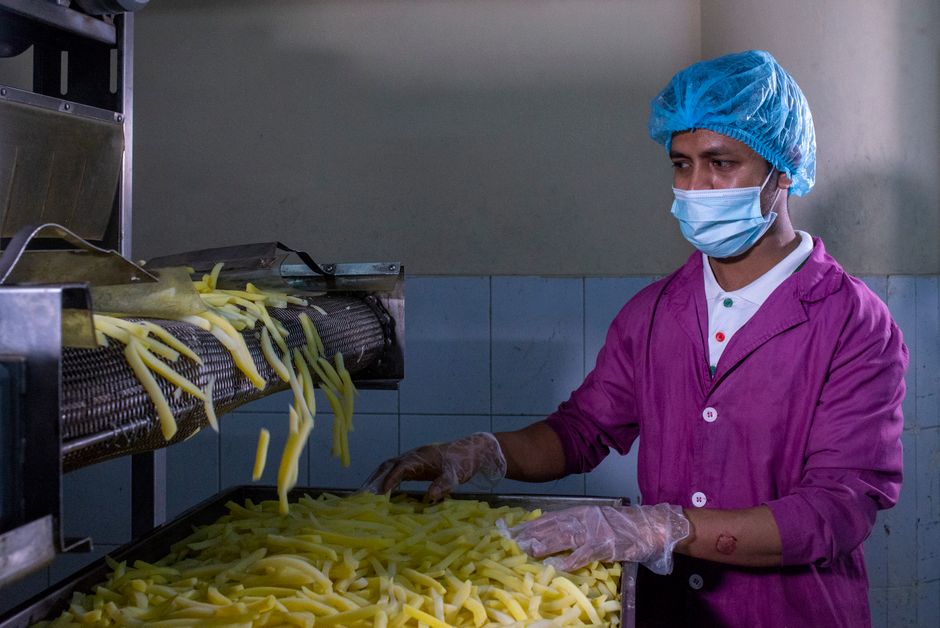
The industrial food chain is the system that moves most food in the United States from farm to table. It runs through large-scale farms, processing plants, distributors, and retailers, with a small number of companies controlling each step. It persists because it is efficient, deeply tied to government policy, and hard to replace once built.
Most people interact with this system three times a day without thinking about it. The chicken breast, the bagged salad, the box of cereal — each passed through a long series of hands before reaching the shelf. Understanding how that chain works helps explain why certain foods cost what they do, why some products are always available, and why changing the system is so difficult.
What Is The Industrial Food Chain And Why Does It Persist?
The industrial food chain is a production and distribution system built on scale, specialization, and consolidation. It persists because it delivers large volumes of food at relatively low cost, and because the infrastructure, policies, and business relationships that support it reinforce one another.
Four features define the system:
- Scale. Farms and facilities are large. A single processing plant may handle animals or ingredients from hundreds of farms.
- Specialization. Different regions, operations, and companies handle specific steps — growing, processing, packaging, distribution — rather than one operation doing everything.
- Consolidation. A small number of companies often control a large share of any given step. Meat processing and grain trading are well-known examples.
- Standardization. Products are designed to look and taste the same everywhere, which requires uniform inputs and consistent processing.
These features make the system efficient at producing volume. They also make it rigid. A plant built to process millions of birds per week cannot easily switch to small-batch, pasture-based production. The system persists partly because the physical infrastructure is expensive and purpose-built.
How Did The Food System Become So Industrialized?
The industrialization of food did not happen by accident. It was shaped by deliberate policy choices, technological change, and economic pressure over roughly the past century.
Several forces converged:
- Mechanization. Tractors, combines, and synthetic fertilizers dramatically raised yields per acre and per worker starting in the mid-20th century.
- Farm policy. Federal programs have long supported commodity crops like corn, wheat, and soy. These policies helped stabilize farm incomes but also encouraged large-scale production of a few crops.
- Consolidation. Over decades, smaller farms and processors merged or closed. Fewer, larger operations replaced them.
- Cold chain and transport. Refrigeration, trucks, and highways made it possible to move perishable food across long distances reliably.
- Consumer demand for convenience. Pre-cut, pre-cooked, and ready-to-eat products shifted more processing from the kitchen to the factory.
One clarification worth making: the shift was not simply a story of big companies pushing out small farmers. Many farmers adopted larger-scale methods because the economics rewarded it. The system grew from a mix of policy, technology, and market incentives, not a single cause.
Why Does The Industrial Food Chain Persist Despite Criticism?
The system persists because it solves real problems at a scale that alternatives have not matched. It produces enormous quantities of food, keeps prices relatively low for many products, and provides year-round variety that would have been unthinkable a few generations ago.
Specific reasons it endures:
- Cost and volume. Economies of scale lower the cost per unit. Feeding large populations cheaply is a genuine strength.
- Consistency and safety systems. Standardized processing allows uniform food safety protocols, though it also means a single contamination event can reach many people quickly.
- Locked-in infrastructure. Processing plants, distribution networks, and supply contracts are expensive to build and hard to redirect.
- Policy and subsidy structures. Government programs and crop insurance shape what gets grown and how.
- Consumer expectations. Shoppers expect low prices, constant availability, and uniform quality. The system is built to deliver exactly that.
Critics point to environmental costs, animal welfare concerns, worker conditions, and the dominance of highly processed foods in the diet. These are legitimate areas of debate. What is less clear is whether the system can be reformed incrementally or would need to be rebuilt — and how either path would affect food prices and availability. The evidence on large-scale transition is genuinely limited.
What Are The Main Stages Of The Industrial Food Chain?
The chain typically runs through five stages, each with its own economics and risks.
- Inputs. Seeds, fertilizer, feed, and pharmaceuticals are produced and sold to farms, often by a concentrated group of suppliers.
- Production. Large farms grow crops or raise animals, usually specialized in one or a few products.
- Processing. Facilities slaughter, clean, cut, cook, package, and formulate food. This stage is often the most consolidated.
- Distribution. Trucks, warehouses, and cold storage move products to retailers and food service.
- Retail and food service. Grocery chains, restaurants, and institutions sell to consumers.
Each stage adds cost and each stage concentrates risk. When a processing plant goes down, the effects ripple outward quickly — a pattern seen during disruptions in recent years, when a handful of plant closures led to supply shortages and price spikes in some categories.
How Does Consolidation Affect Food Prices And Choice?
Consolidation can lower costs through efficiency, but it also reduces competition. When a few companies control a large share of a market, they have more influence over prices paid to farmers and prices charged to buyers.
The effects are not one-directional. In some categories, consolidation has helped keep consumer prices down by streamlining operations. In others, it has been linked to narrower margins for farmers and fewer choices for shoppers. Regulators and economists continue to debate how much consolidation contributes to food price inflation. The evidence is mixed and depends heavily on the specific market.
A less obvious point: consolidation also affects resilience. A system with many small, distributed producers can absorb local shocks. A system with a few large nodes can be very efficient until one node fails. Both designs have trade-offs, and neither is automatically safer.
What Are The Criticisms And The Limits Of The Evidence?
The main criticisms of the industrial food chain are environmental impact, animal welfare, worker treatment, and diet quality. Each is a real area of concern, though the strength of evidence varies by claim.
On environment, research consistently shows that large-scale agriculture contributes significantly to greenhouse gas emissions, water use, and soil degradation. The scale of those contributions and the best ways to reduce them are actively debated.
On diet, the link between highly processed foods and poorer health outcomes has grown stronger in recent years. Some studies suggest associations with increased risk of certain chronic conditions, though the mechanisms are not fully settled and the research has limitations.
On animal welfare and worker conditions, concerns are well documented, but solutions and their costs are contested.
Where evidence is genuinely thin: claims that one system is definitively better for all outcomes, or that a full transition is feasible without major trade-offs. Those are open questions, not settled facts.
Can The Industrial Food Chain Change?
The system can change, and it already is changing at the edges. But large-scale transformation is slow because the infrastructure and economics are deeply entrenched.
What is happening now:
- Growth in local and regional food systems, though these remain a small share of total food sales.
- Increased consumer interest in transparency, labeling, and animal welfare standards.
- Some companies adopting supply chain standards and sustainability targets, with varying degrees of follow-through.
- Policy attention to competition in food and agriculture.
What is not clear is how quickly these shifts can scale, or whether they will meaningfully change the overall system. No clinical or economic consensus currently confirms that any single alternative can replace the industrial chain at current volumes. The honest position is that reform is possible but the path and pace are uncertain.
Frequently Asked Questions
What is the industrial food chain in simple terms?
It is the large-scale system that moves food from farms through processing, distribution, and retail to your table. It relies on big operations, few companies at each step, and standardized products.
Why does the industrial food chain persist?
It persists because it produces large amounts of food at relatively low cost, and because the infrastructure and policies supporting it are expensive and hard to change. Consumer expectations for low prices and constant availability reinforce it.
Is the industrial food chain bad for health?
The evidence links highly processed foods from this system to poorer health outcomes, though the research has limits and mechanisms are not fully settled. The system also produces many nutritious foods, so the picture is not one-sided.
Can the industrial food chain be replaced?
No consensus currently confirms that any alternative can replace it at current volumes. Local and regional systems are growing but remain a small share of total food sales.
