
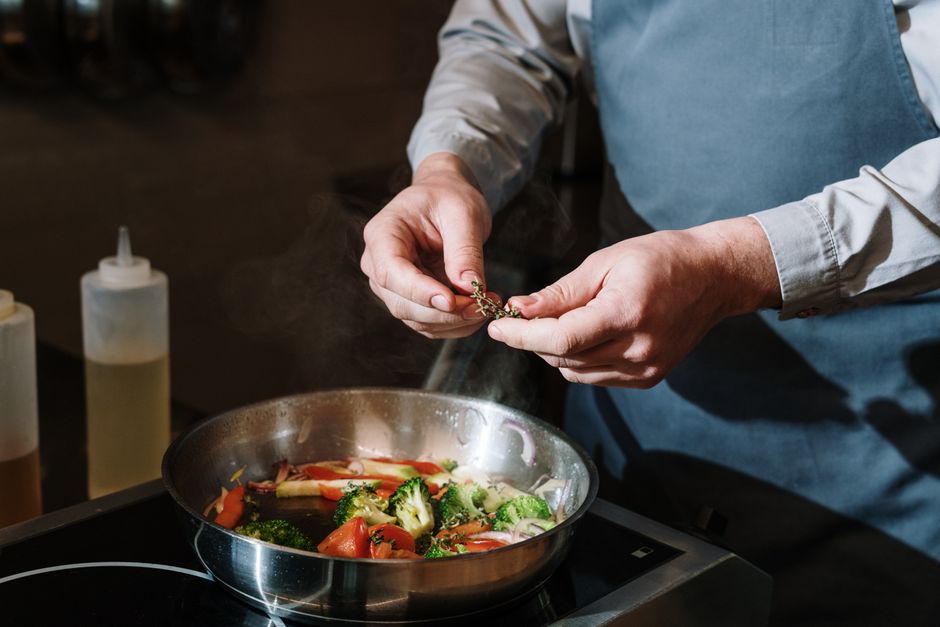
Olive oil is the healthiest oil to saute with for most home cooking. Its main fat is monounsaturated, which holds up better under heat than the polyunsaturated fats in many seed oils, and it has the strongest body of research behind it for heart health. For everyday sauteing at medium heat, extra virgin olive oil is a sound and well-studied choice.
The word “healthiest” depends on what you are measuring. Some oils resist heat damage better. Others carry more evidence for long-term health. The best pick balances both. Here is how the major cooking oils compare, and where the real differences lie.
What Happens to Oil When You Heat It?
Heat changes oil at the chemical level. Every cooking oil is a mix of fatty acids, and those fatty acids differ in how stable they are when exposed to heat, light, and oxygen.
The key factor is saturation. Fatty acids come in three main types:
- Saturated fats have no double bonds. They are the most stable under heat. Butter, coconut oil, and animal fats are high in these.
- Monounsaturated fats have one double bond. They are fairly stable. Olive and avocado oils are rich in these.
- Polyunsaturated fats have two or more double bonds. They are the least stable. Many seed oils are high in these.
Those double bonds are the weak point. When polyunsaturated fats get hot, oxygen can attack the bonds and start a chain of reactions. This produces compounds called aldehydes and other oxidation products. Some of these compounds are linked to health concerns when consumed in large amounts or repeatedly.
This is why the old advice said to avoid olive oil for cooking and reach for “high smoke point” oils instead. That advice was based on smoke point alone. It turns out smoke point is not the whole story.
Does Smoke Point Actually Matter?
Smoke point matters less than most people think. Smoke point is the temperature at which an oil visibly starts to smoke. It is easy to measure and easy to market, which is why it became the standard talking point.
But smoke point does not predict how much harmful oxidation happens. An oil can have a high smoke point and still break down into undesirable compounds before it ever smokes. The chemical stability of the fat matters more than the visible smoke.
Extra virgin olive oil is a good example. It has a smoke point around 375 to 410 degrees Fahrenheit, lower than refined oils. Yet in studies that heated different oils and measured oxidation products, extra virgin olive oil produced fewer of these compounds than several oils with higher smoke points. The natural antioxidants in unrefined olive oil appear to protect it during heating.
Typical sauteing happens between about 250 and 350 degrees Fahrenheit. That is below the smoke point of extra virgin olive oil. So for normal stovetop cooking, smoke point is rarely the limiting factor.
What Is The Healthiest Oil To Saute With?
Extra virgin olive oil is the strongest overall choice, and the reasons combine heat behavior with human health data. It is high in monounsaturated fat, low in polyunsaturated fat, and carries its own antioxidants. It also has by far the largest body of research connecting it to cardiovascular health.
Research on Mediterranean-style eating patterns, which center on olive oil, has consistently linked these diets to lower rates of heart disease. A large randomized trial in Spain, published in the New England Journal of Medicine, found that people eating a Mediterranean diet supplemented with extra virgin olive oil had fewer major cardiovascular events than a comparison group. That is a rare level of evidence for any single food.
Avocado oil is a reasonable alternative. It is also high in monounsaturated fat and has a high smoke point, which makes it convenient for higher-heat cooking. Its health research base is much smaller than olive oil’s, so it is reasonable but less proven.
Refined olive oil and regular “light” olive oil are fine too. They are more neutral in flavor and have higher smoke points, but they contain fewer of the natural antioxidants found in the extra virgin form.
How Do Common Cooking Oils Compare?
The table below shows the dominant fat type in each oil. The percentages are approximate and vary by brand and processing.
| Oil | Main Fat Type | Stability Under Heat | Health Evidence |
|---|---|---|---|
| Extra virgin olive | Monounsaturated | High | Strong |
| Avocado | Monounsaturated | High | Limited |
| Canola | Monounsaturated | Moderate to high | Moderate |
| Butter or ghee | Saturated | Very high | Mixed |
| Coconut | Saturated | Very high | Mixed |
| Sunflower, corn, soybean | Polyunsaturated | Lower | Mixed |
Notice the pattern. The oils that resist heat best are the ones highest in saturated and monounsaturated fats. The ones that are least stable are highest in polyunsaturated fats.
What About Seed Oils Like Canola and Sunflower?
Seed oils have become a heated topic, and much of the online discussion overstates the case in both directions. Here is what the evidence actually shows.
Polyunsaturated fats are not inherently bad. In fact, replacing saturated fat with polyunsaturated fat is linked to lower LDL cholesterol and lower heart disease risk in many studies. Omega-6 fats, which are common in seed oils, are essential nutrients. Your body needs them.
The concern is not the fat itself. It is what happens when these oils are heated hard and repeatedly, such as in deep frying over many hours. Under those conditions, polyunsaturated oils do form more oxidation products. For a quick saute at home, that concern is small.
Canola oil is a middle ground. It is relatively high in monounsaturated fat and low in saturated fat, with a high smoke point. It is a reasonable choice for cooking, though it has less of a research base than olive oil.
The practical takeaway: seed oils are not the villains some claim, and they are not the ideal choice for high-heat cooking either. For gentle to medium sauteing, the difference between them and olive oil is modest.
How Should You Store and Use Cooking Oil?
How you store oil matters as much as which oil you pick. Heat, light, and oxygen all speed up spoilage, even before the oil hits a pan.
- Keep oil in a cool, dark place, away from the stove.
- Choose dark glass bottles when you can. Light degrades oil over time.
- Keep the cap tightly closed to limit oxygen exposure.
- Buy smaller bottles if you cook less often. Oil does go rancid.
- Reuse frying oil sparingly, if at all. Repeated heating accelerates breakdown.
Signs an oil has gone bad include a stale or crayon-like smell, a bitter or off taste, and a sticky feel. Rancid oil will not necessarily make you sick right away, but it has already lost much of its quality and antioxidant content.
One simple habit helps a lot: do not let oil sit at high heat longer than needed. Add food soon after the oil is hot, and avoid letting a pan of oil smoke while you prep. If oil starts smoking heavily, it has already begun to break down.
Does the Type of Sauteing Change the Answer?
Yes, and this is where a lot of advice gets oversimplified. “Sauteing” covers a range of temperatures and techniques.
A gentle saute of onions or garlic at medium heat is well within extra virgin olive oil’s comfort zone. A hard sear at high heat is a different situation. For very high-heat searing, an oil with a higher smoke point, such as avocado oil or a refined olive oil, may be more practical. Ghee and other high-saturated fats are also stable at high heat, though their health evidence is more mixed than olive oil’s.
For the vast majority of home sauteing, you are cooking at medium heat for a few minutes. Extra virgin olive oil handles that easily, and it brings the strongest health track record to the table.
Frequently Asked Questions
Is extra virgin olive oil safe to saute with?
Yes. Extra virgin olive oil is stable at typical sauteing temperatures, which sit below its smoke point, and studies show it forms fewer oxidation products than several higher-smoke-point oils. It is one of the best-studied cooking oils for both heat stability and heart health.
What oil has the highest smoke point?
Refined oils generally have the highest smoke points, with some refined avocado, safflower, and rice bran oils exceeding 450 degrees Fahrenheit. Smoke point is not the same as heat stability, so a high smoke point does not automatically make an oil the healthiest choice.
Is canola oil healthy for cooking?
Canola oil is a reasonable all-purpose cooking oil. It is high in monounsaturated fat with a high smoke point, though it has a smaller body of health research behind it than olive oil.
Are seed oils bad for you?
No strong evidence shows that seed oils are harmful at normal intakes in home cooking. The bigger concern with polyunsaturated oils is repeated high-heat frying, which can produce more oxidation products than gentle sauteing.
