
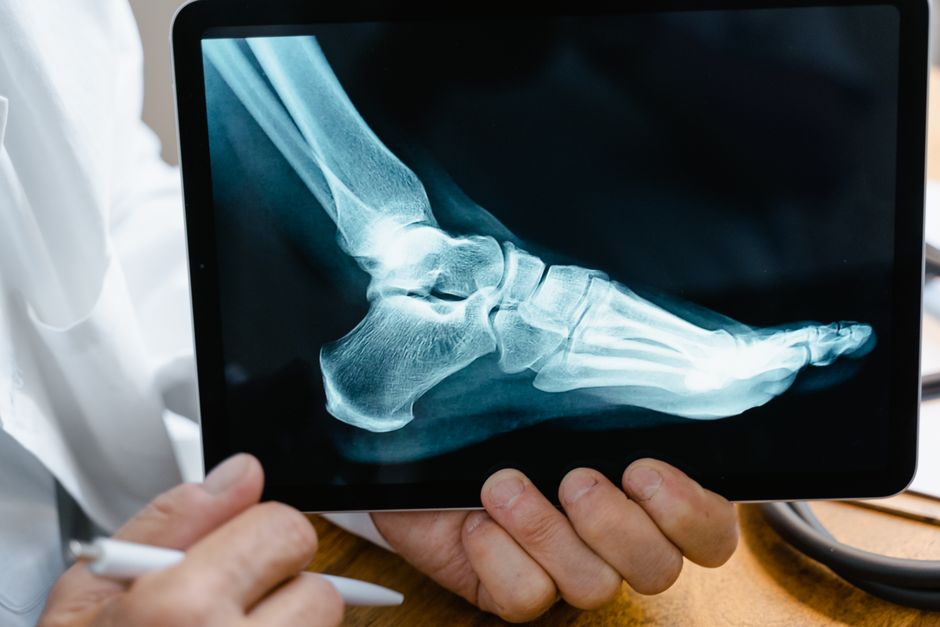
The bone of the heel is called the calcaneus. It is the largest bone in the human foot and forms the foundation of the heel. You can feel it as the hard, rounded surface at the back and bottom of your foot. The calcaneus is also known as the heel bone, and it plays a central role in how you stand, walk, and run.
What Is The Bone Of The Heel Called and Where Is It Located?
The calcaneus sits at the back of the foot, directly beneath the ankle joint. It is one of seven tarsal bones — the group of bones that make up the rear and middle of the foot.
The calcaneus connects to two other bones. On top, it meets the talus, which is the bone that forms the lower part of the ankle joint. In front, it connects to the cuboid bone. These connections form joints that allow the foot to flex and adapt to uneven ground.
At the back of the calcaneus is a rounded bump you can feel with your fingers. This is where the Achilles tendon attaches. The Achilles tendon is the thick band that connects your calf muscles to your heel. When those muscles contract, they pull on the calcaneus and push your foot off the ground. Without a solid calcaneus, walking would be impossible.
The bone is not a simple block. It has a somewhat rectangular shape with a smooth upper surface that meets the talus and a rougher lower surface where ligaments and the plantar fascia attach. The plantar fascia is a thick band of tissue that runs along the bottom of your foot from the heel to the toes. It helps support the arch.
What Does the Calcaneus Do?
The calcaneus has three main jobs: bearing weight, transferring force, and anchoring soft tissues.
Weight bearing. When you stand, roughly half your body weight passes through each heel. The calcaneus is built to handle that load. It has a hard outer layer of cortical bone and a spongy inner layer of trabecular bone. The trabecular bone is arranged in a pattern that distributes force efficiently. This structure lets the heel absorb the impact of each step.
Force transfer. During walking or running, the calf muscles pull on the Achilles tendon. That pull travels through the calcaneus and into the ground, creating the push-off that moves you forward. The calcaneus acts as a lever arm. A longer lever arm gives you more mechanical advantage. This is one reason the human heel is relatively large compared with other primates.
Soft tissue anchor. Several important structures attach to the calcaneus. The Achilles tendon is the largest. The plantar fascia attaches to the bottom. Various ligaments connect it to the talus and other bones. These attachments keep the foot stable and help maintain the arch.
What Conditions Affect the Heel Bone?
The calcaneus can be involved in several conditions. Some are common and treatable. Others are more serious.
Heel spurs. A heel spur is a bony growth on the bottom of the calcaneus. It shows up on X-rays as a small hook of bone. Many people have heel spurs without any pain. When heel pain does occur, it is often caused by plantar fasciitis rather than the spur itself. The relationship between spurs and pain is not straightforward. Some studies suggest spurs are a result of long-term strain on the plantar fascia, not the cause of pain.
Plantar fasciitis. This is inflammation or degeneration of the plantar fascia at its attachment to the calcaneus. It is one of the most common causes of heel pain. The pain is usually worst with the first steps in the morning or after sitting for a while. It tends to improve with movement, though it can return after activity.
Calcaneal fractures. A break in the heel bone usually happens from a fall from a height or a hard landing. These fractures can be severe. They often affect the joint between the calcaneus and the talus, which can lead to long-term stiffness and arthritis. Treatment may involve surgery or immobilization, depending on the type of break. Recovery can take months.
Stress fractures. Repeated impact from running or jumping can cause small cracks in the calcaneus. These are more common in athletes, military recruits, and people who suddenly increase their activity level. Pain usually builds gradually and gets worse with activity.
Bone infections and tumors. These are rare in the calcaneus. When they occur, they can be serious. Persistent heel pain that does not improve with rest or standard treatment should be evaluated by a doctor.
Sever’s disease. This is not a disease in the usual sense. It is inflammation of the growth plate in the calcaneus. It affects children and adolescents, usually between ages 8 and 14, when the heel bone is still growing. Pain occurs during or after sports. The condition resolves when the growth plate closes, but it can be painful in the meantime. No clinical guidelines exist for a single best treatment, though rest, ice, and activity modification are commonly recommended by clinicians.





How Do Doctors Diagnose Heel Bone Problems?
Diagnosis starts with a medical history and physical exam. A doctor will ask when the pain started, what makes it worse, and whether there was an injury. They will press on the heel and check how you walk.
Imaging helps confirm the cause. X-rays can show fractures, spurs, and changes in bone shape. An X-ray is often the first test ordered. If a stress fracture is suspected but not visible on X-ray, an MRI or bone scan may be used. MRI can also show soft tissue damage, such as plantar fascia thickening or tendon tears.
Ultrasound is sometimes used to look at the plantar fascia and Achilles tendon. It is quick and does not use radiation, but it depends on the skill of the person doing the exam.
Blood tests may be ordered if an infection or inflammatory condition is suspected. These are not routine for common heel pain.
What Does Heel Pain Usually Mean?
Most heel pain is not caused by a problem inside the bone itself. The calcaneus is often the attachment point for tissues that become irritated.
Plantar fasciitis is the most common cause of heel pain in adults. It accounts for a large share of cases seen in primary care and sports medicine clinics. The pain is typically under the heel or slightly forward of it. It is often sharp with the first steps after sleep.
Achilles tendinopathy is another common cause. Pain is usually at the back of the heel, where the tendon attaches to the calcaneus. It is more common in people who run, play sports with sudden stops and starts, or have tight calf muscles.
Retrocalcaneal bursitis is inflammation of a small fluid-filled sac between the Achilles tendon and the calcaneus. It causes pain and swelling at the back of the heel. It can be confused with Achilles tendinopathy, but the location is slightly different.
Less common causes include nerve compression, such as tarsal tunnel syndrome, and systemic conditions like gout or rheumatoid arthritis. These require different treatment.
How Are Heel Bone Problems Treated?
Treatment depends on the specific diagnosis. For most soft tissue causes of heel pain, conservative care is tried first.
Common approaches include:
- Rest and activity modification
- Ice applied to the painful area
- Stretching the calf muscles and plantar fascia
- Foot orthotics or heel cups
- Nonsteroidal anti-inflammatory drugs (NSAIDs) for short-term pain relief
- Physical therapy
These measures help many people, but they do not work for everyone. Evidence for some of these treatments is mixed. For example, stretching has been studied for plantar fasciitis with varying results. Some studies show benefit, others do not.
More advanced options include corticosteroid injections, extracorporeal shock wave therapy, and surgery. These are usually reserved for cases that do not improve after several months of conservative care. Corticosteroid injections can reduce pain in the short term, but they carry a risk of plantar fascia rupture and fat pad atrophy. They are not a permanent fix.
Surgery for plantar fasciitis involves partially releasing the plantar fascia. It is generally considered a last resort. Recovery can be slow, and complications are possible.
For calcaneal fractures, treatment may involve surgery to restore the shape of the bone and the joint surface. Not all fractures need surgery. The decision depends on the fracture pattern, the condition of the soft tissues, and the patient’s overall health.
Can You Prevent Heel Bone Problems?
Not all heel problems can be prevented. Some are caused by accidents or structural factors you cannot change. But some steps may lower your risk.
Maintaining a healthy body weight reduces stress on the heel. Each extra pound of body weight adds force through the foot with every step. Gradual increases in activity give the bone and soft tissues time to adapt. Sudden spikes in training volume are a common trigger for stress fractures and plantar fasciitis.
Wearing supportive shoes helps. Shoes that are worn out or lack arch support may increase strain on the plantar fascia. For people with flat feet or high arches, custom orthotics may help, though evidence for their effectiveness varies.
Stretching the calf muscles and plantar fascia may reduce tightness. Some clinicians recommend it, but the evidence is not strong enough to say it prevents heel pain in everyone.
If you have diabetes or peripheral neuropathy, check your feet regularly. Reduced sensation can mask injuries, and small problems can become serious.
When Should You See a Doctor for Heel Pain?
See a doctor if heel pain is severe, lasts more than a few weeks, or interferes with daily activities. Also seek care if you have numbness, tingling, or signs of infection such as redness, warmth, or fever.
If you cannot bear weight on the foot after an injury, get medical attention. A fracture or a tendon rupture needs prompt evaluation. Delaying treatment can lead to worse outcomes.
Heel pain that wakes you from sleep or is present at rest is also a reason to see a doctor. Most common causes of heel pain are worse with activity, not at rest.
Frequently Asked Questions
What is the heel bone called?
The heel bone is called the calcaneus. It is the largest bone in the foot and forms the foundation of the heel.
Is the calcaneus the same as the heel bone?
Yes, calcaneus and heel bone refer to the same structure. Calcaneus is the anatomical term, while heel bone is the common name.
What attaches to the calcaneus?
The Achilles tendon attaches to the back of the calcaneus, and the plantar fascia attaches to the bottom. Several ligaments also connect it to other foot bones.
Can you walk without a calcaneus?
No, the calcaneus is essential for weight bearing and push-off during walking. Without it, normal walking would not be possible.
