
An average adult carries about 5 liters of blood — roughly 1.2 to 1.5 gallons. More precisely, blood volume is about 7% of body weight in a typical adult. A 70-kilogram (154-pound) person holds roughly 4.9 liters, and a 60-kilogram (132-pound) person holds about 4.2 liters.
That is the short answer. The fuller picture involves how the body maintains that volume, how it changes with body size and other factors, and what happens when it drops. Blood volume matters because it affects blood pressure, oxygen delivery, and how the body responds to injury or illness.
What Is The Blood Volume Of An Average Adult?
Roughly 5 liters is the standard figure for a healthy adult. But “average” hides real variation. A person’s blood volume tracks closely with body size, not with age or gender in the simple way many people assume.
The relationship is straightforward: blood volume is proportional to body weight. A larger body needs more blood to fill its larger network of vessels and supply its greater mass of tissue. A smaller body needs less. This is why two healthy adults of the same height can have different blood volumes if their weights differ.
About 7% of body weight is the working estimate. For a 70-kilogram adult, that comes to about 4.9 liters. For a 55-kilogram adult, it comes to about 3.85 liters. These are approximations, not exact measurements, because the true figure depends on body composition — fat tissue holds less blood per gram than lean tissue does.
How Many Liters Of Blood Are In The Human Body?
Most adults have between 4.5 and 5.5 liters. That range covers the great majority of healthy people at ordinary body weights.
Children have less, in proportion to their smaller size. A newborn has roughly 80 to 90 milliliters per kilogram of body weight, which for a 3.5-kilogram infant works out to about 280 to 315 milliliters — a little over a cup. That small volume is why even minor blood loss in an infant is treated seriously.
Blood volume increases through childhood and adolescence as the body grows. By adulthood it stabilizes, then stays fairly constant unless body weight changes substantially or a medical condition alters it.
What Makes Up Blood Volume?
Blood is not a single substance. It is a mix of cells and liquid, and the proportions matter for health.
Plasma is the liquid portion, making up about 55% of blood volume. It is mostly water, carrying dissolved proteins, electrolytes, hormones, nutrients, and waste products. The cells make up the remaining 45%.
- Red blood cells carry oxygen using hemoglobin. They are the most numerous cells in blood.
- White blood cells defend against infection. They are far fewer in number but essential.
- Platelets are cell fragments that help blood clot after injury.
When people talk about “blood volume,” they usually mean the total volume of this mixture. But clinicians often care about a related measure called hematocrit — the percentage of blood that is red cells. A normal hematocrit is about 45% for men and about 40% for women, though reference ranges vary slightly between labs.





How Does The Body Regulate Blood Volume?
The body holds blood volume within a narrow range. It does this through a set of feedback systems that sense pressure and adjust fluid balance.
The kidneys play a central role. When blood volume or pressure falls, the kidneys release an enzyme called renin, which sets off a hormone cascade. This cascade leads to the release of aldosterone, a hormone that tells the kidneys to hold onto sodium and water. Retaining sodium pulls water with it, which raises blood volume back toward normal.
A separate hormone, antidiuretic hormone, controls how much water the kidneys reabsorb. When the body senses low volume, it releases more of this hormone, reducing water lost in urine.
There is a useful clarification here that gets lost in casual discussion: blood volume and blood pressure are related but not the same thing. You can lose blood volume and still maintain blood pressure for a while, because the body compensates by narrowing blood vessels and increasing heart rate. That is why a person can be bleeding internally and still appear stable at first. The compensation eventually fails.
What Causes Blood Volume To Change?
Blood volume shifts with several conditions and circumstances. Some changes are normal and temporary. Others signal a medical problem.
Dehydration reduces blood volume because plasma is mostly water. Losing fluid through sweating, vomiting, diarrhea, or simply not drinking enough lowers the plasma portion. Mild dehydration may not change measured volume much, but significant fluid loss can drop it enough to affect blood pressure and heart rate.
Pregnancy increases blood volume substantially. By the later stages of pregnancy, a woman’s blood volume can rise by a large margin to support the growing fetus and prepare for blood loss during delivery. This is a normal physiological change, not a disorder.
Certain medical conditions raise or lower blood volume. Heart failure and kidney disease can cause fluid retention that increases volume. Anemia affects the cell portion rather than total volume in some cases. Significant blood loss from injury, surgery, or internal bleeding lowers volume directly.
Body weight changes also shift blood volume over time. Gaining or losing a substantial amount of weight changes the total, because volume tracks with body mass.
How Much Blood Can You Lose Safely?
This is where the numbers matter most, and where precision counts.
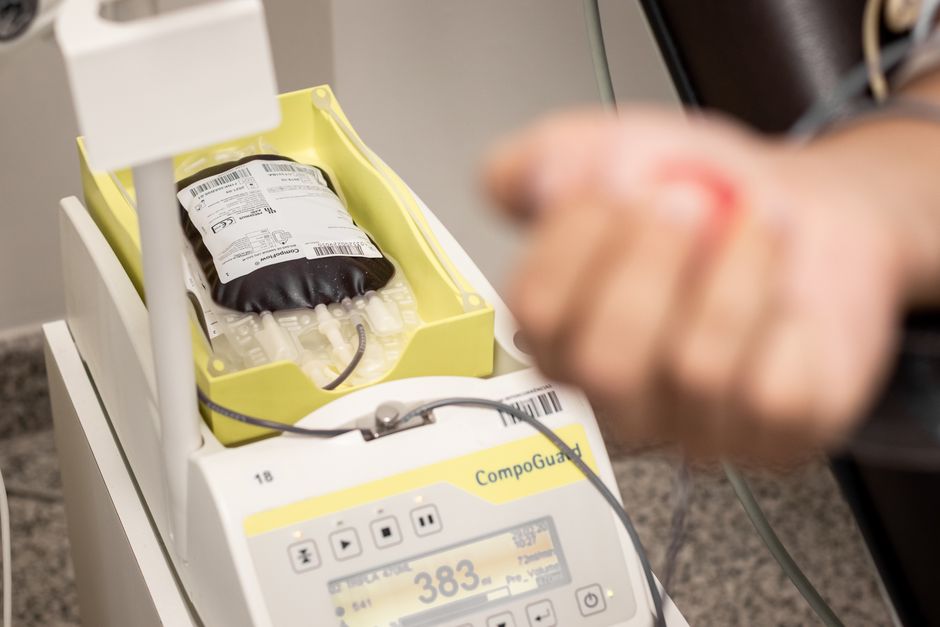
Blood donation offers a well-established reference point. A standard whole-blood donation in the United States removes about 450 to 500 milliliters — roughly one pint, or about 10% of an average adult’s total volume. Healthy donors replace the plasma within about 24 to 48 hours and the red cells over a period of weeks. This is why donation is generally safe for healthy people and why there are waiting periods between donations.
Losing a larger share is more serious. Clinical guidance generally treats blood loss in terms of percentage of total volume, because that is what determines the physiological effect.
- Loss of up to about 15% is usually well tolerated by a healthy adult, with the body compensating.
- Loss of roughly 15% to 30% can cause a rise in heart rate and a drop in blood pressure, and may produce symptoms like dizziness and weakness.
- Loss beyond about 30% to 40% is a medical emergency that can lead to shock and requires urgent treatment.
These categories are general clinical concepts, not precise thresholds that apply identically to everyone. A person’s baseline health, age, and how quickly the blood is lost all affect the response. Rapid loss is more dangerous than the same amount lost slowly, because the body has less time to compensate.
Any significant bleeding — from trauma, a severe injury, or internal sources — is a medical emergency. This article is informational and cannot substitute for emergency care.
How Is Blood Volume Measured?
Doctors rarely measure total blood volume directly in routine care. Instead, they estimate it from body weight or use indirect markers.
When a precise measurement is needed — such as in certain surgical or critical care settings — a technique called a dilution method may be used. A known amount of a tracer substance is injected into the bloodstream, and its concentration is measured after it mixes. The degree of dilution reveals the total volume. These methods are specialized and not part of standard checkups.
More commonly, clinicians assess volume status through signs and symptoms: heart rate, blood pressure, urine output, and physical exam findings. Laboratory tests like hematocrit and hemoglobin give information about the cell portion of blood, which helps but does not directly measure total volume.
This is a point worth understanding. A normal hemoglobin level does not rule out significant blood loss, especially early on. It takes time for the body to redistribute fluid and for lab values to reflect a loss. Clinicians know this and rely on the whole picture, not a single number.
Why Does Blood Volume Matter?
Blood volume is what allows the circulatory system to deliver oxygen and nutrients to every tissue. Without enough volume, blood pressure falls and organs do not get the supply they need.
The body defends blood volume fiercely because it is tied to survival. When volume drops, the compensation systems described earlier kick in — narrowing vessels, raising heart rate, conserving water and sodium. These responses buy time. They do not fix the underlying problem.
Understanding blood volume also helps make sense of everyday medical practices. Why is a pint of blood a safe donation? Because it is a small fraction of the total. Why do doctors worry about dehydration in older adults? Because reduced volume can strain the heart and kidneys. Why does blood pressure matter so much? Because it reflects, in part, whether the system has enough fluid to work with.
The average adult figure — about 5 liters — is a useful anchor. The real value is that it connects body size, physiology, and the body’s constant work to stay in balance.
Frequently Asked Questions
How many liters of blood does an average adult have?
An average adult has about 5 liters of blood, or roughly 1.2 to 1.5 gallons. The exact amount depends mostly on body weight, since blood volume is about 7% of body weight.
Is 5 liters of blood a lot?
Five liters is about 7% of a 70-kilogram adult’s body weight, which is the normal proportion for a healthy person. It is enough to fill the entire circulatory system and supply oxygen to every organ.
How much blood can you lose before it is dangerous?
Losing more than about 30% to 40% of total blood volume is a medical emergency that can cause shock. Loss of roughly 15% to 30% can cause a faster heart rate, lower blood pressure, and symptoms like dizziness.
Does blood volume change with age?
Blood volume stays fairly stable through adulthood and tracks mainly with body weight rather than age. In older adults, reduced fluid intake or certain medical conditions can lower it, which is why dehydration is watched closely.
