
Your elbow hurts when you lift a coffee cup, grip a tool, or shake a hand. That specific pain — sore to the touch, worse with use, better with rest — is often tendonitis. Tendonitis in the elbow is inflammation or irritation of the tendons that attach forearm muscles to the bony points around the joint. It usually comes from repeated strain, not a single injury, and most cases improve with rest, activity changes, and physical therapy rather than surgery.
What Is Tendonitis In The Elbow?
Tendons are tough cords of connective tissue that attach muscle to bone. In the elbow, several tendons anchor the muscles of the forearm to the bony bumps (called epicondyles) on either side of the joint. When those tendons are overloaded, small tears and inflammation can develop. That is tendonitis.
The two most common types are named for where the pain sits:
- Lateral epicondylitis — pain on the outside of the elbow. Often called tennis elbow, though most people who get it do not play tennis.
- Medial epicondylitis — pain on the inside of the elbow. Sometimes called golfer’s elbow, again regardless of whether the person golfs.
One clarification worth knowing: the suffix “-itis” means inflammation. But research over the past two decades has shown that in long-standing cases, the problem is often not true inflammation at all. It is a breakdown and failed healing of the tendon tissue, a process called tendinopathy. This matters because it changes how the condition is treated. Anti-inflammatory approaches help early on but may not be the right answer for a tendon that has been painful for months.
What Causes Tendonitis In The Elbow?
Repetitive motion is the main driver. Any activity that asks the forearm muscles to contract over and over — especially with gripping, twisting, or lifting — places cumulative load on the tendons at the elbow.
Common triggers include:
- Typing or mouse use with the wrist bent for long stretches
- Manual trades: carpentry, plumbing, painting, assembly work
- Racquet sports and golf
- Weight training with heavy gripping movements
- Lifting, carrying, or repetitive household tasks
Age and conditioning play a role. Tendons lose some elasticity with age, and sudden increases in activity — a new workout, a weekend project, a return to a sport after years off — are frequent triggers. Smoking and certain medical conditions, including diabetes, are associated with slower tendon healing, though the exact mechanisms are still being studied.
It is worth separating cause from correlation here. Many people with elbow pain assume their job is the culprit, and often it is. But posture, grip technique, tool design, and overall strength frequently matter as much as the specific task.
What Are The Symptoms Of Elbow Tendonitis?
The hallmark is pain that is localized to one side of the elbow and gets worse with activity. It typically starts gradually.
Common signs:
- Aching pain on the outer or inner elbow
- Pain that spreads into the forearm
- Weak grip strength
- Tenderness when pressing on the bony bump
- Pain with specific movements — lifting a cup, turning a doorknob, shaking hands
- Stiffness in the morning that eases as you move
Lateral epicondylitis usually hurts more with wrist extension (bending the wrist backward). Medial epicondylitis hurts more with wrist flexion (bending the wrist forward). That directional difference is one of the simplest ways clinicians sort out which tendon is involved.
Not all elbow pain is tendonitis. Nerve compression, arthritis, and referred pain from the neck can produce similar symptoms. If pain comes with numbness, tingling, or weakness in the hand, that points toward a nerve issue and needs a different evaluation.





How Is Elbow Tendonitis Diagnosed?
Most cases are diagnosed by history and physical exam alone. A clinician will ask about your activities, press on the tender area, and test your grip and wrist strength against resistance. Reproducing the pain with a specific resisted motion is often enough to confirm the diagnosis.
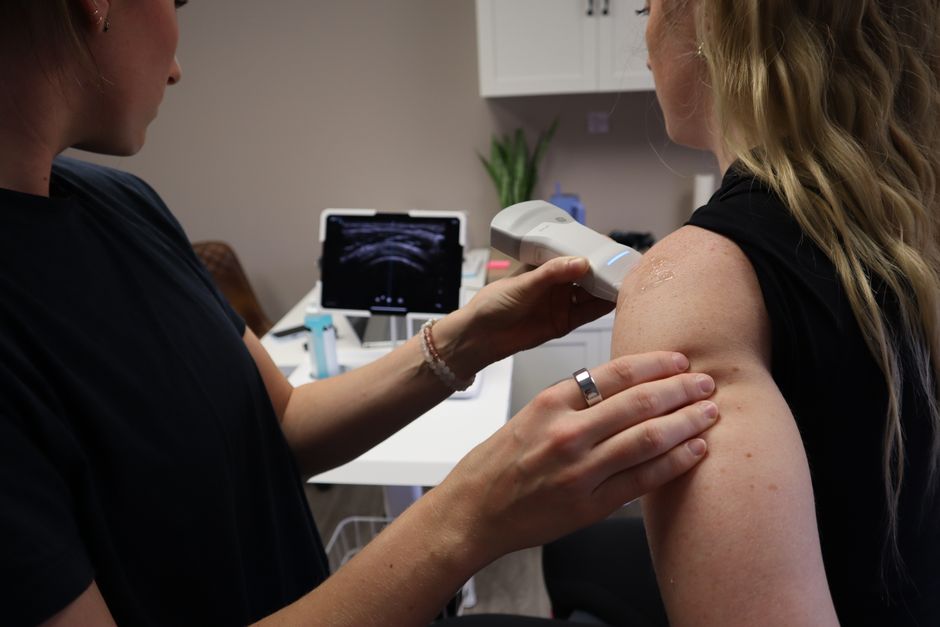
Imaging is not usually needed. X-rays do not show tendons, though they can rule out arthritis or a fracture. Ultrasound and MRI can show tendon changes, but they are typically reserved for cases that are not improving or when surgery is being considered.
One practical point: findings on imaging do not always match symptoms. Studies have found tendon abnormalities on ultrasound in people with no elbow pain at all. That means an image alone does not make the diagnosis — your symptoms and exam do.
How Is Elbow Tendonitis Treated?
Most people improve without surgery. The core of treatment is reducing the load on the tendon while gradually rebuilding its capacity to handle stress. Rest alone rarely fixes the problem; the tendon needs controlled loading to heal properly.
Approaches commonly used:
- Activity modification. Reduce or change the movements that provoke pain rather than stopping all activity.
- Physical therapy. Eccentric strengthening — controlled lengthening of the muscle under load — is one of the better-supported approaches for tendinopathy.
- Ice. May ease pain in the short term, though evidence that it speeds healing is limited.
- Bracing. A counterforce strap or wrist splint can reduce strain on the tendon. Some people find it helpful; the evidence is mixed.
- Pain relief. Over-the-counter medications such as ibuprofen or acetaminophen can reduce pain. For long-standing tendinopathy, regular anti-inflammatory use is debated because inflammation is not always the main problem.
- Corticosteroid injections. These can reduce pain in the short term, but research indicates they may not improve long-term outcomes and could carry a risk of recurrence. They are generally used selectively, not as a first-line fix.
When symptoms persist despite months of conservative care, other options exist. Platelet-rich plasma injections and shockwave therapy have been studied, but results across trials vary and no approach has emerged as clearly superior. Surgery — releasing or repairing the affected tendon — is reserved for a minority of cases and is considered only after other measures have failed.
How Long Does Elbow Tendonitis Take To Heal?
Healing timelines vary widely. Mild cases may settle in a few weeks with activity changes. More stubborn cases can take several months, and some people have lingering symptoms for a year or more.
Tendons heal slowly because they have limited blood supply compared to muscle. That is a big part of why patience matters. Pushing through pain often prolongs recovery rather than shortening it.
Recovery is not usually a straight line. Good days and bad days are normal. What tends to matter most is whether the overall trend is improving over weeks, not whether today feels better than yesterday.
Can Elbow Tendonitis Be Prevented?
You cannot always prevent it, but you can lower your risk. The general principle is to avoid sudden spikes in repetitive load and to keep the forearm muscles and tendons conditioned.
Reasonable steps:
- Increase activity gradually rather than in bursts
- Take breaks from repetitive tasks and vary your grip
- Use tools and equipment that fit your hand and reduce strain
- Keep forearms and grip strength conditioned
- Warm up before sports or heavy work
No prevention strategy is proven to eliminate risk entirely. These measures are based on the general understanding of how tendons respond to load, and they are widely recommended even where strong trial evidence is limited.
Frequently Asked Questions
Is elbow tendonitis the same as tennis elbow?
Tennis elbow is the common name for lateral epicondylitis, which is one specific type of elbow tendonitis on the outer elbow. Medial epicondylitis, or golfer’s elbow, affects the inner elbow instead.
Should I rest completely or keep moving my elbow?
Complete rest rarely helps and can weaken the tendon further. Reducing the movements that cause pain while doing controlled strengthening is generally more effective.
Do cortisone shots cure elbow tendonitis?
Corticosteroid injections can reduce pain in the short term, but research suggests they may not improve long-term healing and could increase the chance of symptoms returning. They are usually used selectively.
When should I see a doctor for elbow pain?
See a clinician if pain lasts more than a few weeks, keeps getting worse, or comes with numbness, tingling, or weakness in the hand. Those added symptoms may point to a nerve problem rather than a tendon one.
