
Every second, your bone marrow releases about two million new red blood cells into your bloodstream. Each one is built for a single job: carrying oxygen from your lungs to every cell in your body and carrying carbon dioxide back out. That job sounds simple, but almost everything your body does — from thinking to healing a cut — depends on it happening without interruption.
Red blood cells, also called erythrocytes, are the most common type of cell in your blood. A healthy adult has roughly 4 to 6 million of them in every microliter of blood. Unlike most cells in your body, they have no nucleus and no mitochondria. That unusual design is not a flaw. It is what makes them so good at their one task.
What Is Red Blood Cells Function?
Their main function is oxygen transport. Red blood cells pick up oxygen in the lungs and deliver it to tissues throughout the body. They also carry a portion of the carbon dioxide produced by those tissues back to the lungs so it can be exhaled.
That transport works because of hemoglobin, a protein packed into every red blood cell. Each hemoglobin molecule contains four iron atoms, and each of those iron atoms can bind one oxygen molecule. A single red blood cell holds roughly 270 million hemoglobin molecules. That adds up to about one billion oxygen molecules per cell.
Oxygen is not very soluble in blood on its own. Without red blood cells, the amount of oxygen your blood could carry would be far too low to support human life. Hemoglobin solves that problem by binding oxygen chemically rather than dissolving it.
Red blood cells do more than move oxygen. Hemoglobin also helps regulate blood pressure by binding and releasing nitric oxide, a molecule that affects how blood vessels relax and narrow. Red blood cells also contribute to the immune response by interacting with certain immune pathways and helping clear some pathogens from circulation.
How Do Red Blood Cells Carry Oxygen?
The process starts in your lungs. As blood flows through the tiny capillaries surrounding the air sacs, oxygen moves across the thin membrane into the red blood cells, where it attaches to the iron in hemoglobin. This is why blood leaving the lungs is bright red — oxygenated hemoglobin reflects light differently than hemoglobin without oxygen.
Once the blood reaches tissue, the environment changes. Tissues use oxygen and produce carbon dioxide, which makes the local environment more acidic and warmer. Those conditions make hemoglobin release its oxygen more readily. This is called the Bohr effect, and it is one reason working muscles receive more oxygen than resting ones.
After releasing oxygen, hemoglobin picks up carbon dioxide. Most carbon dioxide travels in the blood as bicarbonate, a dissolved form, but a portion rides directly on hemoglobin. When the blood returns to the lungs, carbon dioxide is released and exhaled.
Red blood cells also carry carbon monoxide, but they bind it far more tightly than oxygen. That is why carbon monoxide exposure is dangerous — it occupies the seats oxygen needs.
What Do Red Blood Cells Look Like and Why Does Shape Matter?
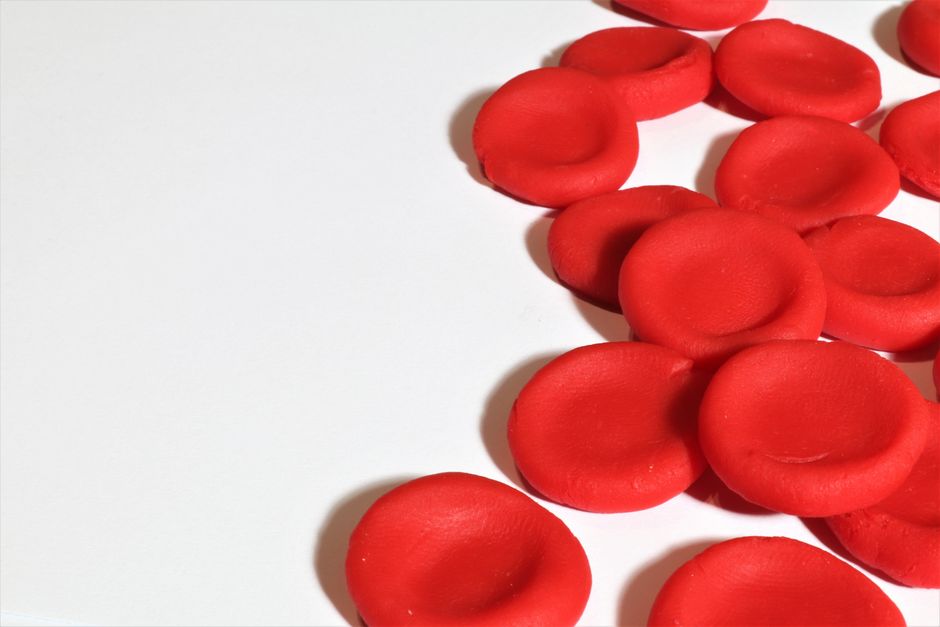
A red blood cell is shaped like a disc with a dent in the middle on both sides — a biconcave shape. This shape gives it more surface area for oxygen exchange than a flat disc or a sphere would.
The shape also makes red blood cells flexible. They can bend, fold, and squeeze through capillaries narrower than the cells themselves. A capillary in your brain or kidney can be just a few micrometers wide. A rigid cell would block it. A flexible one passes through.
This flexibility comes at a cost. Red blood cells have a limited lifespan because they lack the machinery to repair themselves. Without a nucleus, they cannot make new proteins. Without mitochondria, they cannot burn fuel the way other cells do. Instead, they rely on glucose processed without oxygen to keep their membranes working.
After about 120 days in circulation, red blood cells become worn and stiff. The spleen and liver filter them out, and the bone marrow replaces them. This recycling is constant — your body produces and destroys millions of red blood cells every second to keep the count steady.





What Is a Normal Red Blood Cell Count?
Normal ranges vary slightly by lab and by population. In general, a normal red blood cell count in adults is about 4.2 to 5.9 million cells per microliter for men and 3.8 to 5.2 million for women. These are reference ranges, not targets — a value slightly outside the range is not automatically a problem.
Hemoglobin is often the more useful number. A normal hemoglobin level is generally around 13.5 to 17.5 grams per deciliter for men and 12.0 to 15.5 grams per deciliter for women. These ranges can shift with altitude, pregnancy, and other factors.
| Measure | Typical adult range |
|---|---|
| Red blood cell count (men) | 4.2–5.9 million cells/µL |
| Red blood cell count (women) | 3.8–5.2 million cells/µL |
| Hemoglobin (men) | 13.5–17.5 g/dL |
| Hemoglobin (women) | 12.0–15.5 g/dL |
| Hematocrit (men) | 38.8–50.0% |
| Hematocrit (women) | 34.9–44.5% |
Hematocrit is the percentage of your blood volume made up of red blood cells. It is one of the three main numbers doctors look at when evaluating whether your blood is carrying enough oxygen.
These ranges are general guides. A lab report always includes the reference range that lab uses, because equipment and methods differ. Always read your numbers against the range printed on your own report.
What Happens When Red Blood Cells Do Not Work Right?
When red blood cells are too few, too small, or poorly shaped, the body cannot deliver oxygen efficiently. The result is anemia — a condition defined by low hemoglobin or low red blood cell count.
Anemia has many causes, and they are not interchangeable. Iron deficiency is one of the most common worldwide. It develops when the body does not have enough iron to build hemoglobin, often from blood loss, low dietary intake, or poor absorption. Vitamin B12 and folate deficiencies cause a different type of anemia because those vitamins are needed to build DNA in developing red blood cells.
Other causes include chronic kidney disease, where the kidneys produce less erythropoietin — the hormone that signals the bone marrow to make red blood cells. Some anemias are inherited, such as sickle cell disease and thalassemia, where the shape or structure of hemoglobin is altered.
Symptoms of anemia can include fatigue, pale skin, shortness of breath with activity, dizziness, cold hands and feet, and a fast heartbeat. These symptoms are not specific to anemia. Many other conditions cause them, which is why a blood test — not symptoms alone — is needed to identify the cause.
At the other end of the spectrum, too many red blood cells — a condition called polycythemia — makes blood thicker and can raise the risk of clots. It can occur on its own or as a response to chronic low oxygen, such as from sleep apnea or living at high altitude.
What Affects Red Blood Cell Production?
Your body matches red blood cell production to oxygen demand. When tissues sense low oxygen, the kidneys release erythropoietin, which tells the bone marrow to speed up production. This is why people who live at high altitude have more red blood cells — thinner air means less oxygen per breath, so the body compensates.
Several nutrients are required to build red blood cells:
- Iron — needed to make hemoglobin. Found in red meat, poultry, beans, lentils, and fortified cereals.
- Vitamin B12 — needed for red blood cell maturation. Found in animal products and fortified foods.
- Folate — also needed for maturation. Found in leafy greens, beans, and fortified grains.
- Vitamin B6 — involved in hemoglobin synthesis.
- Copper — helps the body use iron properly.
Other factors matter too. Chronic inflammation, certain medications, kidney disease, and some cancers can suppress red blood cell production. So can intense endurance training, which sometimes causes a condition called sports anemia through a mix of increased plasma volume and red blood cell breakdown.
Age also plays a role. Bone marrow becomes less responsive over time, and red blood cell counts may drift slightly lower in older adults. This is not inevitable, and a low count in an older adult should still be evaluated.
How Is Red Blood Cell Function Measured?
A complete blood count, or CBC, is the standard test. It measures red blood cell count, hemoglobin, hematocrit, and several related values. It also reports the mean corpuscular volume, or MCV — the average size of your red blood cells.
MCV helps doctors narrow down the cause of anemia. Small red blood cells often point toward iron deficiency or thalassemia. Large ones can suggest B12 or folate deficiency, certain medications, or alcohol use. Normal-sized anemia has its own list of causes, including chronic disease and sudden blood loss.
Other tests may be ordered depending on what the CBC shows. These can include iron studies, vitamin B12 and folate levels, reticulocyte count (which measures how many new red blood cells are being made), and in some cases a bone marrow biopsy.
One clarification worth knowing: a low hemoglobin level and a low red blood cell count are not the same thing, though they often occur together. You can have a normal number of red blood cells that are smaller or contain less hemoglobin than normal. That is why doctors look at several values together rather than one number in isolation.
Frequently Asked Questions
What is the main function of red blood cells?
The main function is to carry oxygen from the lungs to tissues throughout the body and to help carry carbon dioxide back to the lungs. They do this using hemoglobin, a protein that binds oxygen.
How long do red blood cells live?
Red blood cells live about 120 days in circulation before the spleen and liver remove them. The bone marrow continuously replaces them to keep your count stable.
What happens if red blood cells are low?
Low red blood cells or low hemoglobin causes anemia, which can lead to fatigue, shortness of breath, and pale skin. The cause needs to be identified by a blood test, because treatment depends on whether the problem is iron, vitamin B12, kidney function, blood loss, or something else.
Can you increase red blood cells naturally?
If the cause is a nutrient deficiency, correcting that deficiency through diet or supplements can help restore normal levels. If the cause is something else — such as kidney disease, chronic inflammation, or an inherited condition — nutrients alone will not fix it, and medical treatment is needed.
