
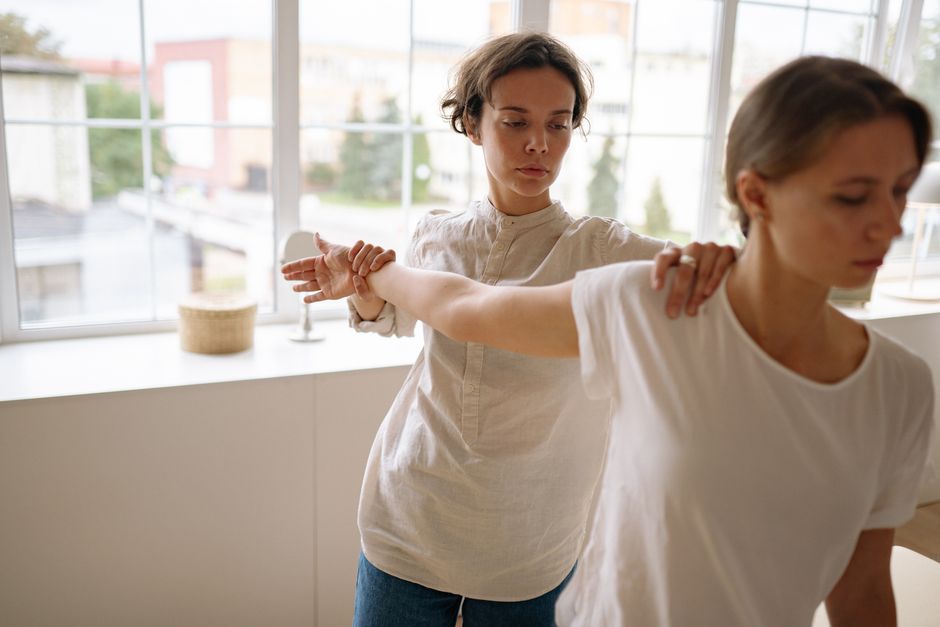
Passive range of motion is the movement of a joint by an outside force while the person’s own muscles stay relaxed. A therapist, a machine, or gravity does the work. It is different from active range of motion, where you move the joint yourself. Passive range of motion matters most when someone cannot move a joint on their own because of injury, surgery, paralysis, or pain.
The term comes up constantly in physical therapy, rehabilitation after surgery, and care for people with limited mobility. It also gets used loosely in fitness settings, sometimes in ways that stretch the meaning. Understanding what the term actually describes — and what it does not — helps you ask better questions about your own care.
What Is Passive Range Of Motion?
Passive range of motion is the full arc a joint can travel when something other than your own muscle contraction moves it. Range of motion itself is measured in degrees, and clinicians typically measure it with a device called a goniometer, which works much like a protractor for the body.
The key distinction is who supplies the force. In active range of motion, your muscles do the moving. In passive range of motion, an external force does. That force could be a physical therapist’s hands, a continuous passive motion machine, or gravity acting on a relaxed limb.
There is a third category worth knowing. Active-assisted range of motion sits between the two — you move the joint partly on your own and something helps complete the movement. Clinicians use all three for different purposes.
One clarification that surprises people: passive range of motion is usually slightly larger than active range of motion in the same joint. That is normal. Your muscles and tendons can limit how far you move a joint under your own power, and when they are relaxed, the joint can often travel a little further.
How Is Passive Range Of Motion Different From Active Range Of Motion?
Active range of motion tells a clinician what you can do by yourself. Passive range of motion tells them what the joint itself is capable of when your muscles are out of the picture.
That difference is diagnostically useful. If passive range is much larger than active range, it suggests the joint structure is relatively free but something is limiting your own movement — pain, weakness, or a muscle or tendon problem. If both active and passive range are limited by roughly the same amount, that points more toward a problem inside the joint itself, such as stiffness or arthritis.
Clinicians use this comparison as part of an assessment. It is one piece of a larger picture, not a diagnosis on its own.
| Feature | Active Range of Motion | Passive Range of Motion |
|---|---|---|
| Who moves the joint | You, using your own muscles | An outside force (therapist, machine, gravity) |
| Muscle contraction | Required | None in the moving limb |
| Typical size of arc | Usually slightly smaller | Usually slightly larger |
| Main purpose | Assess function and strength | Assess joint capability; maintain movement |
| Common settings | Fitness, rehab, daily function | Post-surgical care, paralysis, severe pain |
When Is Passive Range Of Motion Used?
Passive range of motion is used when a person cannot or should not move a joint themselves. The reasons fall into a few broad groups.
- After surgery. Some orthopedic procedures require a period where the joint is moved but not by the patient’s own muscles, to protect healing tissue.
- Paralysis or nerve injury. When muscles cannot contract, joints still need to be moved to prevent stiffness and shortening of surrounding tissue.
- Severe pain. Moving a joint actively may be too painful, but gentle passive movement can help maintain mobility.
- Prolonged bed rest or coma. Care teams move joints to limit the consequences of immobility.
- Joint stiffness from conditions like arthritis. Some clinicians use gentle passive movement as part of a broader management plan.
The underlying logic is straightforward. Joints and the tissues around them adapt to how they are used. When a joint does not move through its range, connective tissue can shorten and the joint can stiffen. Passive movement is one way to counter that when active movement is not possible.
What Are the Benefits and Limits of Passive Range of Motion?
Passive range of motion helps maintain joint mobility and can reduce stiffness when a person cannot move a joint on their own. That much is well established in rehabilitation practice. What it does not do is build strength or muscle mass — those require active muscle contraction.
This is where the term sometimes gets misused. Passive stretching in a fitness class, where a partner pushes your limb further, is a form of passive movement, but it is not the same clinical tool used in rehabilitation. The goals and the context differ.
Evidence on outcomes is more limited than marketing sometimes suggests. Some studies indicate passive range of motion can help preserve joint mobility during immobilization, and continuous passive motion machines have been studied extensively after certain knee surgeries. But research on whether these machines improve long-term outcomes compared with standard rehabilitation has produced mixed results. Some clinicians use them; the evidence does not uniformly show a clear advantage over other approaches.
The honest position: passive range of motion is a legitimate and widely used clinical technique for maintaining movement. Claims that it speeds healing, prevents all complications, or replaces active rehabilitation go beyond what the evidence supports.
Who Performs Passive Range Of Motion — and Is It Safe?
Passive range of motion is typically performed by a physical therapist, an occupational therapist, a trained caregiver, or a mechanical device under clinical supervision. It is not something to perform forcefully on yourself or someone else without guidance.
Safety depends heavily on the situation. In the wrong context — for example, moving a joint too far or too soon after surgery, or moving a joint with an unstable fracture — passive movement can cause harm. That is why it is usually prescribed and progressed by a clinician who knows the specific injury and healing timeline.
For people with osteoporosis, joint replacements, or recent fractures, the amount and direction of passive movement matters. A trained professional accounts for these factors. A well-meaning family member usually does not.
If you are recovering from surgery or injury and someone suggests passive movement, the safe approach is to confirm the specific instructions with the surgeon or treating clinician. General timelines for when passive movement is appropriate vary by procedure and are not something to guess at.
How Is Passive Range Of Motion Measured?
Clinicians measure passive range of motion in degrees using a goniometer. The device has a stationary arm and a moving arm, and the clinician aligns them with specific body landmarks to read the angle at the joint.
Normal values differ by joint. For example, a healthy knee typically extends to roughly 0 degrees (straight) and flexes to about 135 degrees, though these figures vary between individuals and reference sources. A shoulder has a much wider range across multiple planes of movement.
Measurement matters because it lets clinicians track progress objectively. A therapist can compare passive range before and after treatment, or compare it with the opposite limb. Consistency in how the measurement is taken affects its reliability, which is one reason trained clinicians do it rather than estimating by eye.
Passive range is usually recorded alongside active range and other measures. A single number rarely tells the whole story.
What Should You Expect If Passive Range Of Motion Is Part of Your Care?
If a clinician includes passive range of motion in your rehabilitation, expect them to move the joint slowly and within limits set for your condition. You should not feel sharp pain. Some stretching sensation or mild discomfort may occur, but significant pain is a signal to stop and report it.
You may also be taught how to do some passive or active-assisted movements at home, depending on your situation. Follow the specific instructions you are given rather than general advice from the internet, because the right amount of movement depends on your injury, surgery, and stage of healing.
Ask your clinician what the goal is. Are they maintaining mobility while tissue heals? Preventing stiffness during a period of immobilization? Assessing how much the joint can move? Knowing the purpose helps you participate sensibly and flag problems early.
Passive range of motion is a practical, well-established concept in rehabilitation. It is not a cure, and it is not a substitute for the active work that builds strength over time. Used correctly and under proper guidance, it serves a clear and useful role in recovery and care.
Frequently Asked Questions
What is passive range of motion in simple terms?
It is the movement of a joint by an outside force while your own muscles stay relaxed. A therapist, machine, or gravity does the moving instead of you.
Is passive range of motion the same as stretching?
Not exactly. Passive stretching is one form of passive movement, but clinical passive range of motion is a specific rehabilitation technique with defined goals and safety limits.
Does passive range of motion build strength?
No. Building strength requires active muscle contraction, which passive movement does not involve. Passive range of motion helps maintain joint mobility and reduce stiffness instead.
Can I do passive range of motion on myself?
You can perform some passive or active-assisted movements on yourself if a clinician has taught you how. Doing it forcefully or without guidance after surgery or injury can cause harm, so follow professional instructions.
