
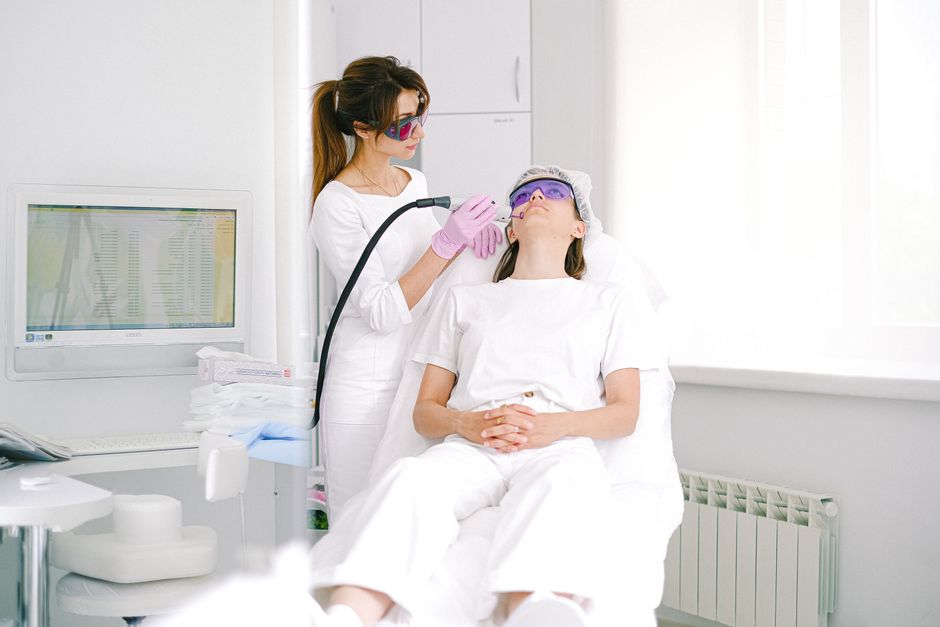
Laser skin treatment uses focused beams of light to change specific layers of the skin without cutting it open. Different wavelengths target different things — pigment, blood vessels, water in tissue, or the skin’s surface — and that is why one laser cannot do everything. The device delivers controlled energy, the skin responds by remodeling or shedding tissue, and the result depends entirely on which laser was used and how deep it reached.
What Is Laser Treatment For Skin How It Works?
Laser stands for light amplification by stimulated emission of radiation. A laser produces light that is a single color, travels in a tight beam, and stays coherent. Ordinary light scatters in every direction and carries many wavelengths at once. Laser light does not.
That precision is the whole point. Skin contains molecules called chromophores that absorb specific wavelengths of light. Hemoglobin in blood absorbs certain wavelengths. Melanin in pigment absorbs others. Water absorbs others still. By choosing a wavelength, a clinician can aim energy at one target and largely spare the surrounding tissue. This principle is called selective photothermolysis, and it is the foundation of nearly every skin laser in use today.
The second variable is pulse duration. The target needs to absorb energy faster than it can cool down. Short pulses heat a small target intensely. Longer pulses spread heat more gently across a wider area. Matching pulse length to the size of the target is what separates a clean result from a burn or a scar.
Depth is the third variable. Wavelength determines how far light penetrates. Some lasers act only on the surface. Others reach the dermis, the deeper layer where collagen and elastin live. A surface laser removes the top layer of skin. A deeper laser leaves the surface intact and heats tissue below it.
What Are the Main Types of Skin Lasers?
Skin lasers fall into two broad groups: ablative and non-ablative. Ablative lasers remove tissue. Non-ablative lasers heat tissue without removing the surface.
Ablative lasers include carbon dioxide (CO2) lasers and erbium-doped yttrium aluminum garnet (Er:YAG) lasers. Both vaporize the outer layer of skin and heat the dermis beneath it. The body then rebuilds the area with new collagen. These are used for deeper wrinkles, scars, and significant sun damage. Recovery is real — treated skin is raw and needs careful wound care for a period of days to weeks, depending on depth.
Non-ablative lasers include fractional lasers, pulsed dye lasers, and alexandrite or Nd:YAG lasers. Fractional lasers treat the skin in a pattern of tiny columns, leaving untreated skin between them. That untreated skin speeds healing. Pulsed dye lasers target hemoglobin and are used for redness, rosacea-related vessels, and certain vascular birthmarks. Alexandrite and Nd:YAG lasers target melanin and are used for pigmentation and hair reduction.
Intense pulsed light (IPL) is often grouped with lasers in marketing but is not a laser. It emits a broad band of wavelengths rather than a single one. That makes it less precise but sometimes more forgiving. Whether IPL counts as a laser matters less than what the device is being used to treat.
What Skin Concerns Do Lasers Actually Treat?
Lasers have well-documented use for several skin concerns. The strength of the evidence varies by condition.
- Sun damage and uneven pigmentation. Pigment-targeting lasers and fractional resurfacing are used for age spots and photoaging. Results are generally good but pigment can return with sun exposure.
- Fine lines and wrinkles. Ablative and non-ablative resurfacing both stimulate collagen remodeling. Ablative tends to produce larger changes with longer recovery.
- Acne scarring. Fractional lasers are among the more studied options for certain scar types. Not all scars respond equally, and deep ice-pick scars may need other approaches.
- Vascular lesions. Pulsed dye lasers are a standard option for port-wine stains and visible facial vessels.
- Unwanted hair. Laser hair reduction works best on dark hair against lighter skin, because the laser targets pigment in the follicle.
- Textural concerns and some benign growths. Selected lesions can be treated, but diagnosis must come first.
What lasers do not reliably do is a longer list than most clinics advertise. They are not a substitute for treating active acne, and they do not remove the cause of melasma — a condition where pigment frequently returns after treatment and can sometimes worsen with heat. They do not replace sunscreen. They do not reverse skin laxity the way surgery does.
What Happens During and After a Laser Session?
A session usually starts with a consultation and often a test spot. The clinician cleans the skin, protects the eyes, and may apply a topical numbing cream. Some lasers need it. Some do not.
During treatment you may feel heat, a snapping sensation, or a brief sting. Sessions range from minutes to over an hour depending on the area and device. Most people tolerate it without sedation.
Afterward, the skin is typically red and warm. Ablative treatments leave raw, weeping skin that needs ointment and gentle cleansing. Non-ablative treatments usually cause redness and mild swelling that settles over days. Pigment can darken before it flakes away. Some treatments cause small scabs or a breakout-like reaction.
Healing time is not a single number. It depends on the device, the depth, the area treated, and the person. A clinician should give you a realistic range before you consent, and that range should be specific to your treatment — not a general claim that lasers are “lunchtime” procedures.
What Are the Risks and Who Should Avoid Laser Treatment?
Laser treatment is not risk-free. The most common problems are temporary redness, swelling, and changes in pigmentation. Post-inflammatory hyperpigmentation — darkening of treated skin — is a well-recognized risk, particularly in people with darker skin tones. Hypopigmentation, where skin lightens, can also occur and is often harder to reverse.
Other risks include burns, blistering, scarring, infection, and reactivation of cold sores in people with a history of them. Eye injury is a real hazard if protective eyewear is not used, which is why it is standard practice.
Some people should be cautious or avoid certain lasers:
- People with active skin infections or open wounds in the treatment area
- People taking medications that cause photosensitivity, such as isotretinoin or certain antibiotics — timing matters and should be discussed with the prescribing clinician
- People with a history of keloid scarring
- People who are pregnant — not because lasers are proven harmful in pregnancy, but because evidence is limited and elective procedures are generally deferred
- People with darker skin tones considering pigment-targeting devices — this needs a clinician experienced with those skin types, not a generalist
One clarification worth making: darker skin does not automatically rule out laser treatment. It changes which devices are appropriate and who should perform them. The risk of pigment complications is higher, and the margin for error is smaller. That is a reason for careful selection, not automatic exclusion.
How Do You Judge Whether Laser Treatment Is Worth It?
The honest answer is that it depends on what you want changed and how much recovery you can accept. A non-ablative session with minimal downtime will produce smaller changes than an ablative resurfacing with weeks of healing. Neither is “better.” They trade off differently.
Be skeptical of any clinic that promises a specific outcome without examining your skin, discussing your history, and being clear about risks. Be equally skeptical of claims that a device is painless, risk-free, or works for every skin type. No laser meets all three.
Ask what device will be used, who will operate it, what training they have, what the realistic recovery looks like, and what happens if pigment changes occur. A clinician who answers those questions plainly is a better signal than any before-and-after photo.
Cost and number of sessions are legitimate questions too. Many laser treatments require multiple sessions spaced weeks apart, and results build gradually as collagen remodels. That process takes months, not days. Anyone promising instant, permanent results is overselling.
Frequently Asked Questions
Is laser skin treatment safe?
Laser skin treatment is generally safe when performed by a trained clinician with appropriate equipment and eye protection. Risks like pigment changes, burns, and scarring exist and are higher in certain skin types and with deeper treatments.
How long does laser skin treatment take to heal?
Healing ranges from a few days for gentle non-ablative treatments to several weeks for deep ablative resurfacing. Your clinician should give you a specific estimate based on the device and depth used.
Can laser treatment remove dark spots permanently?
Laser treatment can significantly lighten many forms of sun-related pigmentation. Results are not always permanent, and spots can return with sun exposure, so daily sunscreen remains essential.
Is laser treatment safe for darker skin tones?
Many lasers can be used safely on darker skin when the device and settings are chosen carefully by an experienced clinician. The risk of pigment complications is higher, so provider experience matters more, not less.
