
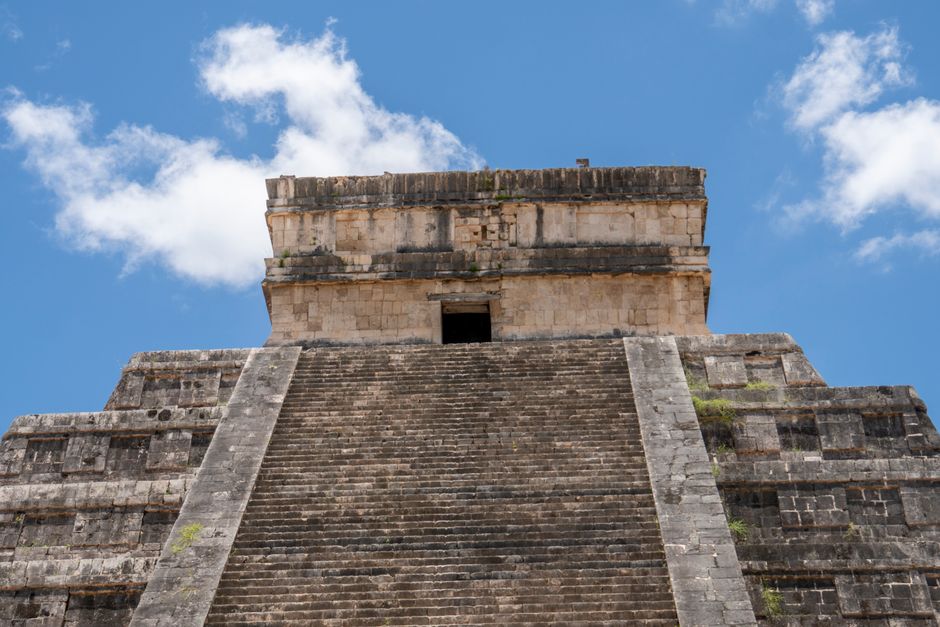
Kukulkan is the feathered serpent deity of the ancient Maya, a god associated with wind, rain, the planet Venus, and the founding of cities. His name comes from the Yucatec Maya words kukul, meaning feathered or quetzal, and kan, meaning serpent. He was worshiped across the northern Yucatán Peninsula, especially at Chichén Itzá, where a massive pyramid built in his honor still stands.
What Is Kukulkan the Mayan Feathered Serpent?
Kukulkan is a Maya deity depicted as a snake covered in quetzal feathers. He is not a monster to be feared in the way a dragon is feared. He is a creator god, a bringer of order, and a cultural hero who taught the Maya science, agriculture, and the calendar.
The feathered serpent appears in Mesoamerican religion for well over a thousand years. The Maya were not the only civilization to worship him. The Aztecs called him Quetzalcoatl, and earlier cultures such as the Olmec and the people of Teotihuacan left images of feathered serpents that predate the Maya version.
The combination of feathers and serpent is symbolic. A snake moves along the ground, close to the earth. Feathers belong to birds, which fly in the sky. Together they represent a being that bridges the earthly and the divine — the ground and the heavens joined in one figure.
Why Was Kukulkan So Important to the Maya?
Kukulkan was tied to things the Maya depended on for survival. Rain, wind, and the movement of Venus across the night sky all fell under his domain. In a region where rainfall determined whether crops lived or died, a god connected to water and weather held enormous importance.
The Maya tracked Venus carefully. Its cycles were predictable and were used to plan ceremonies, warfare, and planting. Kukulkan’s link to Venus made him a celestial timekeeper as much as a god.
He was also a political figure. Maya rulers claimed a connection to Kukulkan to legitimize their power. To rule under his name was to rule with divine backing. This is a common pattern in ancient civilizations, but among the Maya the link between the serpent god and political authority was especially strong in the postclassic period.
One detail that gets lost in popular retellings: Kukulkan was not a single fixed character. Different Maya cities and different eras emphasized different qualities. He could be a creator, a warrior, a wind god, or a culture hero depending on where and when you look.
What Is the Pyramid of Kukulkan at Chichén Itzá?
The most famous monument to Kukulkan is the pyramid at Chichén Itzá, known as El Castillo. It is a step pyramid with four sides, each with a staircase leading to a temple at the top. The structure is a physical calendar built in stone.
Each of the four staircases has 91 steps. Four staircases give 364 steps, and the single top platform makes 365 — the number of days in the Maya solar year. The pyramid is a monument to time itself as much as to the god.
The most striking feature happens twice a year, at the spring and autumn equinoxes. As the sun sets, the western edge of the pyramid casts a series of triangular shadows down the northern staircase. The pattern looks like a serpent slithering down the steps to meet a carved stone serpent head at the base.
This light-and-shadow effect is real and well documented. What is debated is whether the Maya deliberately engineered it or whether it is a fortunate result of the building’s geometry. Many archaeologists believe the effect was intentional, but no written Maya record confirms the purpose of the design. It is worth being honest about that gap between what we can see and what we can prove.
Is Kukulkan the Same as Quetzalcoatl?
Kukulkan and Quetzalcoatl are closely related but not identical. Both are feathered serpent gods. Both are linked to wind, learning, and civilization. But they belong to different cultures and different languages, and each carries its own local stories.
The confusion comes from a shared root. The feathered serpent was a widespread religious idea across Mesoamerica, not the property of one group. The Maya, the Aztecs, and earlier civilizations all inherited and reshaped the concept in their own way.
Treating them as the same figure erases real differences. Quetzalcoatl in Aztec tradition has a detailed mythology about his departure and possible return. Kukulkan in Maya tradition is often more closely tied to specific cities and ruling dynasties. The names are related, but the gods are not interchangeable.
Did Kukulkan Predict the End of the World?
No. The idea that the Maya predicted the world would end in 2012 was a modern invention, not a Maya belief. It spread widely through books, documentaries, and internet culture before the date passed without incident.
The confusion came from the Maya Long Count calendar, a system that tracks time in large cycles. One of those cycles ended on December 21, 2012. A cycle ending is not a prediction of doom. It is closer to a calendar rolling over from December 31 to January 1.
Surviving Maya inscriptions and modern Maya communities treat these cycle endings as moments of renewal, not destruction. The 2012 panic said far more about modern culture than about ancient Maya religion.
How Do We Know What We Know About Kukulkan?
Our knowledge comes from three main sources: archaeology, surviving Maya texts, and accounts written by Spanish colonizers.
The archaeological record gives us temples, carvings, and the pyramid itself. The surviving Maya codices and inscriptions give us fragments of the mythology in the Maya’s own words, though most pre-colonial Maya books were destroyed during the Spanish conquest.
Spanish colonial writings are useful but need caution. They were written by outsiders, often decades after contact, and filtered through European religious ideas. Some descriptions of Kukulkan may blend Maya tradition with Spanish interpretation or with confusion between Kukulkan and Quetzalcoatl.
This is why scholars still debate details that popular sources present as settled. The honest position is that we have a solid outline of Kukulkan and many gaps in the specifics.
Why Does Kukulkan Still Matter Today?
Kukulkan remains a symbol of Maya heritage and Mexican national identity. The pyramid at Chichén Itzá is a UNESCO World Heritage Site and one of the most visited archaeological sites in the world.
For the roughly several million Maya people living in Mexico and Central America today, Kukulkan is part of a living cultural inheritance, not just an ancient curiosity. Maya languages, ceremonies, and traditions continue, even as many ancient religious practices have changed or blended with Christianity over centuries.
The feathered serpent also endures as a symbol in art and design, sometimes used thoughtfully and sometimes stripped of context. Knowing what Kukulkan actually represents — a god of wind, rain, time, and order — makes the symbol harder to reduce to a logo.
Frequently Asked Questions
What does the name Kukulkan mean?
Kukulkan comes from Yucatec Maya and means “feathered serpent,” combining kukul (feathered or quetzal) with kan (serpent). The name describes the god’s form as a snake covered in bird feathers.
Is Kukulkan a god or a real person?
Kukulkan is primarily a deity in Maya religion, associated with wind, rain, Venus, and creation. Some later traditions describe a human ruler or priest who took the god’s name, which likely explains some of the confusion.
What happens at Chichén Itzá during the equinox?
At the spring and autumn equinoxes, shadows fall along the northern staircase of the pyramid in a pattern that resembles a serpent descending. Whether this effect was intentionally designed is debated by archaeologists.
Was Kukulkan the same as Quetzalcoatl?
They are closely related feathered serpent gods from different Mesoamerican cultures, not the same figure. Kukulkan belongs to Maya tradition, while Quetzalcoatl belongs to Aztec tradition, and each has its own stories.
