
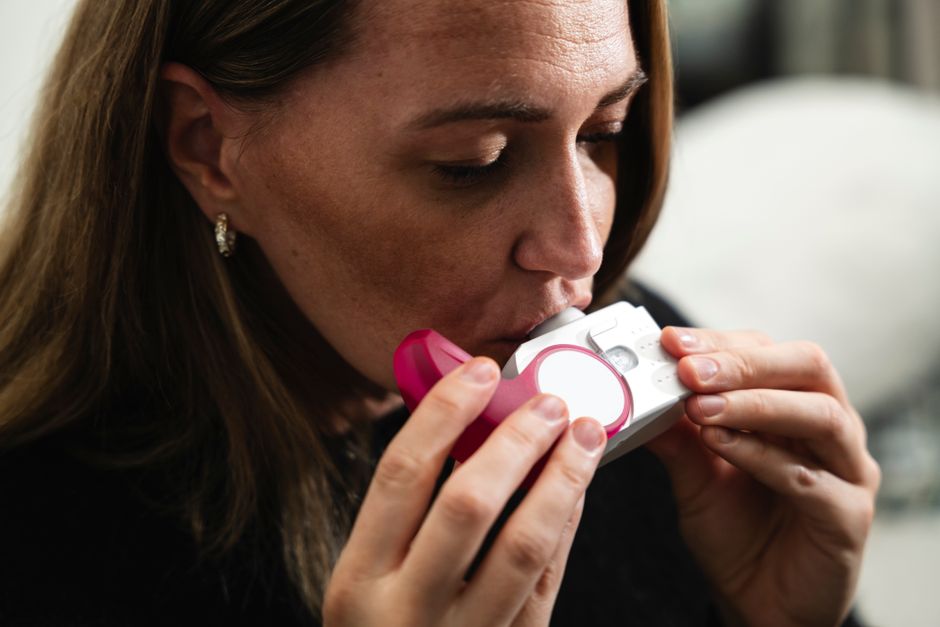
Inhalation is the active process of drawing air into your lungs. It is the first phase of breathing, powered by your diaphragm contracting and moving downward. This creates negative pressure inside your chest, pulling air in through your nose or mouth, down your windpipe, and into tiny air sacs called alveoli where oxygen enters your blood.
What Exactly Happens in Your Body During Inhalation?
Your diaphragm is a dome-shaped muscle below your lungs. When you inhale, it flattens and moves down. Your rib muscles, called intercostals, pull your ribs up and out. This combination makes your chest cavity bigger.
The increase in space lowers the pressure inside your chest. Air outside your body is at higher pressure, so it flows in naturally to balance things out. This is called negative pressure breathing. It is the same principle that makes a straw work.
Air travels through your nose or mouth, past your throat, and into your trachea. From there it splits into two bronchi, one for each lung. These branch into smaller tubes called bronchioles, ending in clusters of alveoli. Your lungs contain about 300 million alveoli. If flattened out, they would cover a tennis court.
What Is Inhalation The Process Of Breathing In Compared to Exhalation?
Inhalation is active. Your muscles contract and use energy. Exhalation is mostly passive. Your diaphragm and rib muscles relax, and air flows out on its own.
During normal breathing, inhalation takes about 40 percent of your breath cycle. Exhalation takes the remaining 60 percent. This changes when you exercise or breathe deeply. During heavy breathing, both inhalation and exhalation become active processes.
Your body has backup muscles for inhalation too. Neck muscles like the scalenes and sternocleidomastoid can help lift your rib cage when you need more air. These are called accessory muscles. You use them during exercise, asthma attacks, or when something blocks your airway.
| Feature | Inhalation | Exhalation |
|---|---|---|
| Muscle action | Diaphragm and intercostals contract | Muscles relax |
| Energy use | Active, requires ATP | Passive at rest |
| Chest pressure | Lower than outside air | Higher than outside air |
| Air movement | Air flows into lungs | Air flows out of lungs |
| Rib cage | Moves up and out | Moves down and in |
What Controls How You Inhale Without Thinking About It?
Your brainstem, specifically the medulla oblongata, runs your breathing automatically. It sends signals through your phrenic nerve to your diaphragm. This nerve originates from your neck at the C3 to C5 vertebrae. A spinal injury above C3 can stop breathing entirely.
Chemoreceptors in your arteries and brainstem monitor carbon dioxide levels. When CO2 rises, your breathing rate increases. This is why holding your breath eventually forces you to inhale. It is not a lack of oxygen that triggers the urge. It is the buildup of carbon dioxide.
Research published in Physiological Reviews shows that the pre-Bötzinger complex in your brainstem generates the basic rhythm of breathing. It fires continuously from birth until death. This cluster of neurons is so critical that when scientists disable it in animal studies, breathing stops immediately.
You can override this automatic system voluntarily. Your cerebral cortex can hold your breath, breathe faster, or change your breathing pattern. But the automatic system always wins eventually. If you pass out from holding your breath, your brainstem takes over and starts breathing again.





What Affects How Easily You Inhale?
Airway resistance matters most. Your airways are not rigid tubes. They can narrow from asthma, allergies, or inflammation. When they narrow, you have to work harder to inhale. The American Lung Association reports that over 25 million Americans have asthma, which directly affects inhalation by constricting airways.
Surface tension in your alveoli also affects inhalation. Your lungs produce surfactant, a soap-like substance that reduces surface tension. Without enough surfactant, your alveoli collapse. This is why premature babies often struggle to breathe. They have not yet produced enough surfactant.
Lung compliance is another factor. Healthy lungs are elastic and expand easily. Conditions like pulmonary fibrosis make lung tissue stiff and harder to inflate. The CDC notes that pulmonary fibrosis affects about 100,000 Americans, with many more undiagnosed.
Your posture changes how well you inhale. Slouching compresses your diaphragm and limits its movement. Standing or sitting upright allows your diaphragm to descend fully. This is why doctors tell people with breathing trouble to sit up straight.
What Common Misconceptions Exist About Inhalation?
Many people believe you breathe in oxygen and breathe out only carbon dioxide. This is not accurate. The air you inhale is about 21 percent oxygen and 78 percent nitrogen. The air you exhale is still about 16 percent oxygen. You only use about a quarter of the oxygen you inhale.
Another myth is that deep breathing always means breathing from your belly. Belly breathing is one type of deep inhalation, but full deep breathing also expands your rib cage in all directions. Your lungs extend higher than most people realize, up behind your collarbones.
Some viral health content claims you can train yourself to breathe through only one nostril for specific health benefits. While nasal cycles are real and your nostrils alternate dominance every few hours, there is no strong evidence that forcing one-nostril breathing provides medical benefits. Some people report feeling calmer, but controlled studies are limited.
The idea that humans only use a small percentage of their lung capacity is also misleading. You use most of your lung capacity during exercise or deep breathing. At rest, you only need a fraction of it. Your lungs are designed with reserve capacity for physical demands, not because you are underusing them.
What Should You Know About Improving Your Inhalation?
Diaphragmatic breathing exercises can strengthen your primary breathing muscle. Lie on your back with your knees bent. Place one hand on your chest and one on your belly. Breathe in slowly through your nose and feel your belly rise. Your chest should stay relatively still. Practice this for five minutes twice a day.
Pursed lip breathing helps people with COPD or asthma. Inhale through your nose for two counts. Pucker your lips like you are blowing out a candle. Exhale slowly for four counts. This keeps your airways open longer and helps remove trapped air.
Evidence published in the Journal of Clinical Medicine found that breathing retraining programs can improve inhalation efficiency in people with asthma and anxiety. The programs typically combine diaphragmatic breathing, nasal breathing, and breath-hold exercises over several weeks.
Regular aerobic exercise improves your body’s ability to inhale efficiently. When you exercise consistently, your respiratory muscles become stronger and more coordinated. Your lungs do not grow new alveoli, but your body gets better at using the oxygen you bring in.
Avoid smoking and air pollution. Smoking damages the cilia that line your airways and clean them. It also destroys alveolar walls over time. The CDC states that smoking causes about 90 percent of lung cancer deaths and 80 percent of COPD deaths. Secondhand smoke also impairs inhalation.
Frequently Asked Questions
What is the difference between inhalation and inspiration?
They mean the same thing. Inhalation and inspiration both describe the process of breathing air into the lungs.
Can you inhale and swallow at the same time?
No. Your epiglottis covers your windpipe when you swallow to prevent food from entering your airway. You cannot inhale while your airway is blocked.
How much air do you inhale with each breath?
A typical adult inhales about 500 milliliters of air during normal resting breathing. This is called tidal volume.
What happens if you inhale through your mouth instead of your nose?
Mouth breathing bypasses the filtering, warming, and moistening that your nose provides. It can lead to dry mouth and increased exposure to airborne particles.
