
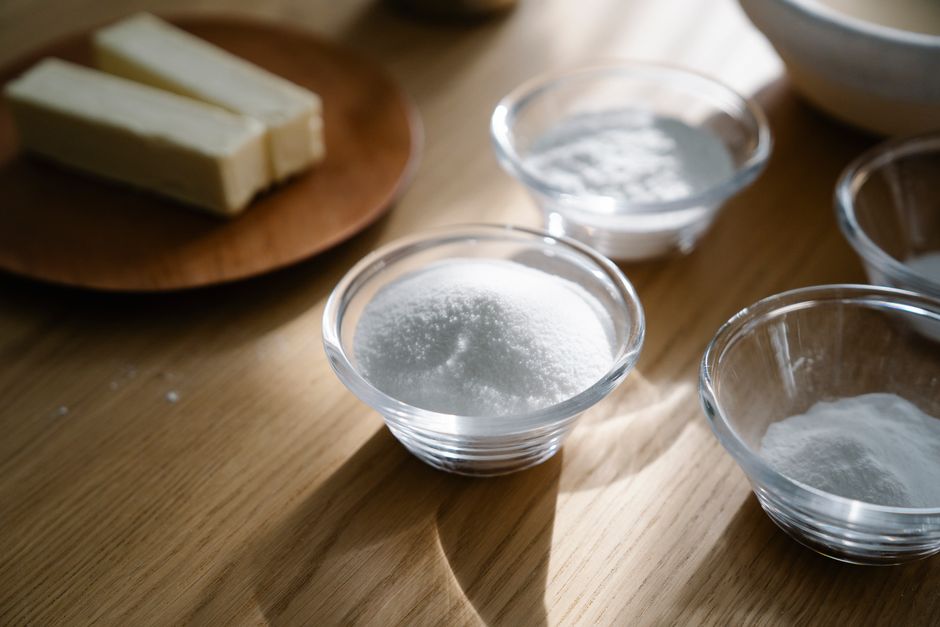
Baking soda is a single chemical compound: sodium bicarbonate, with the formula NaHCO3. That means each molecule contains one sodium atom, one hydrogen atom, one carbon atom, and three oxygen atoms. It is a white crystalline powder that dissolves in water, tastes slightly alkaline, and has been used in cooking, cleaning, and medicine for well over a century.
What Is In Baking Soda?
Baking soda contains one ingredient and nothing else. The label on a box of pure baking soda lists sodium bicarbonate, and that is the entire product. There are no additives, no anti-caking agents, and no preservatives in the standard kitchen box.
Sodium bicarbonate is a salt. It forms when carbon dioxide reacts with a sodium-containing base in water. In nature, it appears in a mineral called nahcolite, which is mined in several parts of the world, including the United States. Most commercial baking soda is either mined directly or made through a chemical process that produces a very pure form of the same compound.
The reason it works in baking comes down to a simple acid-base reaction. When sodium bicarbonate meets an acid and moisture, it releases carbon dioxide gas. Those gas bubbles get trapped in dough or batter, and that is what makes baked goods rise. Heat speeds up the reaction, which is why the rise happens fastest in the oven.
Is Baking Soda the Same as Baking Powder?
No. They are different products with different ingredients, and swapping one for the other changes how a recipe behaves.
Baking soda is pure sodium bicarbonate. It needs an acid to react. If a recipe contains buttermilk, lemon juice, vinegar, yogurt, or cocoa powder, the baking soda has something to work with.
Baking powder contains sodium bicarbonate plus one or more dry acids, and usually a small amount of cornstarch to keep it stable. Because the acid is already built in, baking powder only needs moisture and heat to activate. That makes it useful in recipes with no acidic ingredient.
Here is where it gets practical. A recipe calling for baking soda and buttermilk will not rise properly if you substitute baking powder alone. And a recipe calling for baking powder may taste metallic or soapy if you use too much baking soda instead, because there is no acid to neutralize the excess.
What Does Sodium Bicarbonate Do in the Body?
Sodium bicarbonate is a normal part of human physiology. Your body makes it and uses it constantly to keep blood pH within a narrow range.
Blood pH normally sits between about 7.35 and 7.45. That is slightly alkaline. The body maintains this range through a system called acid-base balance, which involves the lungs, the kidneys, and chemical buffers in the blood. Bicarbonate is the main buffer in that system. It neutralizes excess acid and helps carry carbon dioxide through the bloodstream to the lungs, where it gets exhaled.
The kidneys regulate bicarbonate levels by either holding onto it or excreting it in urine. When the body becomes too acidic, the kidneys conserve bicarbonate. When it becomes too alkaline, they release more. This is a tightly controlled process, and healthy kidneys handle it without any outside help.
This is a useful distinction. The bicarbonate in your blood is not something you need to supplement. It is something your body produces and manages on its own. A box of baking soda in your kitchen is the same chemical, but that does not mean eating it does the same job as your kidneys.





Does Baking Soda Have Health Uses?
Sodium bicarbonate does have established medical uses. It is used in clinical settings, and it appears in some over-the-counter products. But the evidence for most everyday health claims is thin or absent.
Sodium bicarbonate is given intravenously in hospitals for specific conditions, including certain cases of severe metabolic acidosis and some poisonings. It is also a component of some antacids, where it neutralizes stomach acid. It appears in some toothpastes as a mild abrasive. These are real uses supported by clinical practice.
What is not well supported is the broader list of claims that circulate online. Drinking baking soda dissolved in water to “alkalize” the body is a common one. The problem is that blood pH is regulated so tightly that food and drink have very little effect on it. If you are healthy, your body corrects for what you swallow. If you are not healthy, the correction is a medical matter, not a kitchen one.
Some people use baking soda for heartburn or indigestion. It can neutralize stomach acid and provide short-term relief. But it is high in sodium, and regular use is not recommended for people with high blood pressure, heart conditions, or kidney disease. Anyone considering it for a health purpose should talk to a clinician first, especially if they take prescription medications or have an underlying condition.
What Is Baking Soda Used For Around the Home?
Baking soda’s mild abrasiveness and its ability to neutralize acids make it useful for cleaning and deodorizing.
- It works as a gentle scouring powder for sinks, stovetops, and countertops.
- It can absorb odors in refrigerators, trash cans, and closets.
- It helps put out small kitchen fires by smothering them, though a fire extinguisher is the safer choice.
- It can be added to laundry as a mild water softener and odor reducer.
- It is sometimes used in DIY toothpaste recipes, though dental professionals generally recommend fluoride toothpaste for cavity prevention.
These uses are practical, not medical. The cleaning action comes from the same chemistry that makes it work in baking: it reacts with acids and provides mild abrasion.
How Does Baking Soda Compare to Other Leavening Agents?
Baking soda is one of several ways to make baked goods rise. Each has a different role, and they are not interchangeable.
| Leavening Agent | Main Ingredients | Needs Acid? | Typical Use |
|---|---|---|---|
| Baking soda | Sodium bicarbonate | Yes | Recipes with buttermilk, lemon, vinegar, or cocoa |
| Baking powder | Sodium bicarbonate, dry acid, cornstarch | No | Recipes without acidic ingredients |
| Yeast | Living microorganisms | No | Bread, doughs that need time to develop |
| Whipped egg whites | Air trapped in protein foam | No | Soufflés, sponge cakes, meringues |
The choice usually comes down to what else is in the recipe. If there is an acid, baking soda is the right pick. If there is not, baking powder is. Yeast and egg whites work through entirely different mechanisms and are not substitutes for either.
Is Baking Soda Safe to Eat or Drink?
Baking soda is safe in the small amounts used in cooking. It is generally recognized as safe by food regulators when used as intended in food.
Swallowing larger amounts is a different situation. Eating a spoonful of dry baking soda can cause stomach pain, nausea, and vomiting. In rare cases, it has caused serious complications. Drinking it dissolved in water in large or repeated doses can raise sodium levels in the blood, which is a particular concern for people with high blood pressure, kidney disease, or heart failure.
There is also an interaction risk. Baking soda can change how the body absorbs or clears certain medications, including some that affect the kidneys or heart. Anyone on prescription medication should not use baking soda as a home remedy without checking with a pharmacist or doctor.
No clinical guidelines currently exist for using baking soda as a home treatment for any condition in healthy adults. The established medical uses happen under clinical supervision, not at the kitchen counter.
Frequently Asked Questions
What is baking soda made of?
Baking soda is pure sodium bicarbonate, a chemical compound with the formula NaHCO3. It contains sodium, hydrogen, carbon, and oxygen, and nothing else in its pure form.
Is baking soda the same as bicarbonate of soda?
Yes. Baking soda and bicarbonate of soda are two names for the exact same compound, sodium bicarbonate. The naming difference comes from regional usage, not from any difference in the product.
Can I use baking soda instead of baking powder?
Not as a direct swap. Baking soda needs an acid to react, while baking powder already contains one, so substituting one for the other changes how a recipe rises.
Is it safe to drink baking soda in water?
Occasional small amounts are unlikely to cause harm in healthy adults, but regular or large doses can raise blood sodium and interact with medications. No clinical guidelines support drinking it as a routine health practice.
