
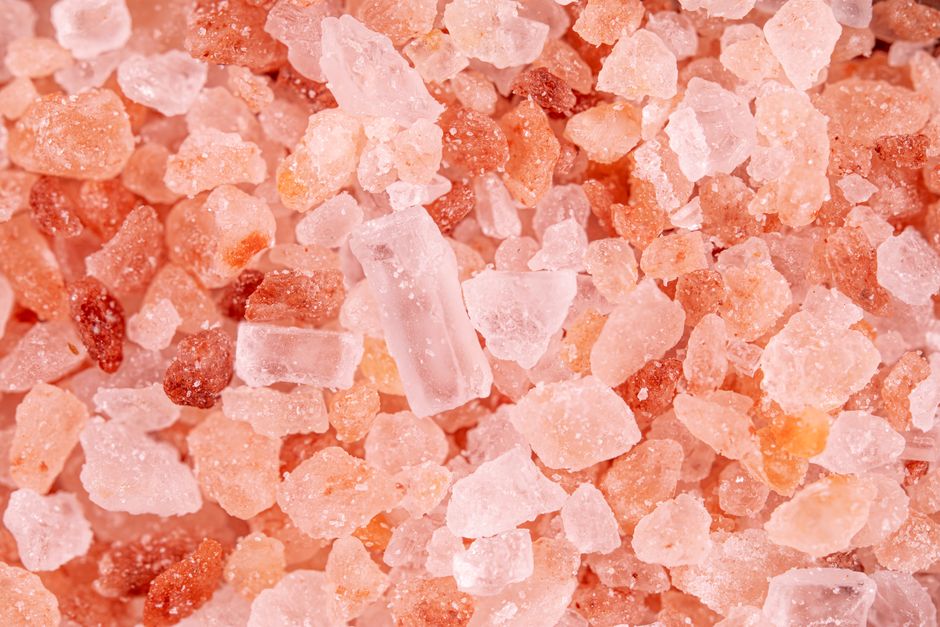
Himalayan pink salt is a rock salt mined from the Punjab region of Pakistan, near the foothills of the Himalayas. It gets its pink color from trace amounts of iron oxide and other minerals. Chemically, it is still sodium chloride — the same compound as ordinary table salt — and its main nutritional contribution to your diet is sodium.
That last point matters, because most of what you have heard about pink salt goes well beyond what the evidence supports. This article separates the chemistry from the marketing.
What Is Himalayan Pink Salt Made Of?
Himalayan pink salt is roughly 98% sodium chloride, with the remaining small fraction made up of trace minerals. Those minerals include iron, calcium, potassium, magnesium, and sulfate, among others. The exact mix varies by location within the mine.
The pink to reddish color comes from iron. The deeper the color, the more iron and other trace minerals are present. Some crystals are nearly white, and some are deep salmon. This is a natural variation, not a sign of quality.
Here is the part that surprises many people. The trace minerals in pink salt are present in amounts so small they contribute almost nothing to your daily needs. You would have to eat an unrealistic amount of salt to get meaningful calcium or magnesium from it — and doing so would be harmful because of the sodium. For minerals like calcium and potassium, food sources such as dairy, leafy greens, beans, and fruit are far more practical.
One clarification worth making: the salt is not “Himalayan” in the sense of being harvested from the Himalayan mountains themselves. The mine — the Khewra Salt Mine — sits in the Punjab plain, and the salt deposits formed from ancient seabeds hundreds of millions of years ago. The name is a marketing label tied to the region, not a geological description.
How Is Himalayan Pink Salt Different From Table Salt?
The main differences are texture, mineral traces, and iodine content — not health effects. All three types below are predominantly sodium chloride.
| Feature | Himalayan Pink Salt | Table Salt | Sea Salt |
|---|---|---|---|
| Main component | Sodium chloride (~98%) | Sodium chloride (~99%) | Sodium chloride (~97–99%) |
| Trace minerals | Small amounts, including iron | Minimal | Small amounts, varies |
| Iodine | Not typically iodized | Usually iodized | Not typically iodized |
| Texture | Coarse crystals | Fine grains | Varies, often coarse |
| Anti-caking agents | Usually none | Often added | Usually none |
The iodine difference is the one with real public health weight. Iodine is essential for thyroid hormone production, and iodine deficiency remains a concern in many parts of the world. Iodized table salt was introduced specifically to address this. If you switch entirely to non-iodized pink salt, you may reduce your iodine intake unless you get iodine from other sources such as seafood, dairy, or eggs. This is not a reason to avoid pink salt — it is a reason to be aware of the trade-off.
The anti-caking agents in table salt (often silicon dioxide or calcium silicate) are food-safe and exist to keep the salt free-flowing. Pink salt’s coarse crystals tend to clump, which is why it is often sold in grinders. Neither choice is inherently healthier.
Does Himalayan Pink Salt Have Health Benefits?
No clinical evidence currently confirms that pink salt provides health benefits beyond what any sodium chloride provides. The claims you see online — better hydration, improved mineral balance, detoxification — are not supported by controlled human trials.
The mineral content argument deserves a direct look. Yes, pink salt contains trace amounts of magnesium, calcium, and potassium. But the amounts are so small relative to your daily requirements that they are nutritionally trivial. A typical serving of salt is a small fraction of a teaspoon, and the mineral content in that amount is measured in milligrams or less. Compare that to a cup of milk or a banana, which deliver far more of these minerals without the sodium load.
There is one claim worth addressing directly: that pink salt is “healthier” because it has fewer additives. The additives in table salt are present in tiny, regulated amounts and are considered safe. The absence of additives does not make a salt more nutritious. It is still sodium chloride.
Some people report that pink salt tastes “saltier” or “cleaner” than table salt. This is a real sensory experience, but it is about crystal size and how the salt dissolves on your tongue, not about a different chemical effect on your body.
Is Pink Salt Better For You Than Regular Salt?
For most people, the health impact of pink salt versus table salt is essentially the same, because both are dominated by sodium. The health question that matters is not which salt you choose — it is how much sodium you consume overall.
Federal dietary guidelines recommend that adults limit sodium to less than 2,300 milligrams per day. That is about one teaspoon of salt. Most Americans consume considerably more than that, largely from processed and restaurant foods rather than from the salt shaker. Switching from table salt to pink salt does nothing to change that total if the amount used stays the same.
There is a nuance worth knowing. Coarse salts like pink salt contain less sodium by volume than fine table salt, because the crystals pack less densely. If you measure salt by the spoonful, a teaspoon of coarse pink salt may contain somewhat less sodium than a teaspoon of fine table salt. But this is a measurement artifact, not a health advantage. If you salt by taste rather than by measure, the difference largely disappears.
For people with high blood pressure, heart failure, or kidney disease, sodium intake is a genuine clinical concern. The source of the sodium matters far less than the total amount. Anyone managing a sodium-restricted diet should treat pink salt exactly as they would treat table salt.
Are There Safety Concerns With Himalayan Pink Salt?
Himalayan pink salt is safe to eat in normal culinary amounts. The safety concerns that exist are about quantity, not about the salt itself.
The main concern is sodium. Excess sodium intake is associated with elevated blood pressure and increased cardiovascular risk in many people. This applies to all salts equally. The trace minerals in pink salt do not offset the effects of sodium.
A separate concern involves heavy metal content. Some testing of various salts has detected trace amounts of metals such as lead, arsenic, and cadmium. These have generally been found at levels well below established safety thresholds, and regulatory agencies have not flagged pink salt as a health hazard. That said, the testing is not exhaustive, and the levels can vary by source. This is a case where the honest position is that the risk appears low based on available testing, but the data are not comprehensive.
One more practical point: pink salt is not a substitute for iodized salt in terms of thyroid health. If your diet relies heavily on non-iodized salt and you eat few iodine-rich foods, you may want to discuss iodine intake with a healthcare provider. This is particularly relevant during pregnancy, when iodine needs increase. No clinical guidelines recommend pink salt for iodine — it is not a reliable source.
How Should You Use Himalayan Pink Salt?
Use it as you would any salt — for flavor, in cooking, and at the table — while keeping total sodium intake in mind. Its coarse texture works well for finishing dishes, grilling, and in salt grinders. Its visual appeal makes it a popular choice for presentation.
There is no culinary or health reason to avoid it, and no reason to treat it as a superior product. It is a flavorful, attractive salt with the same basic nutritional profile as the salt you already have in your kitchen.
If you are choosing between salts, the more useful question is whether you are getting enough iodine from other sources and whether your overall sodium intake is within recommended limits. Those questions have real health implications. The choice between pink and white salt does not.
Frequently Asked Questions
Is Himalayan pink salt healthier than regular salt?
No. Both are about 98–99% sodium chloride, and the trace minerals in pink salt are too small to provide meaningful nutrition. The health impact depends on how much sodium you consume, not which salt you choose.
Does Himalayan pink salt contain iodine?
Typically no. Pink salt is not usually iodized, so it is not a reliable iodine source. If you rely on it exclusively, you may need iodine from other foods such as seafood, dairy, or eggs.
Can Himalayan pink salt help with mineral deficiencies?
No. The amounts of calcium, magnesium, and potassium in pink salt are nutritionally negligible. Food sources provide far more of these minerals without the sodium load.
Is it safe to use Himalayan pink salt every day?
Yes, in normal culinary amounts. The main concern is total sodium intake, which should stay under 2,300 milligrams per day for most adults. Pink salt counts toward that limit just like any other salt.
