
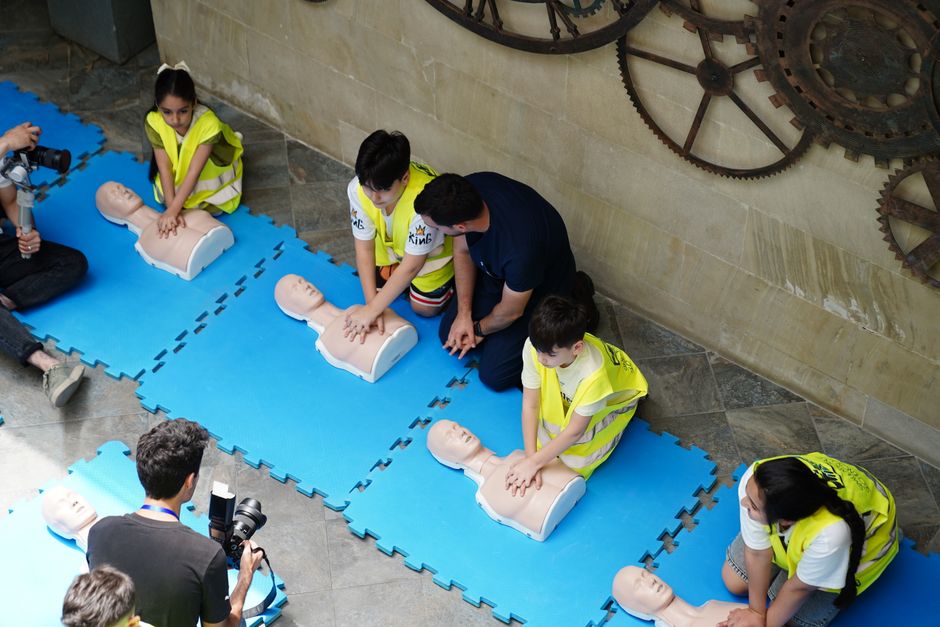
High fidelity simulation in healthcare is a training method that recreates real clinical situations with enough realism that the body and brain respond much as they would in an actual patient care setting. It combines sophisticated mannequins or trained human actors, real medical equipment, and monitored physiological responses like heart rhythm, breathing, and blood pressure. The goal is not to teach facts. It is to build the judgment, teamwork, and muscle memory that only come from practicing under pressure — without putting a real patient at risk.
What Is High Fidelity Simulation In Healthcare?
High fidelity means the simulation reproduces clinical reality closely enough that participants suspend disbelief. That is the working definition used across medical education.
Three elements usually have to be present:
- Realistic physiology. A computerized mannequin responds to interventions. Give a drug and the blood pressure changes. Ventilate the lungs and the chest rises. The vital signs are not scripted static numbers; they react to what the learner does.
- Realistic environment. The room looks and feels like an operating theater, emergency bay, or intensive care unit. The same monitors. The same crash cart. The same background noise.
- Realistic roles. Participants act as they would on a real team. A nurse, a physician, and a respiratory therapist each play their actual part.
Fidelity is a spectrum, not a switch. A low-fidelity task trainer might be a plastic arm for practicing IV insertion. A high-fidelity setup might be a full intensive care scenario with a mannequin that speaks, blinks, and deteriorates if the team misses a step.
The distinction matters because realism changes what gets trained. Task trainers build technical skill. High-fidelity scenarios build decision-making and communication under stress — the parts of clinical work that are hardest to teach from a textbook.
How Does High Fidelity Simulation Actually Work?
A simulation session runs in three phases, and the middle one is not the most important.
Prebriefing. Before the scenario begins, facilitators set the ground rules. Participants learn where the equipment is, what the mannequin can and cannot do, and that mistakes are expected. This phase establishes what educators call psychological safety — the understanding that errors will be examined, not punished. Without it, learners hold back and the training loses much of its value.
The scenario. Participants manage a clinical situation in real time. A mannequin might present with a sudden drop in blood pressure and an abnormal heart rhythm. The team has to recognize the problem, communicate, and act. A facilitator in another room controls the mannequin’s responses and can introduce new complications.
Debriefing. After the scenario, the team and facilitator review what happened. This is where most learning occurs. Participants examine their decisions, their communication, and the gaps between what they intended and what they did. Research in medical education consistently points to debriefing quality as a major driver of whether simulation translates into better performance.
Some programs use video review during debriefing. Others rely on guided conversation alone. Both approaches are used, and the evidence does not clearly favor one over the other across all settings.
What Is the Difference Between High Fidelity and Low Fidelity Simulation?
Fidelity refers to how closely the simulation mirrors reality. The higher the fidelity, the more the training environment resembles the actual clinical setting.
Low-fidelity simulation uses simple tools. A foam pad for practicing sutures. A plastic torso for chest compressions. These are inexpensive, portable, and effective for drilling specific physical skills.
High-fidelity simulation adds technology and context. The mannequin has a pulse, a chest that rises with breathing, and eyes that respond to light. The scenario unfolds over time and requires the team to think, not just perform a single motion.
Neither is better in every case. A landmark review of simulation-based medical education found that the key factor is not the fidelity of the mannequin itself but how the simulation is integrated into the curriculum — with clear objectives, deliberate practice, and feedback. A high-tech mannequin used poorly teaches less than a simple model used well.
That finding is worth sitting with. Fidelity is a tool, not a goal.
Where Is High Fidelity Simulation Used?
The method has spread across nearly every corner of clinical training.
Medical and nursing schools use it to teach students before they ever touch a real patient. Students practice everything from basic assessments to complex emergencies in a controlled setting.
Hospital residency programs use it for advanced training. Surgical residents rehearse procedures. Emergency medicine residents run through trauma scenarios. Anesthesia residents practice managing airway crises.
Team training is one of the most established uses. Crisis resource management courses — which focus on communication, leadership, and role clarity during emergencies — rely heavily on high-fidelity scenarios. These skills are difficult to teach any other way.
Certification and assessment. Some professional bodies use simulation for evaluating competence. Certain credentialing exams include simulated scenarios as part of the assessment.
Systems testing. Hospitals use simulation to test new equipment, new room layouts, and new protocols before going live. A team might run a mock code in a newly built unit to find problems before a real patient is affected.
Does High Fidelity Simulation Improve Patient Outcomes?
This is the question that matters most, and the answer requires care.
Simulation clearly improves learning. Studies consistently show that simulation-based training produces better skill acquisition and retention than traditional lecture-based teaching for many procedural and team-based skills. That much is well established.
The harder question is whether better-trained teams produce measurably better patient outcomes. Here the evidence is more mixed.
Some studies have linked simulation-based team training to improvements in specific outcomes, such as reduced complications during certain procedures. Other studies have found improvements in process measures — like how well teams follow protocols — without clear evidence of change in patient outcomes.
Part of the difficulty is that patient outcomes are influenced by many factors beyond individual or team training. Isolating the effect of simulation is genuinely hard.
The honest position: simulation improves the skills and teamwork that are known to matter for patient safety. Whether that reliably translates into fewer complications or deaths across all settings is not fully settled. The evidence is strongest for procedural skills and team performance, and weaker for broad outcome improvements.
What Are the Limitations and Costs?
High fidelity simulation is resource-intensive.
Full-body mannequins with realistic physiology can cost tens of thousands of dollars. Simulation centers require space, staff, and maintenance. Scenarios need trained facilitators and dedicated debriefing time. These costs put the method out of reach for some smaller institutions and lower-resource settings.
There are also limits to what a mannequin can reproduce. A mannequin cannot fully simulate certain physical findings, the feel of abnormal tissue, or the emotional weight of a real patient deteriorating. Human actors — standardized patients — can fill some of these gaps, but they cannot simulate internal physiology.
Another limitation is transfer. Skills learned in a simulation lab do not automatically transfer to the clinical environment. How well they transfer depends on how closely the simulation resembles real practice, how often the training is reinforced, and whether the clinical setting supports the same behaviors.
Simulation also requires psychological safety to work. If participants feel judged or embarrassed, they disengage, and the learning suffers. Facilitators trained in debriefing are essential, and not every institution has them.
What Is the Future of Simulation in Healthcare?
Technology is expanding what simulation can do.
Virtual reality and augmented reality are being used for certain procedural skills, particularly in surgical training. These tools can provide repeated practice without consuming physical resources. The evidence base for VR is growing but is not yet as strong as for traditional mannequin-based simulation for many applications.
Artificial intelligence is being explored for scenario control and for automated feedback. Some systems can now adjust a scenario in real time based on learner performance. How well these systems compare to human facilitators is an open question.
Remote simulation — where participants and facilitators are in different locations — became more common during the COVID-19 pandemic and has continued in some programs. Its effectiveness compared to in-person simulation is still being studied.
What has not changed is the core principle. Simulation works because it lets people practice under realistic pressure, make mistakes safely, and learn from those mistakes through structured reflection. The technology is a means to that end, not the end itself.
Frequently Asked Questions
What is high fidelity simulation in healthcare?
It is a training method that uses realistic mannequins, equipment, and environments to recreate clinical situations. Participants practice managing real scenarios without putting patients at risk.
Is high fidelity simulation better than low fidelity simulation?
Not always. Research suggests the quality of debriefing and how simulation is integrated into training matters more than the fidelity of the mannequin itself. Low-fidelity tools can be highly effective for specific skills.
Does simulation training improve patient outcomes?
The evidence is strongest for improving skills and team performance, which are known to matter for safety. Whether that reliably translates into fewer complications across all settings is not fully established.
Who uses high fidelity simulation?
Medical schools, nursing programs, hospital residency programs, and hospital systems all use it. It is also used for certification exams and for testing new equipment or protocols before they go live.
