
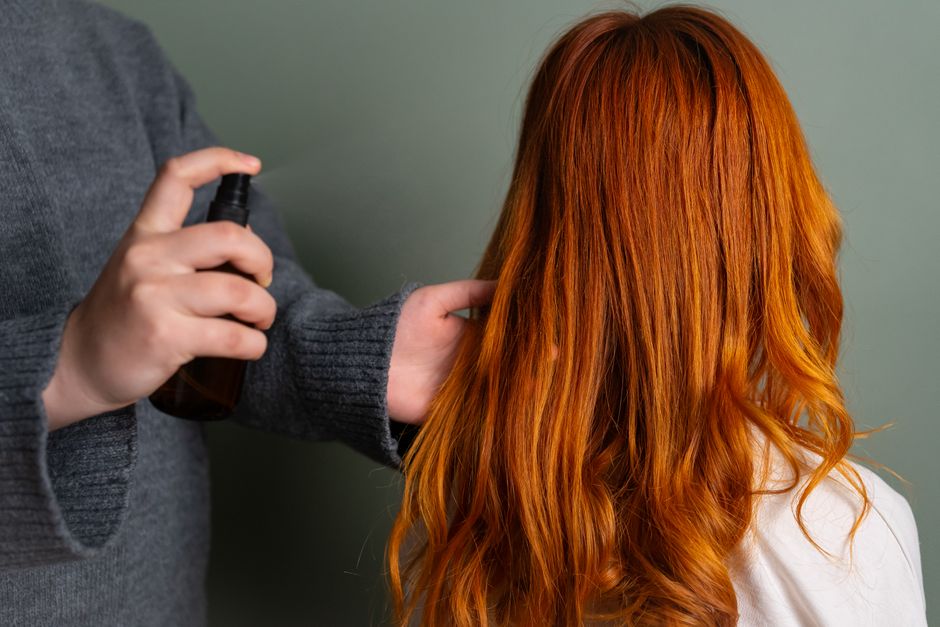
Hair color banding is when visible lines of different color run across the hair, usually from the roots to the ends. It happens most often when dye, bleach, or lightener is applied unevenly or left on for different amounts of time in different sections. The fix depends on the cause, but it almost always means going back in with a targeted correction rather than applying more of the same color over the top.
What Is Hair Color Banding And How Do You Fix It?
Banding is a horizontal stripe of color that does not match the hair above or below it. You see it most clearly in lightened hair, where you get a dark root area, a lighter middle section, and then another dark or brassy band near the ends.
The reason it looks so obvious comes down to how hair lightens. Bleach does not lift color evenly along the strand in one pass. It works fastest where the hair is warmest and where the product is freshest. When you reapply lightener only to the roots during a touch-up, the previously lightened mid-lengths and ends do not get re-processed. If the first application was uneven to begin with, that unevenness becomes a permanent map on the strand.
Hair is also not uniform along its length. The ends are older, more porous, and have usually been through more chemical and heat exposure. Porous sections absorb color faster and release it faster. So even a single, careful application can produce a band if the porosity changes sharply somewhere along the strand.
Fixing it is a matter of matching the method to the cause. Sometimes that means re-lightening a specific band. Sometimes it means filling and re-toning. Sometimes the honest answer is that the hair cannot take another chemical process without breaking, and the band has to be managed with a cut, a glaze, or a color that blends rather than removes it.
What Causes Color Banding In Hair?
Almost every case traces back to one of a few mechanical or chemical causes. The color itself is rarely the problem. The application is.
- Overlapping lightener. Reapplying bleach over already-lightened hair lifts it further, creating a lighter stripe.
- Uneven saturation. Dry or densely packed sections absorb less product, so they lift or deposit less color.
- Inconsistent processing time. If one section sits with product longer than another, it develops further.
- Porosity differences. Porous ends grab color fast and can turn out darker or more intense than the mid-lengths.
- Box dye applied root to tip. Single-formula dye is designed for one uniform starting canvas. On multi-toned hair it produces multi-toned results.
- Previous color underneath. Old dye, henna, or metallic salts can react unpredictably with new lightener.
The porosity point deserves more attention than it usually gets. Two sections of hair can look identical and behave completely differently because one has a tighter cuticle and the other has a raised, damaged one. This is why two people can use the same product at home and get completely different results. It is also why a stylist can do everything correctly and still see a faint band where the hair’s porosity changes.
Is Hair Color Banding The Same As A Shadow Root Or Ombre?
No, and the difference matters. A shadow root and an ombre are intentional, controlled color placements. Banding is unintentional and uneven.
A shadow root is a deliberate darker application at the base that blends gradually into lighter mid-lengths. An ombre is a deliberate gradient from darker at the top to lighter at the bottom. Both are designed, both transition smoothly, and both are the result the client asked for.
Banding has a hard edge. It does not blend. You can usually point to the exact line where one tone stops and another starts. That hard transition is the defining feature. If the color shifts gradually and looks intentional, it is a technique. If it looks like a stripe, it is banding.
This distinction matters because the correction is different. You do not fix a shadow root. You fix a band.





Can You Fix Hair Color Banding At Home?
Some mild cases can be softened at home. Most cannot be fully corrected, and attempting a full correction at home is where people usually make the problem worse.
What at-home options can realistically do is blend and disguise, not remove. A color-depositing gloss or a semi-permanent toner can tint a band so it reads closer to the surrounding hair. Because these products sit on the surface and fade over several washes, they carry far less risk than lightener or permanent dye. They also cannot lighten anything. If your band is too dark, a gloss will not fix it.
What at-home options cannot safely do is re-lighten a specific band. Lightener is the most damaging chemical process in hair coloring, and applying it freehand to one section of a strand while keeping it off the hair directly above and below is genuinely difficult. The risk is that you create a second band, or that the hair in the target zone breaks off.
There is one more factor people underestimate. Hair that has already been lightened has less structural integrity than virgin hair. A strand that has been through one round of bleach has already lost a meaningful amount of its internal protein structure. A second round on the same strand is not the same operation as the first round. This is why professionals often test a small section before committing to a full correction.
How Do Professionals Correct Banding?
Correction is diagnostic first and chemical second. A stylist needs to know what is on the hair, how many times it has been processed, and how much integrity is left before deciding on a method.
Common approaches include:
- Band-specific lightening. Lightener is applied only to the darker band, carefully isolated, often with foils to keep it off the surrounding hair.
- Toning or glossing. A deposit-only color is used to shift the band’s tone closer to its neighbors without lifting it.
- Color melting. Two or more shades are blended across the transition zone to soften a hard line.
- Filling. A warm or red-based filler is applied before a darker color to prevent a hollow, muddy result on porous hair.
- Cutting. If the band sits at the ends, removing length removes the band.
Professionals also run strand tests and elasticity checks before starting. A wet strand that stretches and does not spring back is a warning sign. Hair in that condition may not survive another lightening process, and the honest recommendation may be to stop rather than proceed.
This is the part of correction that gets left out of most online advice. Not every band can be fixed. Sometimes the correct answer is that the hair has reached its limit, and the plan has to change.
How Do You Prevent Banding In The First Place?
Prevention is mostly about controlling application and timing. The chemistry is unforgiving, but the process is manageable.
If you color at home, apply product to the mid-lengths and ends last, not first. The roots process faster because of scalp heat, so starting there and then working outward is a common way to end up with a lighter root area and a darker band below it. Read the manufacturer’s timing instructions and follow them. Do not extend processing time hoping for a better result. Lightener keeps working while it is on the hair, and “a few extra minutes” is a common cause of an unintended band.
If you see a stylist, tell them the full history of what has been on your hair. Box dye, henna, and previous salon services all affect how the next process behaves. Henna in particular can react badly with lightener, and this is one of the few cases where a stylist may refuse the service outright for safety reasons.
Between appointments, keep the hair conditioned. Conditioner does not prevent banding directly, but it reduces the porosity swings that make bands more likely and more visible. Minimize heat styling on lightened hair. Heat damage raises porosity unevenly along the strand.
One practical point: if you are growing out a band, a glaze or a series of light toners can keep it wearable while the hair grows. This is slower than a correction, but it is far gentler, and for damaged hair it is often the better path.
When Should You See A Professional Instead Of Fixing It Yourself?
See a professional if the band is more than about an inch wide, if the hair has been lightened more than once, if you can see or feel breakage, or if the band is lighter than the surrounding hair.
Those situations all point to correction that requires isolating specific sections of the strand. That is precision work. Doing it wrong does not just fail to fix the band. It can create a second one, and it can cost you length.
If the hair feels gummy when wet, stretches without springing back, or sheds more than usual during brushing, stop and get an assessment before any further chemical service. Those are signs that the hair’s structure is already compromised. Adding more chemistry to compromised hair is how people end up with a cut they did not want.
Frequently Asked Questions
Can hair color banding be fixed without bleach?
Sometimes. A toner or color-depositing gloss can blend a band by shifting its tone, but it cannot lighten a band that is too dark. Removing color requires lightener or a color remover.
Why does my hair go darker in bands after dyeing?
Porous sections absorb color faster and hold more pigment, so they can turn out darker than less porous areas. This is common on ends that have been previously colored or heat-damaged.
Will banding go away on its own?
No. Permanent color and lightener change the hair’s internal structure, and that change does not reverse with time. The band stays until it is corrected or cut off.
Is it safe to bleach over a band at home?
It is difficult to do safely because lightener must be kept off the hair directly above and below the band. Freehand application at home often creates a second band or causes breakage.
