
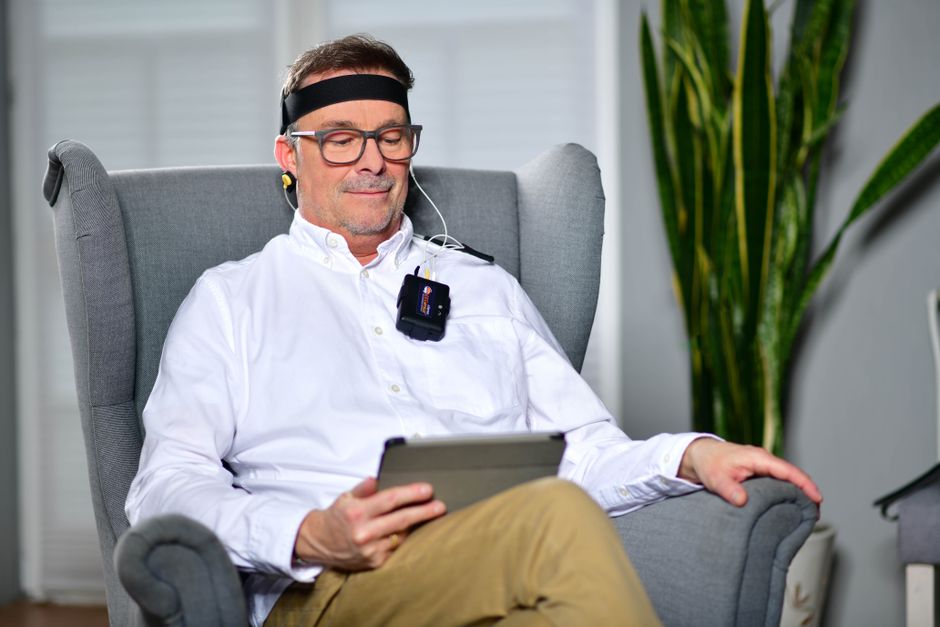
Neurofeedback is a form of brain training that uses real-time readings of your brain’s electrical activity to help you learn to change it. Electrodes placed on the scalp pick up brain waves, a computer turns those signals into a display, and you try to shift the pattern in a chosen direction. The idea is that the brain can learn new habits, much like a muscle learns a movement.
The “EEG” in EEG neurofeedback stands for electroencephalography, the technique that records electrical activity from the brain. It is a non-invasive method. Nothing is injected or implanted. The same basic recording technology has been used in hospitals and sleep labs for decades.
What Is EEG Neurofeedback And How Does It Work?
EEG neurofeedback works by measuring your brain waves, showing them to you in real time, and rewarding you when you move toward a target pattern. The reward is usually something simple — a tone, a bar that grows, or a video that plays smoothly. When your brain activity drifts away from the target, the reward fades or stops.
This is a form of operant conditioning, the same learning principle that trains animals with rewards. Your brain is not consciously told what to do. Instead, it picks up on the feedback over many sessions and adjusts.
Here is the sequence in a typical session:
- Electrodes are placed on your scalp, usually with conductive paste or gel.
- The EEG equipment records the electrical signals your brain produces.
- Software filters the signal into frequency bands.
- A therapist sets a target — for example, more activity in one band and less in another.
- You watch or listen to the feedback display and try to shift the pattern.
Most sessions last somewhere around 30 to 45 minutes. Training usually happens across multiple sessions over weeks or months. The exact number varies by clinic and by what is being addressed.
What Are Brain Waves And Why Do Frequency Bands Matter?
Brain waves are patterns of electrical activity produced by large groups of neurons firing together. They are grouped into frequency bands, measured in hertz (cycles per second). The main bands are delta, theta, alpha, beta, and gamma.
Each band tends to be associated with different states. Delta is linked to deep sleep. Theta shows up in drowsiness and some forms of light sleep. Alpha is often present during relaxed wakefulness with eyes closed. Beta is associated with active focus and alertness. Gamma is linked to fast, coordinated activity across brain regions.
These associations are broad tendencies, not strict rules. A person can have beta activity while relaxed, and alpha can appear during certain tasks. The bands describe patterns, not fixed states.
This is where a common misunderstanding creeps in. It is tempting to think “more alpha is better” or “less theta is better.” That is not accurate. What counts as a useful target depends on the individual, the goal, and the assessment. There is no single “healthy” brain wave profile that applies to everyone.
What Happens In A Neurofeedback Session?
A session begins with preparation. The scalp is cleaned, and electrodes are attached at specific locations. The number of electrodes varies — some systems use one or two, others use a full cap with many sensors.
You sit comfortably and interact with the feedback. In many setups, you watch a screen where a bar rises, a game responds, or a video brightens. When your brain activity moves toward the target, the display rewards you. When it moves away, the reward pauses.
You are not usually told exactly what to do. The learning is largely implicit. Over time, some people report they start to sense what “works” and can reproduce it.
After the session, the clinician reviews the data. Progress is tracked across sessions. Adjustments may be made to the target as your brain activity changes.
It is worth knowing that the field does not have one standardized protocol. Different practitioners use different targets, equipment, and session structures. This variety makes it hard to compare results across studies and clinics.
What Is Neurofeedback Used For?
Neurofeedback has been studied for several conditions, with varying levels of evidence. The strongest and most consistent research interest has been in attention-deficit/hyperactivity disorder (ADHD).
For ADHD, some studies suggest neurofeedback may improve attention and impulse control. However, the evidence is mixed. Some trials show benefit, while others find effects similar to placebo or comparison treatments. A key challenge is that it is hard to design a convincing “sham” neurofeedback control, so separating real effects from expectation is difficult.
Other areas that have been studied include anxiety, insomnia, depression, and certain types of chronic pain. For most of these, the evidence is limited or preliminary. Some small studies show promise, but larger, well-controlled trials are needed before drawing firm conclusions.
Neurofeedback has also been explored in epilepsy, particularly as a complementary approach in some clinical settings. This is a specialized area and should only be considered with a treating neurologist involved.
What is clear: neurofeedback is not a substitute for established treatment of any medical or psychiatric condition. For conditions where medication or therapy is the standard of care, neurofeedback is at most a complementary option, and the evidence for added benefit is not strong across the board.
Does Neurofeedback Actually Work?
The honest answer is that it depends on what it is being used for, and the evidence is uneven. For some applications, there is real but limited support. For others, the evidence is weak or absent.
The central scientific challenge is the placebo problem. Neurofeedback involves many sessions, attention from a practitioner, and the expectation of improvement. All of these can produce real changes in how a person feels and functions, independent of the brain training itself. Good studies try to control for this, but it is genuinely hard to do.
Some research suggests that when neurofeedback works, the benefits may come partly from learning to self-regulate attention and arousal — skills that overlap with what any focused practice might build. This does not mean it is “just placebo,” but it does mean the mechanism is not fully settled.
A reasonable position: neurofeedback is a low-risk technique with some evidence of benefit in specific areas, particularly ADHD, but it is not a proven treatment for most conditions. Claims that it “rewires the brain” or treats a long list of unrelated problems go beyond what the evidence supports.
Is Neurofeedback Safe?
Neurofeedback is generally considered low-risk because it is non-invasive and does not involve medication. The most common issues are minor and practical — skin irritation from electrodes or paste, and occasional fatigue or mild headache after sessions.
Some people report feeling temporarily more alert or more tired after training. These effects usually pass.
There are reports of rare adverse effects, such as increased anxiety or mood changes in some individuals, but these are not well documented in large studies. The evidence on safety is reassuring but not exhaustive, particularly for long-term use.
Anyone considering neurofeedback for a medical or psychiatric condition should discuss it with their treating clinician first. This is especially important for children, for people with epilepsy, and for anyone currently taking medication for a mental health condition.
How Many Sessions Does It Take?
There is no standard number of sessions. Clinics commonly recommend a course of multiple sessions, often ranging from several weeks to several months, but protocols vary widely.
No clinical guidelines establish a universal session count for any condition. What is recommended depends on the practitioner, the equipment, and the goal. Be cautious of anyone promising a fixed result after a fixed number of sessions.
It is reasonable to ask a practitioner how they measure progress, what happens if there is no change after a set period, and what the total cost will be. Neurofeedback is often not covered by insurance, so cost is a practical consideration.
What Should You Expect From A Practitioner?
A responsible practitioner will assess you before starting, explain what neurofeedback can and cannot do, and be clear about the limits of the evidence. They should not promise a cure.
Ask about their training and credentials. The field is not uniformly regulated, and qualifications vary. Ask how they will track whether it is working and when they would recommend stopping.
Be wary of anyone who claims neurofeedback treats a long list of unrelated conditions or who discourages you from using proven treatments. That is a red flag.
Frequently Asked Questions
Is EEG neurofeedback the same as biofeedback?
Neurofeedback is a type of biofeedback that specifically targets brain wave activity. Other forms of biofeedback measure things like heart rate, breathing, or muscle tension.
Can neurofeedback cure ADHD?
No, neurofeedback is not a cure for ADHD, and the evidence for its benefit is mixed. Some studies suggest it may help with attention and impulse control, but it is not a replacement for established treatment.
Does neurofeedback hurt?
No, the procedure is not painful because it only records electrical activity from the scalp. Some people notice minor skin irritation from the electrodes or feel tired after a session.
How long does it take to see results from neurofeedback?
There is no established timeline, and results vary widely between individuals and conditions. Some people report changes after several sessions, while others notice nothing, and no clinical guidelines set a standard expectation.
