

Eczema is a common skin condition that causes patches of dry, itchy, and inflamed skin. It often looks like red or brownish patches that may be rough, scaly, or even oozing. The appearance changes depending on your skin tone, the severity of the flare-up, and where it appears on the body.
What Does Eczema Look Like on Different Skin Tones?
Eczema does not look the same on everyone. On lighter skin, it usually appears as red or pink patches. On darker skin, the inflammation can look purple, dark brown, or ashy gray. The redness that is obvious on fair skin can be harder to see on deeper skin tones, which sometimes delays diagnosis.
The affected areas are often dry and scaly. In darker skin, the patches may also look thickened or have small bumps that are the same color as the surrounding skin. This is why eczema is sometimes missed or mistaken for other conditions in people with darker complexions.
What Are the Most Common Symptoms?
Itching is the defining symptom of eczema. The itch can be intense and is often worse at night. Scratching leads to more inflammation, which creates a cycle that is hard to break.
Beyond the itch, the skin itself shows clear signs. During a flare-up, you may see:
- Dry, sensitive skin
- Red to brownish-gray patches
- Small raised bumps that may leak fluid and crust over
- Thickened, cracked, or scaly skin
- Raw, sensitive areas from scratching
In infants, eczema often appears on the scalp, forehead, and cheeks. In older children and adults, it typically shows up on the hands, neck, elbows, knees, and ankles.
Where Does Eczema Usually Appear on the Body?
The location of eczema changes with age. Babies usually get it on their face, scalp, and the outer parts of their arms and legs. This is often called cradle cap when it affects the scalp, though cradle cap is technically a form of seborrheic dermatitis, not atopic eczema.
Children and adults tend to get eczema in the flexural areas — the creases of the elbows, behind the knees, and around the neck. The skin in these areas is thinner and more prone to irritation. Adults may also develop eczema on the hands, which is common in people who work with chemicals or wash their hands frequently.
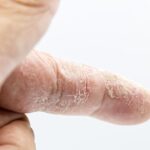




What Is Eczema Look Like During a Flare-Up vs. Between Flare-Ups?
Between flare-ups, the skin may look almost normal, though it is often drier than the rest of your skin. Some people have lingering patches of rough or slightly discolored skin even when the condition is quiet.
During a flare-up, the skin becomes actively inflamed. It looks redder or darker, feels warm to the touch, and itches more intensely. If you scratch, the skin can break open, weep clear fluid, and form crusts. This is not an infection — it is the skin’s inflammatory response. However, broken skin does increase the risk of bacterial infection, especially with Staphylococcus aureus.
How Can You Tell Eczema Apart From Other Skin Conditions?
Eczema is frequently confused with psoriasis, contact dermatitis, and fungal infections. Each has distinct features, though they can overlap.
Psoriasis usually produces thicker, silvery scales on well-defined plaques, commonly on the elbows, knees, and scalp. Eczema patches are less defined and tend to be more oozy or weepy when active. Contact dermatitis looks very similar to eczema but is caused by a specific irritant or allergen — it appears where the skin touched the trigger. Fungal infections often form ring-shaped patterns with a clearer center, which eczema does not.
If the rash does not improve with basic moisturizing and avoidance of triggers, see a dermatologist. A skin biopsy or patch testing may be needed to confirm the diagnosis.
What Causes the Skin to Look That Way?
Eczema is fundamentally a problem with the skin barrier. The outermost layer of skin holds in moisture and keeps irritants out. In people with eczema, this barrier is weaker than normal. Water escapes more easily, which is why the skin gets dry. Irritants and allergens penetrate more easily, which triggers the immune system to respond with inflammation.
The inflammation is what creates the redness, swelling, and itching. The immune system releases chemicals that make blood vessels dilate and leak fluid into the tissue. That fluid is what causes the swelling and the weeping that you see in severe flares. Genetics play a large role — a common mutation in the filaggrin gene, which helps build the skin barrier, is strongly linked to eczema.
When Should You See a Doctor?
Mild eczema can often be managed at home with regular moisturizing and by avoiding known triggers. But there are situations where medical evaluation is necessary.
See a doctor if the rash is widespread, severely itchy, or keeps you awake at night. Also seek care if you see signs of infection, such as yellow crusting, oozing pus, increased pain, or red streaks spreading from the area. A fever alongside an eczema flare is another warning sign. Eczema that does not respond to over-the-counter moisturizers and hydrocortisone after a week or two also warrants a professional opinion.
What Treatments Actually Change the Appearance of Eczema?
Treatment aims to restore the skin barrier and reduce inflammation. The most important daily step is moisturizing. Thick ointments like petroleum jelly or heavy creams work better than thin lotions because they trap more moisture in the skin. Apply them immediately after bathing while the skin is still damp.
For active flares, topical corticosteroids are the standard treatment. They reduce inflammation directly, which clears the redness and itching. Low-potency versions are available over the counter; stronger ones require a prescription. Newer non-steroid prescription options, such as topical calcineurin inhibitors, are also available and are often used on sensitive areas like the face.
For moderate to severe eczema that does not respond to topical treatment, newer biologic medications have changed the picture. These injectable drugs target specific parts of the immune system and have shown strong results in clinical trials. They are prescription-only and are typically reserved for people who have not improved with other treatments.
Can You Prevent Flare-Ups From Changing the Skin’s Appearance?
Prevention is about managing triggers. Common triggers include harsh soaps, wool fabrics, sweat, stress, and dry winter air. Identifying your personal triggers takes time, but keeping a simple log of flare-ups and what you were exposed to beforehand can help.
Bathing habits matter more than most people realize. Short, lukewarm showers are better than long, hot ones. Hot water strips the skin of its natural oils. Pat the skin dry with a towel instead of rubbing, and apply moisturizer within a few minutes of getting out.
It is worth noting that no treatment cures eczema. Even with excellent care, flare-ups can happen. The goal is to keep the skin healthy enough that flare-ups are less frequent and less severe.
Frequently Asked Questions
Can eczema look like dry skin only?
Yes, mild eczema can appear as nothing more than persistently dry, rough patches. The key difference is that eczema itches, while ordinary dry skin usually does not.
Does eczema always have a rash?
No. Between flare-ups, the skin may look normal or just slightly dry. The visible rash appears only when the skin is actively inflamed.
Can eczema look different on a baby than an adult?
Yes. Babies typically get eczema on the face, scalp, and outer arms and legs. Adults more often get it in the creases of the elbows and knees, and on the hands.
How long does an eczema flare-up last?
With proper treatment, a flare usually improves within one to three weeks. Without treatment, it can persist for months or become chronic.
