

Capsule endoscopy is a procedure that uses a tiny wireless camera inside a pill-sized capsule to take pictures of your digestive tract. It is mainly used to examine the small intestine, which is hard to reach with traditional endoscopy. The capsule is swallowed, passes through your system naturally, and is then excreted. It is generally safe, with low risk of complications, and costs vary widely depending on insurance and location.
What Is Capsule Endoscopy?
Capsule endoscopy is a non-invasive imaging test. You swallow a capsule about the size of a large vitamin pill. Inside is a small camera, a light source, a battery, and a transmitter. As the capsule moves through your digestive tract, it takes thousands of pictures. Those images are sent to a recorder you wear on a belt or vest. The capsule is single-use and passes out of your body in a bowel movement, usually within 24 to 48 hours.
The test is most commonly used to find the cause of bleeding in the small intestine. It can also detect polyps, tumors, Crohn’s disease, and other problems. It is not a replacement for upper endoscopy or colonoscopy, but it reaches areas those tests cannot.
How Does the Procedure Work?
You will likely be asked to follow a clear liquid diet for 24 hours before the test. A laxative may be given to clear the bowel. You should not eat or drink for about 10-12 hours before swallowing the capsule.
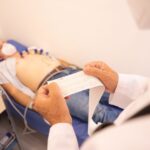
At the clinic, sensors are attached to your abdomen with adhesive patches. These sensors pick up signals from the capsule. You swallow the capsule with water. You can go home and continue normal activities, but you must avoid strenuous exercise, heavy lifting, or bending during the test. You also need to avoid eating for two hours after swallowing. After four hours you may have a light snack unless your doctor says otherwise.
You wear the recorder for about 8 to 12 hours. During this time the capsule takes images at a rate of 2 to 18 frames per second. After the recording period, you return to the clinic to return the recorder and sensors. The images are then downloaded and reviewed by a doctor. The capsule itself does not need to be retrieved — it leaves the body naturally.
What Conditions Does It Diagnose?
Capsule endoscopy is most helpful for unexplained bleeding, especially when the source is suspected to be in the small intestine. It is also used to diagnose Crohn’s disease, particularly when inflammation is limited to the small bowel. Other uses include detecting small intestinal tumors, polyps, and ulcers. It can sometimes help evaluate celiac disease if biopsies cannot be done through standard endoscopy.
The test can also be used to screen for polyps in people with hereditary polyposis syndromes. However, it is not a routine screening tool for colon cancer — colonoscopy remains the standard for that.




What Are the Risks and Side Effects?
Capsule endoscopy is very safe, but no medical test is risk-free. The most common risk is capsule retention — the capsule does not pass through and gets stuck in the digestive tract. This happens in about 1% to 2% of cases overall, but the rate is higher in people with known Crohn’s disease, tumors, or strictures. If the capsule stays stuck for more than a few days, doctors may need to remove it with endoscopy or, rarely, surgery.
Other risks are less common. The capsule could be aspirated (inhaled into the lungs) instead of swallowed, which requires emergency removal. There is also a small chance that the capsule’s battery dies before the test is complete or that a technical problem causes image loss. Some people experience mild discomfort or bloating from the bowel preparation, but this is not caused by the capsule itself.
Because the capsule is single-use, there is no risk of infection from the device. The sensors on your skin may cause mild irritation.
How Much Does Capsule Endoscopy Cost?
The cost of capsule endoscopy varies by location, hospital, and insurance plan. Without insurance, the procedure typically costs between $1,000 and $2,000. This includes the capsule, the recorder, the doctor’s interpretation, and facility fees. Some insurance plans cover capsule endoscopy when it is medically necessary, such as for unexplained gastrointestinal bleeding. You may still have a copay or deductible.
Medicare usually covers capsule endoscopy for certain conditions like obscure GI bleeding. Private insurance policies differ. It is important to check with your insurance company before the test to understand what is covered and what your out-of-pocket costs will be.
There is no official standard price for capsule endoscopy, so costs can be higher or lower depending on your specific situation. Some hospitals may charge more if the test is performed in an outpatient facility rather than a doctor’s office.
Who Should Not Have Capsule Endoscopy?
People with known or suspected intestinal blockages should not have capsule endoscopy. If a blockage is present, the capsule may get stuck and require surgery. People with swallowing disorders may also have difficulty — in some cases the capsule can be placed using endoscopy instead of being swallowed.
People with implanted electronic devices, such as pacemakers or defibrillators, were once warned against capsule endoscopy. However, current evidence shows the test is safe for most with these devices. Still, you should tell your doctor if you have any implanted device. Pregnant women are generally advised to avoid capsule endoscopy unless the benefit clearly outweighs the risk, though data on safety in pregnancy is limited.
How Does It Compare to Traditional Endoscopy?
Traditional endoscopy uses a long, flexible tube with a camera that is inserted through the mouth or rectum. It allows the doctor to see the upper GI tract or colon directly, take biopsies, and perform treatments. Capsule endoscopy cannot take biopsies or treat problems — it only produces images.
The main advantage of capsule endoscopy is that it can see the entire small intestine, which is about 20 feet long and mostly inaccessible to standard endoscopes. Traditional endoscopy can only reach the first part of the small intestine (duodenum) and the last part (terminal ileum). Capsule endoscopy is also less invasive and does not require sedation. However, it takes longer to get results and may miss some lesions if the capsule moves too quickly or if images are poor.
For most people, capsule endoscopy is used when traditional methods cannot find the source of bleeding or inflammation. It is a complementary test, not a replacement.
Frequently Asked Questions
How long does capsule endoscopy take?
The recording period lasts 8 to 12 hours. You swallow the capsule and wear the recorder for that time. The entire process from prep to results takes about 24 to 48 hours.
Is capsule endoscopy painful?
No. Swallowing the capsule is like swallowing a large pill. You feel nothing while it moves through your body. Some people find the bowel preparation uncomfortable, but the test itself is painless.
What happens if the capsule gets stuck?
If the capsule does not pass within a few days, your doctor may order an X-ray to locate it. If it remains stuck and causes symptoms like pain or vomiting, removal with endoscopy or surgery may be needed. This is rare.
Can you eat before capsule endoscopy?
No. You must follow the preparation instructions given by your doctor, usually a clear liquid diet for 24 hours and then nothing by mouth for 10-12 hours before swallowing the capsule. A clean bowel gives the best images.
