
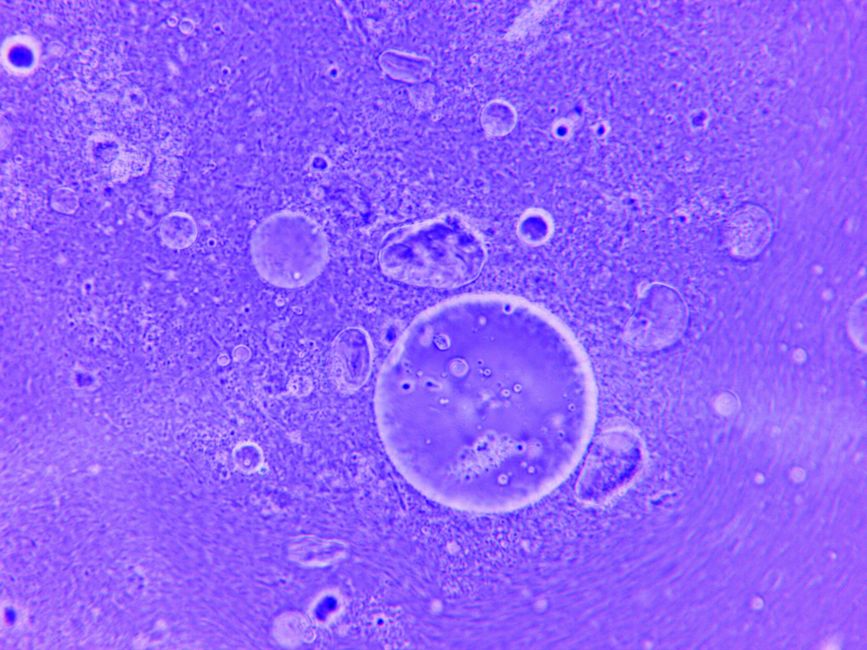
An ovular cell — more precisely called an oocyte, or egg cell — is the female reproductive cell that carries half the genetic material needed to create a new human being. It is one of the largest cells in the human body, visible to the naked eye at roughly 0.1 millimeters in diameter. Its structure includes a protective outer shell, a nutrient-rich interior, and a nucleus holding 23 chromosomes. Its functional lifespan is long and unusual: a female is born with all the oocytes she will ever have, and those cells can remain dormant for decades before one is released during ovulation.
What Is an Ovular Cell and How Does It Differ From Other Cells?
An ovular cell is a female gamete — a reproductive cell. Its job is to merge with a sperm cell to form a zygote, the single cell that will divide and develop into an embryo.
What makes it different from nearly every other cell in the body is its size and its purpose. Most human cells are microscopic and measured in micrometers. A mature oocyte is roughly 100 micrometers across, making it one of the largest cells in the body. It is built to store nutrients, protect genetic material, and support the first few days of development before an embryo can implant in the uterus.
Unlike body cells that divide constantly, oocytes are produced before birth and then held in a paused state for years. They do not replicate. Each one is unique and irreplaceable.
What Is the Structure of an Ovular Cell?
The oocyte has several distinct layers, each with a specific role. Understanding the structure helps explain how fertilization works and why egg quality matters.
Zona pellucida — This is a thick, gel-like shell surrounding the egg. It protects the cell and plays a key role in fertilization. When a sperm penetrates the zona pellucida, the shell hardens almost immediately. This blocks additional sperm from entering, preventing an embryo from receiving too many sets of chromosomes.
Corona radiata — A layer of cells that sits just outside the zona pellucida. These cells provide nutrients to the egg and help it move through the fallopian tube. They are shed gradually after ovulation.
Ooplasm (cytoplasm) — The interior of the egg. It contains water, proteins, mitochondria, and stored nutrients. The mitochondria in an oocyte are particularly important because they supply the energy for early cell division after fertilization. Unlike most cells, where mitochondria come from both parents, mitochondria in an embryo come almost entirely from the egg.
Nucleus — The oocyte nucleus contains 23 chromosomes — half the usual 46 found in body cells. During fertilization, the sperm contributes the other 23. The nucleus also contains the nucleolus, a structure involved in building ribosomes, which are needed for protein production once the embryo begins developing.
Plasma membrane — The outer membrane of the egg cell itself. It regulates what enters and exits the cell and participates in the fertilization reaction.
What Is the Function of an Ovular Cell?
The primary function of an oocyte is to combine with a sperm cell and create a new organism. But that single sentence undersells what the cell actually does.
Before fertilization, the egg is metabolically active. It builds up stores of proteins, RNA, and nutrients that will be needed in the first days after fertilization — before the embryo can produce its own energy or build its own proteins.
After fertilization, the oocyte completes a division process it had been paused in. It releases a second polar body, a small packet of discarded genetic material, and becomes a mature fertilized egg. From there, it begins dividing. The first few cell divisions happen while the embryo is still traveling down the fallopian tube toward the uterus.
The egg also contributes more than DNA. It provides the mitochondria that power early development, the molecular signals that guide the first cell divisions, and the protective shell that controls the timing of implantation.




How Long Does an Ovular Cell Live?
The lifespan of an oocyte depends on which stage you are measuring. There are three distinct timelines.
Before ovulation: A female is born with all the oocytes she will ever have — roughly one to two million at birth. These cells remain paused in an early stage of division for years, sometimes for more than four decades. This is one of the longest-lived cell types in the human body.
After ovulation: Once an egg is released from the ovary, its viable lifespan is short. Most sources estimate it can be fertilized for roughly 12 to 24 hours after release. After that window, it begins to degrade if fertilization does not occur.
Sperm survival in the reproductive tract: Sperm can survive for up to about five days in the female reproductive tract under favorable conditions. This means fertilization is possible if intercourse occurs in the days leading up to ovulation, not just on the day itself.
These timelines are well established in reproductive medicine. They are also why fertility awareness methods focus on the days around ovulation.
Why Does Egg Quality Decline With Age?
Egg quality declines with age, and the reason is tied directly to how long oocytes sit in a paused state. This is one of the more non-obvious facts about reproductive biology.
Oocytes are formed before birth and then arrest in the first stage of cell division. They stay there until just before ovulation, when they resume division. Over decades, the machinery that holds chromosomes in place can weaken. Proteins that keep chromosomes properly organized degrade over time. The result is that older eggs are more likely to have chromosomal errors — too many or too few chromosomes — which can lead to miscarriage or conditions like Down syndrome.
This is a biological reality, not a lifestyle failure. Age is the single strongest factor affecting egg quality, and it is not something anyone can control. Other factors — smoking, certain medical treatments, and some environmental exposures — may also affect ovarian reserve and egg health, but the evidence for many lifestyle interventions on egg quality specifically is limited.
No supplement, diet, or procedure has been proven in large human trials to reverse or significantly slow the age-related decline in egg quality. Some clinics recommend certain supplements based on small studies or biological reasoning, but the evidence base is not strong. Anyone considering such products should understand the difference between a plausible mechanism and demonstrated benefit.
How Many Eggs Does a Female Have at Different Life Stages?
The number of oocytes declines steadily from before birth. Here is the general pattern based on established reproductive data:
| Life Stage | Approximate Number of Oocytes |
|---|---|
| Around 20 weeks of fetal development | 6 to 7 million |
| At birth | 1 to 2 million |
| At puberty | 300,000 to 500,000 |
| At menopause | Fewer than 1,000 |
These numbers are estimates from established reproductive research. The vast majority of oocytes never ovulate — they are lost through a natural process called atresia, in which immature eggs degenerate and are reabsorbed by the body. Only about 300 to 400 eggs will ever be released through ovulation during a typical reproductive lifetime.
The rate of decline is not perfectly linear. It accelerates in the late 30s and early 40s, which is one reason fertility rates drop more sharply during that period.
What Happens to an Egg If It Is Not Fertilized?
If an egg is not fertilized within its viable window, it degenerates and is reabsorbed by the body. The corpus luteum — the structure left behind in the ovary after ovulation — continues producing progesterone for about 12 to 14 days. When the egg is not fertilized, the corpus luteum breaks down, progesterone levels drop, and the uterine lining is shed as menstruation.
This cycle repeats roughly every 28 days on average, though normal cycles range from about 21 to 35 days. The egg itself does not linger. It simply breaks down, and the body moves on to prepare the next cycle.
Can Egg Quality Be Improved?
This is where honesty matters. There is no proven method to reverse the biological aging of oocytes. However, some factors are associated with better reproductive outcomes in general.
Not smoking is strongly associated with better fertility outcomes and earlier menopause. Maintaining a healthy weight is associated with more regular ovulation. Some evidence suggests that certain nutrient deficiencies — if present — can affect fertility, but correcting a deficiency is not the same as improving egg quality beyond a normal baseline.
For anyone concerned about egg quality or ovarian reserve, the most reliable step is to consult a reproductive endocrinologist. Tests such as anti-Müllerian hormone (AMH) levels and antral follicle counts can estimate ovarian reserve, though they do not directly measure egg quality. No test currently measures egg quality directly.
Frequently Asked Questions
What is an ovular cell?
An ovular cell, or oocyte, is the female reproductive cell that carries 23 chromosomes and can combine with a sperm cell to form an embryo. It is one of the largest cells in the human body, measuring about 0.1 millimeters across.
How long can an egg cell live after ovulation?
An egg is generally viable for fertilization for about 12 to 24 hours after it is released from the ovary. If fertilization does not occur within that window, the egg breaks down and is reabsorbed.
How many eggs is a woman born with?
A female is born with approximately 1 to 2 million oocytes, and that number declines steadily over her lifetime. By puberty, roughly 300,000 to 500,000 remain, and fewer than 1,000 are present at menopause.
Can you improve egg quality naturally?
No supplement or lifestyle change has been proven to reverse age-related declines in egg quality. Not smoking and maintaining a healthy weight are associated with better overall fertility, but age remains the strongest factor affecting egg quality.
