
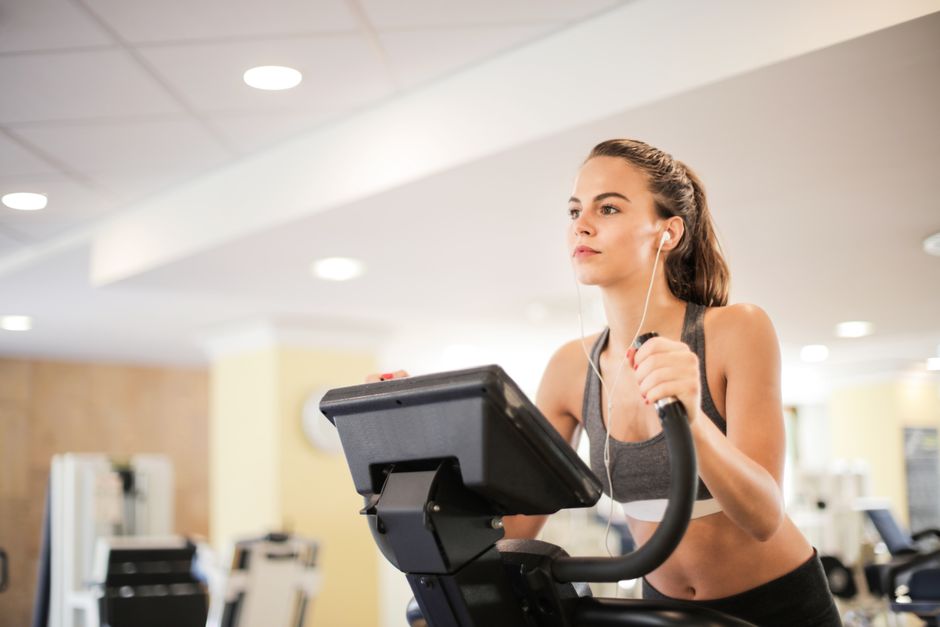
An elliptical machine is a stationary exercise device that lets you walk, jog, or run in a smooth, oval-shaped motion while your feet stay on pedals. Because your feet never leave the pedals, the movement is low-impact — there is no landing force like there is with running. It works both your upper and lower body at the same time through moving handles and foot pedals connected to a flywheel and resistance system.
What Is an Elliptical Machine and How Does It Work?
The elliptical gets its name from the path your feet trace — an elongated oval. Instead of striking the ground, your feet glide along that path, driven by two pedals that move in opposition to each other.
When you push down on one pedal, the other rises. Handle bars linked to the pedals move back and forth, so your arms and legs work together. A flywheel smooths the motion, and a resistance mechanism — either a magnetic system, an eddy current brake, or in older or cheaper models a friction pad — makes the pedaling harder or easier.
Because your feet stay planted, the impact forces that travel up through your ankles, knees, and hips during running are largely absent. That is the central mechanical difference between an elliptical and a treadmill. The trade-off is that you are not supporting your full body weight against gravity in the same way, so the movement pattern is not identical to walking or running.
Most machines also let you change the incline, which alters the angle of the footpath and shifts which muscles do more of the work. Some models include moving handles that add a pushing and pulling motion for the upper body.
Is an Elliptical a Good Workout?
Yes, if you use it hard enough and long enough to raise your heart rate into a training zone. The machine itself does not determine the workout — your effort does.
Research consistently shows that regular aerobic exercise improves cardiovascular fitness, helps manage blood pressure and blood sugar, and supports weight control when combined with appropriate eating. An elliptical can deliver that aerobic stimulus, and the American College of Sports Medicine and other major health bodies recommend adults get at least 150 minutes of moderate-intensity aerobic activity per week, or 75 minutes of vigorous activity, along with muscle-strengthening work on two or more days.
What an elliptical does not do well on its own is build bone. Bone responds to impact and to load-bearing forces. Because the elliptical removes most of the impact, it is generally not a strong stimulus for improving bone density the way walking, running, or resistance training can be. If bone health is a goal, the elliptical is a supplement to weight-bearing exercise, not a replacement.
It also does not build much muscle mass on its own. The resistance is light compared with weight training, and the motion is repetitive. Some studies suggest that elliptical use can improve balance and lower-body strength modestly in older adults, but the evidence base is smaller than for walking or traditional resistance training.
What Muscles Does an Elliptical Work?
The lower body does most of the work. Your quadriceps, hamstrings, glutes, and calves all contribute to pushing the pedals. Your hip flexors help lift the leg on the return phase.
If you use the moving handles, your upper body joins in. Your lats, chest, shoulders, biceps, and triceps all activate to some degree as you push and pull. The amount depends on how much you actually grip and drive the handles rather than just resting your hands on them.
Your core stabilizes the whole movement. It is not a targeted abdominal exercise, but it is active throughout.
Changing the incline changes the emphasis. Higher inclines tend to shift more work to the glutes and hamstrings. Lower inclines with higher resistance tend to emphasize the quads. Reverse pedaling — going backward — shifts some load to the hamstrings and calves and is a common way to vary the stimulus.





Elliptical vs Treadmill vs Stationary Bike
Each machine offers a different balance of impact, muscle involvement, and joint load. There is no single best choice — the best one is the one you will actually use consistently.
| Machine | Impact on joints | Upper body involvement | Weight-bearing load |
|---|---|---|---|
| Elliptical | Low | Yes, with handles | Partial |
| Treadmill | Moderate to high, depends on speed | Minimal | Full |
| Stationary bike | Very low | None | Minimal |
A treadmill involves full weight-bearing and impact, which makes it a better stimulus for bone if you walk or run on it. It also more closely mimics real walking and running. The downside is that the repeated impact can aggravate knee, hip, or ankle problems in some people.
A stationary bike removes almost all impact and is often well tolerated by people with knee pain, but it does not involve the upper body at all and offers no bone-loading benefit.
The elliptical sits between them. It is low-impact like a bike but involves the arms and a standing posture more like walking. That combination is why it is often chosen by people who want a cardio workout without aggravating joints.
Who Should Use One — and Who Should Be Careful?
Ellipticals are commonly used by people who want cardio without the pounding of running. That includes people with knee or hip osteoarthritis, people recovering from certain injuries, and older adults who want to stay active with less joint stress.
They are also a reasonable option for people who are new to exercise and want a machine that is easy to start on and hard to fall off.
There are situations where an elliptical is not the best first choice. People with significant balance problems may find the standing position and moving handles challenging. People with certain hip or knee conditions may find the fixed footpath uncomfortable because the foot position is constrained — you cannot adjust your stride the way you can on a treadmill. Anyone with a heart condition, uncontrolled blood pressure, or who is pregnant should talk with a clinician before starting a new exercise program, as should anyone with an injury that has not been assessed.
There is no clinical guideline that says an elliptical is safer or more effective than any other cardio machine for a specific condition. The evidence is general: low-impact aerobic exercise is well tolerated by many people with joint pain, and the elliptical is one way to get it.
How to Use an Elliptical Correctly
Stand tall. Do not lean heavily on the handles or hunch over the console. Your weight should be over your feet, not resting on your arms.
Keep your feet flat on the pedals. Let your heel stay in contact rather than pushing only through the ball of your foot. This reduces strain on the calves and ankles.
Use a resistance and pace that lets you talk in short sentences if you are aiming for moderate intensity. If you cannot speak without gasping, you are working vigorously — which is fine, but not for the whole session if you are new.
Start with a warm-up of a few minutes at low resistance, then increase. Cool down at the end. If you feel sharp pain, dizziness, or chest discomfort, stop and seek medical attention.
A common mistake is setting the resistance too low and coasting. The machine will feel easy and your heart rate will stay low. If the goal is fitness, you need enough resistance and speed to make the work real.
Common Elliptical Myths
One claim is that the elliptical is “better than running” because it is low-impact. It is not better — it is different. Running loads bone and builds more leg strength per minute in most people. The elliptical spares joints. Which one is better depends on your goals and your body.
Another claim is that the elliptical “does not work your legs” because there is no impact. That is false. Your legs are doing the work — they are just not absorbing landing forces. Muscle activation during elliptical use is real and measurable.
A third claim is that you can “spot reduce” belly fat with an elliptical. No exercise does that. Fat loss happens across the whole body through a calorie deficit, and where you lose it first is largely determined by genetics and hormones.
Finally, some marketing suggests an elliptical can replace strength training. It cannot. Resistance on an elliptical is light and repetitive. Building or maintaining muscle mass requires progressive resistance — weights, bands, or bodyweight work that gets harder over time.
Frequently Asked Questions
Is an elliptical as good as running?
It is not better or worse — it is different. Running builds more bone and usually burns more calories per minute, while the elliptical is lower impact on joints and involves the upper body.
How long should I use an elliptical to see results?
General aerobic guidelines recommend at least 150 minutes of moderate-intensity activity per week, which can be split across elliptical sessions and other exercise. Visible changes in fitness typically take several weeks of consistent work.
Does an elliptical build muscle?
It builds some lower-body endurance and modest strength, especially if you use higher resistance. It does not build significant muscle mass the way progressive resistance training does.
Can I use an elliptical every day?
Many people can, but daily hard sessions without rest can lead to overuse issues. Alternating elliptical work with walking, strength training, or rest days is generally a more sustainable pattern.
