
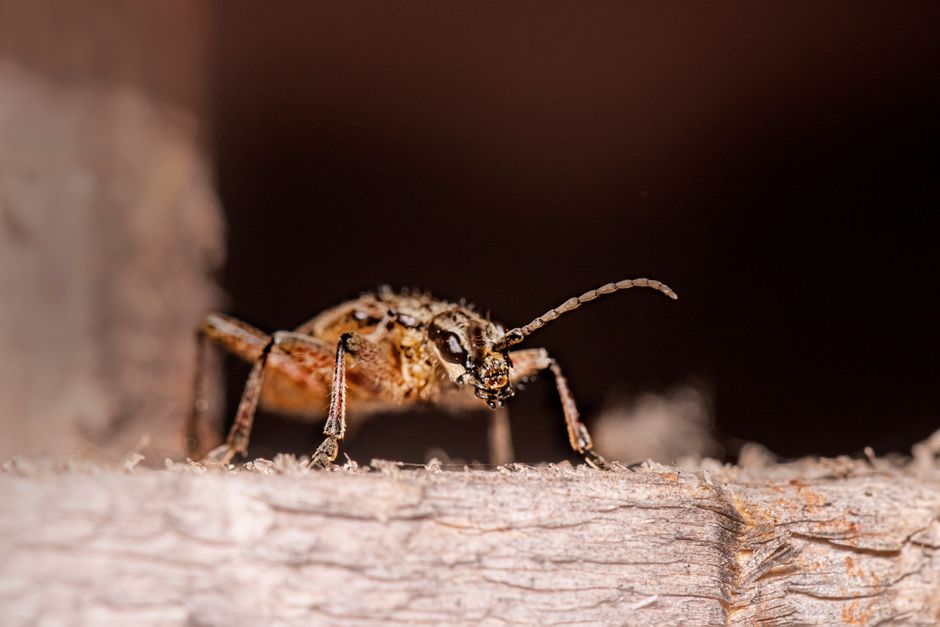
A wood borer is any insect that tunnels into wood, and the term covers several different species — including beetles, moths, and wasps — that share the same destructive habit. The insects themselves are rarely what you see. What you find is the damage: small round or oval holes, fine sawdust, and wood that crumbles or sounds hollow. Treatment depends entirely on which borer is present and whether the wood is structural or decorative, which is why identification comes before any chemical or physical fix.
What Is A Wood Borer?
A wood borer is an insect whose larvae feed inside wood, hollowing out tunnels as they grow. The adult insects lay eggs on or just under the wood surface. When the eggs hatch, the larvae — often called grubs or woodworms — chew inward and can spend months or years feeding before they emerge as adults.
That life cycle matters for two reasons. First, the damage usually happens while the insect is hidden, so by the time you spot an exit hole the wood may already be weakened inside. Second, the adult stage is when the insects spread to new wood, so timing any treatment around the life cycle affects how well it works.
Wood borers are not one family of insects. They come from different orders entirely, and they attack different kinds of wood for different reasons. A borer in a damp floor joist is a very different problem from one in a dry oak chair leg.
What Are the Main Types of Wood Borer?
The main types fall into a few broad groups, each with its own habits and preferred wood. Knowing the group narrows down what you are dealing with.
- Furniture beetles (also called woodworm in older British usage) attack seasoned hardwood and softwood, often in furniture, flooring, and structural timber. The common furniture beetle is one of the most frequently reported indoor wood pests.
- Deathwatch beetles favor older, damp structural timber, particularly in older buildings. They are associated with decayed or moisture-damaged wood.
- Powderpost beetles reduce wood to a fine, flour-like dust. They tend to attack hardwoods and can reinfest finished wood products.
- Longhorn beetles are larger and their larvae can do serious structural damage in some species. They are more commonly associated with trees and freshly felled timber than with indoor furniture.
- Carpenter bees and carpenter ants are not true wood borers in the larval sense — they excavate wood to nest — but their damage is often confused with borer damage.
- Wood-boring moths (such as the leopard moth) attack living trees and are less often an indoor structural issue.
This is not an exhaustive list. Many borer species exist, and exact identification often requires an entomologist or pest professional examining the insect or the frass (the sawdust-like material the larvae leave behind).
What Are the Signs of a Wood Borer Infestation?
The signs of wood borer activity are usually physical and visible, even when the insects themselves are not. Look for these clues:
- Exit holes. Small round or oval holes in wood, often roughly the diameter of a pencil lead up to a few millimeters. Fresh holes with clean edges suggest recent activity.
- Frass. Fine sawdust, wood dust, or tiny pellets collecting below holes or on surfaces. The texture varies by species — some produce flour-like dust, others coarser pellets.
- Weak or hollow-sounding wood. Tapping the surface may reveal a hollow sound where tunnels have formed inside.
- Crumbling edges. Wood that dents easily or breaks at the surface.
- Adult insects. Occasionally you see the adult beetle or moth, especially near windows after emergence.
One clarification worth making: a single old exit hole does not automatically mean active infestation. Many holes are years old and the insects long gone. Fresh frass and new holes are stronger evidence of current activity than holes alone.
How Do You Tell Wood Borers Apart From Termites and Other Pests?
Wood borer damage is often mistaken for termite damage, and the two require different responses. The distinction is worth getting right before you spend money on treatment.
Termites typically leave mud tubes, soft and hollowed wood with a honeycombed interior, and often damage that runs with the grain in long galleries. Borer damage tends to show as distinct round exit holes with frass nearby, and the tunnels are usually the size of the larva that made them.
Carpenter ants and carpenter bees excavate smooth, clean tunnels and push debris outward — carpenter ants leave sawdust piles, while carpenter bees leave coarse frass and often stain wood near the entrance. Powderpost beetles leave very fine dust. The exact material left behind is one of the most reliable clues.
When the evidence is ambiguous, a pest control professional or a qualified inspector can identify the insect from frass, holes, or specimens. Guessing wrong can mean treating the wrong pest entirely.
What Causes a Wood Borer Infestation?
Wood borers need three things: suitable wood, moisture, and a way in. Most infestations trace back to one or more of these.
Moisture is a major factor. Damp wood — from leaks, poor ventilation, or rising damp — is more attractive to several borer species and more susceptible to the decay that often accompanies them. Fixing the moisture source is frequently more important than any spray.
Reused or salvaged timber can carry borers indoors. So can firewood stored against a building, or furniture made from untreated or infested wood. In older buildings, long-established populations can persist in structural timber for years.
Newly built homes are less commonly affected by the classic furniture beetle, but powderpost beetles can infest new hardwood flooring and furniture, so new does not mean immune.
How Is a Wood Borer Infestation Treated?
Treatment depends on the species, the extent of the damage, and whether the wood is structural. There is no single universal fix, and the evidence for some treatments is stronger than for others.
For limited, non-structural problems — a piece of furniture, a small decorative item — removing and discarding the affected item is often the simplest and most reliable step. For structural timber, professional assessment comes first, because the priority is whether the wood still carries its load safely.
Insecticidal treatments exist, including surface sprays and injected formulations for structural wood, and they are widely used by pest control professionals. The evidence for their effectiveness varies by product and species, and correct application matters. Some clinicians and pest professionals also use heat treatment for certain items, though availability and suitability vary.
What does not reliably work: home remedies such as vinegar, borax solutions, or essential oils marketed as borer killers. No clinical or pest-management evidence confirms these eliminate an established infestation. They may make you feel proactive, but they are not a substitute for proper identification and, where needed, professional treatment.
Any structural work should follow an assessment of the wood’s remaining strength. Cosmetic filling of holes does not address the tunnels inside.
How Can You Prevent Wood Borers?
Prevention centers on keeping wood dry and keeping infested wood out of the building.
- Fix leaks and improve ventilation in crawl spaces, basements, and roof areas.
- Store firewood away from the house and never against exterior walls.
- Inspect salvaged or secondhand timber and furniture before bringing it indoors.
- Seal or paint exposed structural wood where appropriate — this can reduce egg-laying on some surfaces, though it is not a guarantee.
- Address wood decay promptly, since decay and borer activity often go together.
Regular inspection of older buildings, especially around joists, floorboards, and roof timbers, catches problems earlier. Early detection usually means less damage and simpler treatment.
When Should You Call a Professional?
Call a professional when you find active signs in structural wood, when damage is extensive, or when you cannot confidently identify the insect. Structural timber supports the building, and getting the assessment wrong can be costly.
A qualified pest professional can identify the species, judge whether the infestation is active, and advise on treatment options and whether the wood needs repair or replacement. For anything load-bearing, a building surveyor may also be needed.
For a single piece of furniture with a few old holes, professional help may be unnecessary. For floor joists, roof timbers, or repeated fresh frass, it usually is.
Frequently Asked Questions
Are wood borers dangerous to humans?
Wood borers do not bite or sting people and are not known to transmit disease. The real risk is structural — weakened timber that can fail over time.
How do I know if wood borer holes are active?
Fresh frass below the holes and new holes with clean edges are the strongest signs of current activity. Old holes with no fresh dust are often inactive.
Does vinegar or borax kill wood borers?
No reliable evidence confirms that household remedies like vinegar or borax eliminate an established wood borer infestation. Proper identification and, for structural wood, professional treatment are more dependable.
Can wood borers spread to other furniture?
Some species, including furniture beetles and powderpost beetles, can spread to nearby wood. Isolating and inspecting affected items early helps limit the spread.
