

A bimalleolar fracture is a break of both the medial malleolus and the lateral malleolus — the two bony bumps on either side of your ankle. Together they form the ankle mortise, the socket that holds the talus bone and allows the joint to move. When both bumps break, the ankle joint becomes unstable, and treatment almost always involves surgery to restore stability and alignment.
This is one of the most common ankle fractures surgeons treat. It is also one of the most misunderstood by patients, who often assume a broken ankle is a broken ankle. The location and number of breaks matter a great deal for how the injury is treated and how the ankle functions afterward.
What Is A Bimalleolar Fracture?
The ankle is not a single bone. It is a joint formed by three bones: the tibia (shin bone), the fibula (the smaller bone alongside it), and the talus (the bone that sits between them and connects to the foot). The lower end of the tibia has a bony projection on its inner side called the medial malleolus. The lower end of the fibula forms the lateral malleolus on the outer side.
When both of these projections break, the result is a bimalleolar fracture. The word “bi” means two, and “malleolus” refers to each bony bump. A fracture of just one side is a unimalleolar fracture. A fracture involving both malleoli plus the posterior edge of the tibia (the back of the shin bone) is called a trimalleolar fracture.
The distinction matters because the two malleoli together create the stability of the ankle joint. Break one and the joint may still hold. Break both and the talus can shift out of position, which is why this injury is typically treated as an unstable fracture.
What Causes A Bimalleolar Fracture?
Most bimalleolar fractures come from a twisting or rolling force applied to the ankle. The foot is planted, the body rotates, and the bones absorb a load they were not designed to handle.
Common causes include:
- Falls, especially from a height or on uneven ground
- Sports injuries involving sudden pivoting or landing
- Motor vehicle collisions
- Direct impact or crushing force to the ankle
- Low-energy twisting in people with weakened bone, such as from osteoporosis
The pattern of the break often tells the surgeon something about the direction of the force. A common mechanism is the ankle rolling outward (external rotation), which stresses the fibula first and then the medial side of the ankle. The specific fracture pattern guides how the injury is repaired.
Age and bone quality influence who gets this injury. Younger, active people tend to sustain bimalleolar fractures from higher-energy events. Older adults can sustain the same injury from a simple fall because bone strength declines with age. Research consistently shows that ankle fracture rates rise in older populations, and the proportion of fractures occurring in people with osteoporosis has grown.
What Are The Symptoms Of A Bimalleolar Fracture?
The symptoms are usually obvious and immediate. Most people know something serious has happened the moment it occurs.
Typical signs include:
- Sudden, severe pain at the ankle
- Rapid swelling around the joint
- Inability to put weight on the foot
- Visible deformity, where the ankle looks bent or out of place
- Bruising that develops over hours to days
- Tenderness directly over both the inner and outer ankle bones
Deformity is a red flag. If the ankle looks crooked or the foot is angled abnormally, the joint may be dislocated or subluxed, meaning the bones have shifted out of their normal position. This is a medical emergency that needs prompt evaluation, because prolonged dislocation can injure the skin, nerves, and blood vessels around the ankle.
Not every bimalleolar fracture looks dramatic. Some produce swelling and pain without obvious deformity. That is why any ankle injury with severe pain and inability to bear weight should be assessed rather than assumed to be a sprain.



How Is A Bimalleolar Fracture Diagnosed?
Diagnosis starts with a physical exam. A clinician will look at the ankle, check for swelling and deformity, feel for tenderness over each malleolus, and test blood flow and sensation in the foot. They will ask how the injury happened.
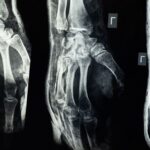
Imaging confirms the diagnosis. X-rays are the standard first test. They show whether both malleoli are broken, whether the bones are displaced, and whether the joint space is even. Clinicians often take X-rays from several angles to see the full picture.
In some cases, a CT scan is used. It gives a more detailed three-dimensional view of the fracture, which helps surgeons plan the repair, particularly when the fracture extends into the joint surface or when the pattern is complex.
One useful point: the severity of a bimalleolar fracture is not measured by pain alone. Some fractures that look relatively mild on the outside involve significant joint instability underneath. That is why imaging matters even when pain seems manageable.
How Is A Bimalleolar Fracture Treated?
Most bimalleolar fractures are treated with surgery. The reason is stability. When both malleoli are broken, the ankle joint loses the bony support that keeps the talus centered. Without repair, the joint can heal in a poor position, which raises the risk of arthritis and chronic pain later.
Surgery, called open reduction and internal fixation (ORIF), involves realigning the broken bones and holding them in place with metal plates and screws. The hardware stays in place permanently in most cases, though it can sometimes be removed later if it causes irritation.
Some bimalleolar fractures can be treated without surgery. This is generally reserved for fractures where the bones are not displaced and the joint remains stable. Even then, the ankle is protected in a cast or boot and kept off the ground for a period while it heals. The decision between surgery and conservative treatment is made by the treating clinician based on the specific fracture pattern, the patient’s activity level, and other health factors.
After surgery or casting, recovery follows a staged path:
- Protection phase: The ankle is immobilized and weight-bearing is limited while the bone begins to heal.
- Mobility phase: Guided movement and physical therapy begin to restore range of motion.
- Strengthening phase: Progressive loading and strengthening rebuild the muscles around the ankle.
Timelines vary widely by person, fracture severity, and whether surgery was performed. Bone healing generally takes weeks, and full return to demanding activity often takes several months. Clinicians set weight-bearing and activity limits individually, so patients should follow their own care plan rather than a general timeline.
What Are The Risks And Complications?
Like any fracture, bimalleolar fractures carry risks. Some relate to the injury itself, and some relate to treatment.
Injury-related risks include post-traumatic arthritis, stiffness, and chronic ankle pain. Because the fracture involves the joint surface, the cartilage can be damaged, and this can lead to arthritis years later. The risk is higher when the joint was significantly displaced or when the fracture extends into the weight-bearing surface of the tibia.
Surgery-related risks include infection, problems with wound healing, blood clots, nerve irritation, and hardware that causes discomfort. These are real but uncommon in healthy patients, and surgeons take steps to reduce them.
One factor that strongly influences outcomes is whether the ankle is restored to a stable, well-aligned position. Research consistently shows that anatomic restoration of the joint is linked to better long-term function. This is a major reason surgery is recommended for unstable fractures.
Can A Bimalleolar Fracture Be Prevented?
Not every fracture can be prevented, but some risks can be reduced. Strengthening the muscles around the ankle and improving balance help lower the chance of falls and twisting injuries, particularly in older adults.
Bone health matters too. Adequate calcium and vitamin D intake, weight-bearing exercise, and appropriate medical management of osteoporosis all support bone strength. People with known low bone density should discuss fall prevention and bone health with a clinician.
Practical steps like wearing supportive footwear, using handrails on stairs, and removing tripping hazards at home reduce fall risk. In sports, proper training and conditioning can lower the chance of the twisting injuries that cause many ankle fractures.
None of these steps guarantees prevention. They reduce risk, not eliminate it.
Frequently Asked Questions
Is a bimalleolar fracture serious?
Yes. It involves both sides of the ankle joint and usually makes the joint unstable, which is why surgery is often needed. With proper treatment, most people recover good function, but recovery takes time.
Will I need surgery for a bimalleolar fracture?
Most bimalleolar fractures are treated with surgery to restore stability and alignment of the ankle joint. Some non-displaced fractures can be treated without surgery, and the decision is made by the treating clinician based on the specific fracture pattern.
How long does it take to recover from a bimalleolar fracture?
Bone healing generally takes weeks, and full return to demanding activity often takes several months. Recovery timelines vary widely by person, fracture severity, and treatment, so patients should follow their own care plan.
Can a bimalleolar fracture heal without surgery?
In some cases where the bones are not displaced and the joint remains stable, yes. Unstable or displaced fractures generally require surgery because healing in a poor position raises the risk of arthritis and chronic pain.
