
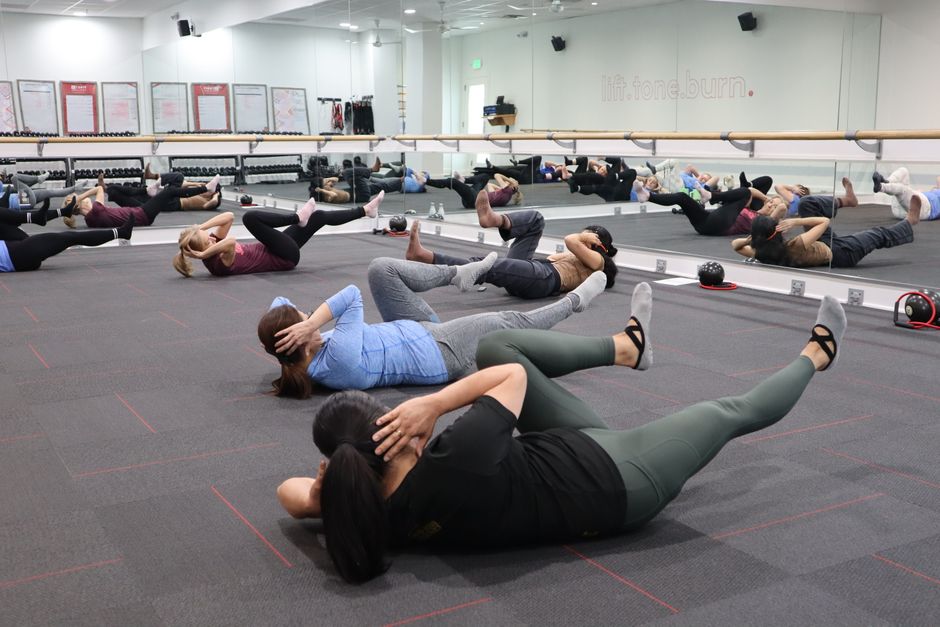
A barre class is a workout that combines ballet-inspired movements with fitness training, using a ballet barre for support. It blends elements of dance, Pilates, and yoga with light resistance training to build strength, improve posture, and increase flexibility. The focus is on small, controlled movements that target specific muscle groups, especially the legs, glutes, and core.
What Happens In A Typical Barre Class?
A typical barre class runs between 45 and 60 minutes. You start with a warm-up, then move through sections targeting different parts of the body. Most classes follow a similar structure: arms and upper body, thighs, glutes, and a core section at the end. You finish with a cool-down and stretching.
The instructor leads you through exercises at the barre and on a mat. You hold the barre for balance, not for pulling yourself into position. Many movements are tiny and precise. You might do a small pulse at the barre, hold a squat position, or lift your leg just a few inches. These small movements create sustained tension in the muscle, which is what makes the workout challenging.
You will use light weights, often 1 to 3 pounds, for arm work. Some classes use resistance bands, small balls, or sliders. The equipment is simple because the workout relies on body positioning and repetition rather than heavy resistance.
What Muscles Does Barre Work?
Barre primarily targets the lower body. The thighs, hamstrings, glutes, and calves do most of the work. The constant tension and small pulses fatigue these muscles quickly, even though you are not using heavy weights.
The core is also a major focus. Almost every exercise requires you to stabilize your torso while your arms or legs move. This constant stabilization trains the deep abdominal muscles, including the transverse abdominis, which acts like a natural corset around your midsection.
Upper body work is included but is less intense than lower body work. The light weights tone the arms, shoulders, and upper back. You will not build large muscles with 2-pound weights, but you can improve muscular endurance and definition.
Postural muscles get significant attention. The exercises emphasize a lengthened spine, pulled-in abdominals, and relaxed shoulders. Over time, this can improve how you stand and sit outside of class.
What Are The Benefits Of Barre Classes?
Barre improves muscular endurance. Holding a position or performing repeated pulses trains your muscles to work for longer periods without fatigue. This type of endurance is useful for everyday activities like carrying groceries, climbing stairs, or standing for long periods.
Balance and stability improve with regular practice. The barre gives you support while you challenge your balance on one leg or in an unstable position. Over weeks and months, your body learns to stabilize itself more effectively, which reduces fall risk as you age.
Flexibility is a genuine benefit. Barre classes include dedicated stretching sections, and the movements themselves take joints through a wide range of motion. Research on barre specifically is limited, but the stretching component shares similarities with static stretching programs that have been shown to improve flexibility over 8 to 12 weeks.
Posture often improves. The constant cues to lengthen the spine, tuck the pelvis, and engage the core reinforce good alignment. Many people report standing taller after a few months of consistent practice.
Barre is low impact. There is no jumping or running, which makes it easier on the knees, ankles, and hips compared to high-impact workouts. This makes it accessible for people with joint concerns, though you should still check with a doctor if you have a specific injury.





Is Barre Good For Weight Loss?
Barre is not a high-calorie-burning workout. A typical class burns fewer calories than running, cycling, or a high-intensity interval training session. The small movements and sustained holds are not designed to spike your heart rate.
However, barre can contribute to weight loss as part of a broader fitness routine. Building muscle, even small amounts, increases your resting metabolic rate slightly. More importantly, consistent exercise of any kind supports weight management when combined with a balanced diet.
If weight loss is your primary goal, barre alone is probably not enough. You would likely see faster results combining barre with cardiovascular exercise like brisk walking, swimming, or cycling several days per week. The American College of Sports Medicine recommends at least 150 minutes of moderate-intensity cardio per week for general health and weight management.
Who Should Take A Barre Class?
Barre suits a wide range of fitness levels. Beginners can take classes because the movements are low impact and the barre provides support. You can adjust the intensity by how deeply you bend your knees or how far you lift your leg.
People recovering from certain injuries often find barre appealing because it is gentle on the joints. The controlled movements are less likely to cause sudden strain than running or jumping. Still, if you have a specific injury, especially in the back, hip, or knee, talk to your doctor or physical therapist before starting.
Pregnant women can often continue barre with modifications, but this requires caution. No large clinical trials have specifically studied barre during pregnancy. Some instructors are trained in prenatal modifications, but many are not. If you are pregnant, tell your instructor and get clearance from your healthcare provider first.
Barre is not ideal for building significant muscle mass. If your goal is substantial strength gain, traditional resistance training with heavier weights is more effective. Barre is better classified as a toning and endurance workout than a strength-building one.
What Are The Risks Or Downsides?
Barre is generally safe, but it has some risks. The most common issue is knee pain from excessive bending or from the knees tracking past the toes incorrectly. Proper form matters. If your knees hurt, reduce the depth of your squat or lunge and check your alignment.
Lower back pain can occur if you arch your back during core exercises. The key is to keep the abdominals engaged and the spine neutral. If you feel sharp pain in your back, stop the movement and adjust your position.
Muscle soreness is expected, especially in the first few sessions. The small, sustained contractions target muscles in ways that may feel different from other workouts. This soreness usually peaks 24 to 48 hours after class and fades within a few days.
One downside is the learning curve. The movements are precise, and beginners may feel lost or uncoordinated during the first few classes. This improves quickly. Most people feel comfortable within three to five sessions.
Another consideration is cost. Barre classes are often sold as boutique fitness memberships, which can be more expensive than a standard gym membership. Many studios offer drop-in rates or class packages, which can help you decide if the format suits you before committing to a monthly membership.
How Is Barre Different From Pilates And Yoga?
Barre, Pilates, and yoga share some similarities, but they are distinct disciplines. Pilates focuses on core strength, spinal alignment, and controlled breathing, typically performed on a mat or specialized equipment. Barre borrows Pilates principles but adds the ballet barre and a faster pace with more repetition.
Yoga emphasizes flexibility, balance, and breath work, often holding poses for longer durations. Barre is more dynamic, with continuous movement and muscle fatigue as a primary goal. Yoga tends to be more meditative, while barre is more physically demanding in a cardio-adjacent way.
Barre sits between these two. It has the core focus of Pilates, the flexibility work of yoga, and the choreography and positioning of ballet. If you enjoy variety, many people rotate between these three formats across the week.
How Often Should You Do Barre?
Two to three barre classes per week is a reasonable starting point. This frequency allows for muscle recovery between sessions while still providing enough stimulus to see progress. Some people do barre daily, but this increases the risk of overuse injuries, particularly in the knees and lower back.
You can combine barre with other workouts. Many people pair barre with cardio sessions on alternate days. For example, barre on Monday, Wednesday, and Friday, with walking or cycling on Tuesday and Thursday. This combination addresses both strength and cardiovascular fitness.
Listen to your body. If you feel excessive soreness or joint pain, reduce your frequency. Rest days are part of any effective training program, not a sign of weakness.
Frequently Asked Questions
Do you need to know ballet to take a barre class?
No, ballet experience is not required. The class uses ballet-inspired positions, but the instructor guides you through every movement and modifications are always available.
Will barre make you bulky?
No. The light weights and high repetitions used in barre build muscular endurance, not large muscle mass. Significant muscle growth requires progressive overload with heavier weights over time.
What should you wear to a barre class?
Wear comfortable athletic clothing that allows movement and grip socks or bare feet, depending on the studio. Avoid baggy pants that hide your leg alignment, since seeing your form helps you maintain proper position.
Is barre safe for beginners?
Yes, barre is suitable for beginners because it is low impact and the barre provides support. Start with a beginner class if available and let the instructor know you are new.
