
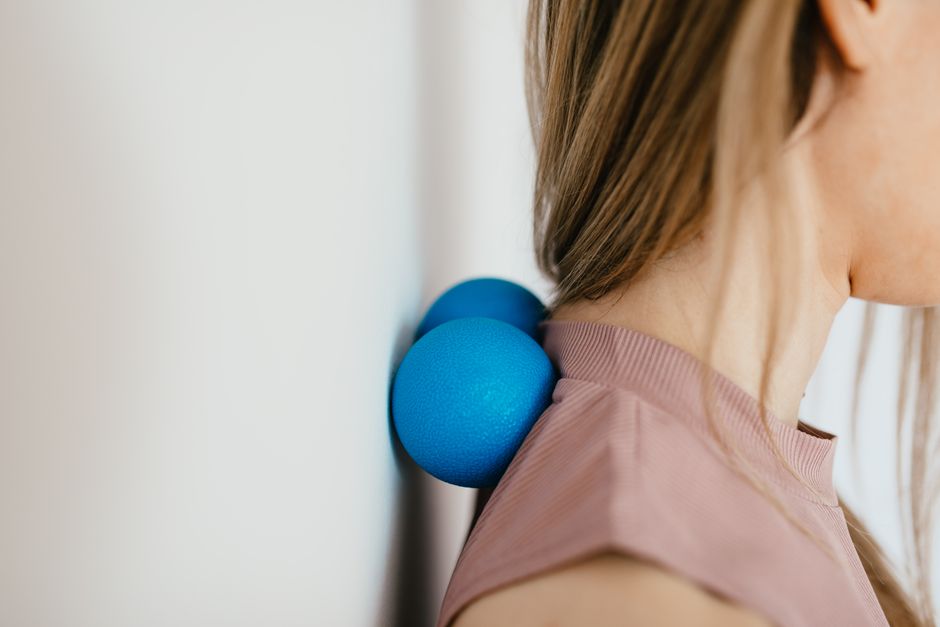
Pain at the base of the skull is often a mechanical problem, not a sign of something dangerous. Most cases come from the upper neck joints and muscles that attach to the back of the head. The most reliable things that help are gentle movement, targeted exercises for the deep neck and shoulder blade muscles, attention to posture and sleep position, and short-term use of heat or over-the-counter pain relievers. If the pain is severe, came after a head or neck injury, or comes with numbness, weakness, or fever, see a clinician first.
That pain in the back of your head, right where the skull meets the neck, has a name and a set of well-understood causes. Understanding the anatomy explains why certain fixes work and others do not.
What causes neck pain at the base of the skull?
The upper neck is built for movement and pays for it. The first two vertebrae, called the atlas and axis, allow most of the head’s rotation and tilting. A dense web of small muscles attaches there and runs up to the base of the skull. These structures carry the head’s weight and manage constant small corrections all day.
When those muscles and joints are strained or overworked, pain shows up exactly where they attach. That is the base of the skull.
Common causes include:
- Muscle strain from sustained positions — long hours at a screen, reading in bed, or holding the head forward.
- Joint irritation in the upper cervical spine, which can refer pain upward into the back of the head.
- Tension-type headache, which frequently involves the neck and scalp muscles.
- Cervicogenic headache, a headache whose source is the neck itself. Clinicians diagnose this when the pain clearly arises from neck structures.
- Whiplash or other injury, which strains the ligaments and muscles of the upper neck.
Not all head and neck pain at the skull base is mechanical. Less common causes include arthritis of the upper neck, and in rare cases, inflammation of blood vessels or other medical conditions. That is why pain that is new, severe, or comes with other symptoms deserves a proper look.
Why does the pain sit right at the base of the skull?
Nerves from the upper neck connect to the same area of the brain that receives signals from the back of the head. Because of this shared pathway, a problem in the neck joints or muscles can be felt as pain at the skull base. Clinicians call this referred pain.
This explains a pattern many people notice. The neck itself may feel stiff but not very sore, while the back of the head aches. The pain is real and it is coming from the neck.
The muscles at the skull base are also small and work hard. The suboccipital muscles, a group of four small muscles connecting the upper vertebrae to the skull, help fine-tune head position. They are not built for hours of holding the head forward while you look at a screen. Sustained tension in these muscles is a common source of skull-base discomfort.
What actually helps neck pain at the base of the skull?
Most mechanical neck pain improves with conservative care. The strategies below are the ones with the most support and the lowest risk.
Keep moving gently
Rest beyond a day or two tends to make neck pain worse, not better. Gentle range-of-motion exercises — slowly turning the head side to side, tilting ear toward shoulder, and nodding chin toward chest — help maintain movement. Move within a comfortable range. Sharp pain is a signal to stop.
Strengthen the deep neck muscles
The deep muscles at the front of the neck help support the head. When they are weak, the muscles at the back of the neck work harder. A simple chin tuck — gently drawing the chin straight back as if making a double chin, holding briefly, then releasing — is a common exercise for these muscles. Some clinicians teach this; it is widely used in physical therapy, though the strength of trial evidence varies by condition.
Address shoulder blade and upper back strength
The neck does not work alone. Weak muscles between the shoulder blades and in the upper back change how the head is carried. Exercises that target the shoulder blade muscles are a standard part of neck pain rehabilitation. A physical therapist can tailor these to your situation.
Use heat or cold for comfort
Heat can relax tight muscles and ease stiffness. Cold may help with acute pain after an injury. Neither treats the underlying cause, but both are low-risk ways to manage symptoms. Use a barrier between the skin and the heat or cold source, and avoid leaving either in place for long periods.
Consider over-the-counter pain relievers
Nonsteroidal anti-inflammatory drugs and acetaminophen are commonly used for short-term relief of neck pain. They ease symptoms but do not fix the cause. Follow the label directions. Check with a pharmacist or clinician if you take other medications or have health conditions, especially stomach, kidney, or heart problems.
Improve your setup
Raise your screen so the top is near eye level. Keep your feet supported. Take short, frequent breaks to move rather than one long break. There is no single perfect posture — the best posture is one you change often.




Does posture really cause skull-base pain?
Posture matters, but not in the simple way many people believe. There is no single correct posture that prevents all neck pain. Research on posture and neck pain shows a mixed picture. Some studies find an association between sustained awkward positions and neck discomfort. Others find that people with and without neck pain have similar postures.
The more reliable principle is variation. Holding any position for a long time loads the same tissues repeatedly. Changing position regularly spreads the load. That is why frequent short movement breaks tend to help more than trying to hold a rigid “perfect” posture.
This is a useful clarification. You do not need to sit perfectly. You need to move often.
What about sleep position and pillows?
Sleeping positions that twist or bend the neck can strain the upper neck for hours. Back sleeping with a pillow that supports the natural curve of the neck is generally comfortable for many people. Side sleeping with a pillow that keeps the head in line with the spine is another option. Stomach sleeping forces the head to turn to one side for a long time, which many people with neck pain find aggravates symptoms.
Pillow choice is personal. There is no single pillow proven to help everyone. A pillow that keeps your head roughly in line with your spine — not propped too high or too low — is a reasonable starting point. Some people find a contoured pillow helpful. Others do not. Trial and error is normal here.
When should you see a clinician?
Most neck pain at the skull base is not serious and improves on its own or with conservative care. Some situations need prompt medical attention.
See a clinician promptly if you have:
- Pain after a head or neck injury, such as a fall or car crash
- Numbness, weakness, or tingling in the arms or hands
- Severe headache that came on suddenly, or a headache unlike any you have had
- Fever, unexplained weight loss, or night sweats along with neck pain
- Neck stiffness so severe you cannot touch your chin to your chest, especially with fever
- Pain that is getting worse despite conservative care
These signs do not mean something is seriously wrong. They mean a clinician should check. Some of these symptoms can point to conditions that need timely treatment, and a proper exam sorts that out.
What does the evidence say about treatments?
Exercise and manual therapy are the treatments with the most support for mechanical neck pain. Physical therapy that combines strengthening, stretching, and posture education is a standard approach. Manual therapy — hands-on techniques used by physical therapists, chiropractors, and others — has some evidence for short-term relief of neck pain, though results vary.
Some treatments are widely used but have weaker evidence. Massage, dry needling, and acupuncture are used by some clinicians for neck pain. The evidence is mixed, and results vary from person to person. These are reasonable to discuss with a clinician, but they are not proven to work for everyone.
Be cautious with claims that a product or device “corrects” posture or “realigns” the neck. No clinical evidence currently confirms that most posture devices fix the underlying problem. The neck is not a structure that can be permanently realigned by a brace or gadget.
Frequently Asked Questions
How do I get rid of pain at the base of my skull?
Gentle movement, exercises for the deep neck and shoulder blade muscles, heat, and short-term over-the-counter pain relievers help most cases. If pain is severe or follows an injury, see a clinician first.
What is the pain at the base of the skull called?
When the source is the neck, clinicians call it cervicogenic headache. Pain from strained muscles at the skull base is often part of tension-type headache or simple mechanical neck pain.
Can stress cause neck pain at the base of the skull?
Yes. Stress increases muscle tension, and the muscles at the skull base are commonly involved. Relaxation, gentle movement, and stress management can help reduce symptoms.
Should I stretch my neck if it hurts at the base of the skull?
Gentle stretching within a comfortable range is usually fine and can help maintain movement. Avoid forceful stretching or pushing into sharp pain, and see a clinician if symptoms worsen.
