
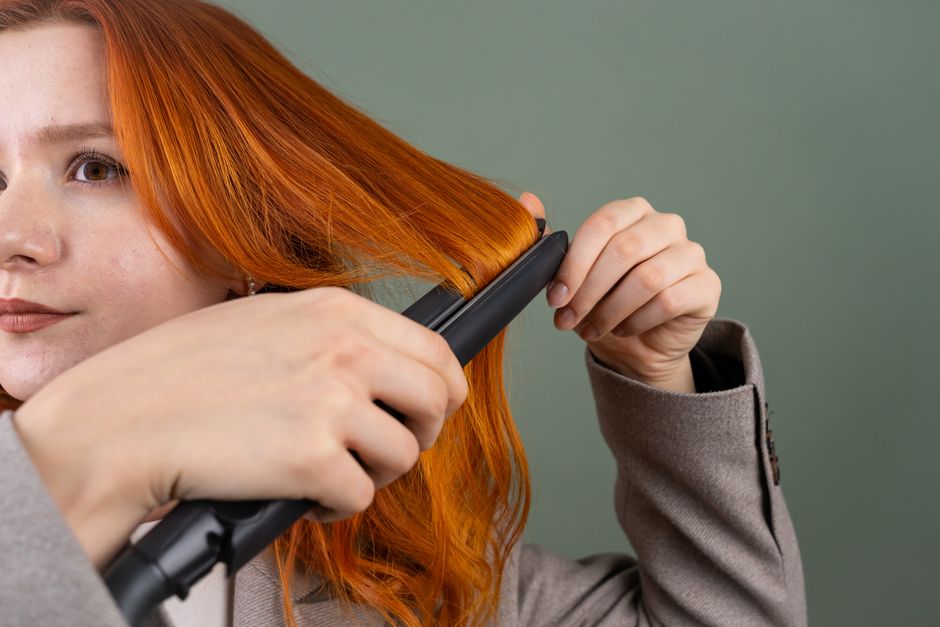
Straightening curly hair changes it in two ways at once. The heat and tension of styling temporarily pull the curl pattern flat, and the chemical bonds that hold curls in place can be permanently reshaped by chemical straighteners. The first effect lasts until water or humidity resets the hair. The second does not reverse. Understanding which one you are doing matters, because the risks are very different.
What Happens When You Straighten Curly Hair?
Two separate things happen depending on the method. Heat styling, like a flat iron, temporarily breaks the hydrogen bonds inside the hair shaft. These bonds are weak and reform when the hair cools, which is why a blowout or flat iron result lasts until moisture or washing resets it.
Chemical straightening works differently. Relaxers and permanent straightening treatments break stronger bonds in the hair’s internal structure and rebuild them in a new shape. That change is permanent. The hair that has been treated stays straight until it grows out or is cut off.
Curly hair has a distinct physical structure. The fiber twists along its length, and that twist creates points where the hair bends sharply. These bends are mechanically weaker than the straight sections. When you apply heat or tension, the curve is where damage tends to start.
The hydrogen bond effect
Hydrogen bonds are the reason wet hair can be reshaped. Water disrupts them, which is why curly hair springs back after a shower. A flat iron uses heat to temporarily break those same bonds and holds the hair straight while it cools. The curl returns the moment humidity or water gets involved again.
The disulfide bond effect
Chemical straighteners target disulfide bonds, which are much stronger. These bonds are part of what gives hair its shape and strength. Breaking and reforming them changes the hair permanently. It also weakens the fiber in the process, because the treatment removes some structural integrity that does not come back.
What Does Heat Straightening Do to Curly Hair?
Heat straightening causes temporary structural change and, at high enough temperatures or with repeated use, permanent damage. The difference between a healthy blowout and lasting harm comes down to temperature, frequency, and how wet the hair is when heat is applied.
Hair is made mostly of a protein called keratin. Keratin loses moisture and structural integrity when exposed to high heat repeatedly. Research on hair fibers has found that temperatures well above the boiling point of water cause measurable changes to the surface and internal structure of the hair. The exact threshold varies by hair type and condition.
Curly hair is often drier than straight hair by nature, because natural oils have a harder time traveling down a twisted fiber. That makes it more vulnerable to heat damage. Applying high heat to already-dry curly hair speeds up moisture loss and protein breakdown.
A few things increase the risk of lasting damage:
- Using a flat iron on hair that is still damp, which can cause what is sometimes called “bubble hair” as trapped water boils inside the shaft
- Repeated passes over the same section of hair
- High heat settings used every day or every wash
- Skipping heat protectant, which reduces but does not eliminate heat damage
- Straightening hair that is already chemically treated or color-treated
Heat protectant products can reduce the rate of damage. They do not make high heat safe. No product currently available reverses structural damage once it has happened.
What Does Chemical Straightening Do to Curly Hair?
Chemical straightening permanently alters the hair’s structure and carries real risks beyond cosmetic damage. The two main categories are lye-based and no-lye relaxers, and both work by breaking disulfide bonds in a highly alkaline environment, then reforming them in a straight configuration.
The process weakens the hair shaft. Some breakage and loss of elasticity is expected, not a sign that something went wrong. The question is how much. Hair that is over-processed, left on too long, or applied to already-damaged hair can break at the root or mid-shaft.
There are also scalp and skin risks. Relaxers are strong alkaline chemicals. They can cause chemical burns if left on too long or applied to broken skin. Scalp irritation and burns are documented adverse effects, and some clinicians have raised concerns about long-term scalp health with repeated use.
A separate concern involves formaldehyde. Some “smoothing” or “Brazilian” straightening treatments have been found to release formaldehyde gas during application, sometimes at levels above occupational safety limits. Formaldehyde is a known respiratory irritant and a recognized human carcinogen at sufficient exposure. Regulatory agencies in multiple countries have issued warnings about these products. Not all smoothing treatments contain formaldehyde, but some labeled “formaldehyde-free” have been found to release it when heated.
Anyone considering chemical straightening should ask what is actually in the product. “Formaldehyde-free” on a label is not a reliable guarantee.
Does Straightening Curly Hair Cause Permanent Curl Loss?
Heat styling alone does not permanently change curl pattern if the hair is not damaged. Chemical straightening does, by design. The confusion comes from heat damage that mimics permanent straightening.
When heat damage is severe enough, the hair loses its ability to hold a curl. The bonds that create the curl pattern are disrupted beyond recovery, and the hair stays limp and straight even after washing. This is sometimes called heat damage or “heat-trained” hair. It is not the same as chemical straightening, but the result looks similar.
The key difference is mechanism. Chemical straightening deliberately and completely restructures the bonds. Heat damage happens when repeated high heat degrades the protein structure until the hair can no longer return to its natural shape. In both cases, the affected hair does not revert. Only new growth comes in with the original curl pattern.
Some people find their curl pattern loosens over years of heat styling without full straightening. This is gradual structural change, and it is not fully reversible on the affected hair.
How Can You Reduce Damage When Straightening Curly Hair?
Damage reduction is about lowering heat, lowering frequency, and protecting the hair’s moisture balance. None of these methods makes straightening risk-free. They reduce the rate of harm.
Lower the temperature. Most flat iron manufacturers publish recommended temperature ranges, and finer or more fragile hair generally needs lower heat than coarse hair. Using the lowest effective setting reduces protein damage.
Straighten dry hair only. Water trapped inside the hair shaft can boil when it contacts a hot iron, which damages the fiber from the inside. A rough blow-dry first removes surface water but does not guarantee the inner shaft is dry. Waiting until hair is fully dry is safer.
Limit passes. One slow pass per section causes less cumulative heat exposure than several quick passes. Going over the same section repeatedly adds damage with each pass.
Use heat protectant consistently. Silicone-based and some polymer-based protectants create a barrier that slows heat transfer to the fiber. They are not a substitute for lower heat.
Space out treatments. Daily flat ironing gives hair no recovery time. Stretching the interval between heat sessions reduces cumulative damage.
Deep conditioning supports moisture balance. Curly hair tends to be drier, and heat styling pulls more moisture out. Conditioning does not repair broken bonds, but it helps maintain the hair’s flexibility and reduces breakage from dryness.
For chemical straightening, the main risk-reduction step is professional application with proper timing and patch testing. Do not apply a relaxer over previously relaxed hair or on a scalp with cuts or irritation. Ask specifically about formaldehyde content and request the safety data sheet if the salon has one.
Is Straightening Curly Hair Bad for Your Health?
Heat styling is a cosmetic risk, not a health risk. Chemical straightening carries some health considerations beyond the hair itself, mainly involving scalp burns and formaldehyde exposure.
Scalp burns from relaxers are a documented adverse effect. They can cause pain, scabbing, and in rare cases scarring that affects future hair growth. People with sensitive skin, a history of scalp conditions, or recent chemical treatments are at higher risk.
Formaldehyde exposure during certain smoothing treatments is the more serious concern. The gas is released during application and can be inhaled. Ventilation in salons varies widely, and some workers have reported respiratory symptoms. Regulatory bodies have taken action on specific products, but enforcement varies by region.
This does not mean every chemical straightener is dangerous. It means the category includes products with real documented hazards, and the label does not always tell you what you are getting. Asking direct questions about ingredients is reasonable.
What Should You Know Before Straightening Curly Hair?
The most useful thing to understand is that temporary and permanent straightening are not the same decision. A flat iron is reversible. A relaxer is not.
If you want occasional straight hair, heat styling with lower temperatures and good technique carries less risk. If you want permanent straightness, understand that the change is structural and the damage is cumulative with repeat treatments.
Curly hair is not damaged hair. It is a different fiber structure with different care needs. Many people straighten it for years without major problems. Others develop significant breakage or lose their curl pattern. The outcome depends on hair type, technique, frequency, and the specific products used.
There is no way to straighten curly hair with zero structural impact. There is a meaningful difference between low-impact and high-impact methods, and knowing which is which is the practical starting point.
Frequently Asked Questions
Does straightening curly hair permanently damage it?
Heat styling causes temporary change and can cause permanent damage with repeated high heat. Chemical straightening permanently alters the hair structure by design.
Can curly hair go back to normal after straightening?
Hair straightened with heat returns to its curl pattern after washing, unless it has been heat-damaged. Hair that has been chemically straightened does not revert, and only new growth comes in curly.
Is it safe to straighten curly hair every day?
Daily high-heat styling increases the risk of cumulative damage and curl loss over time. Lower temperature and less frequent styling reduce that risk, but do not eliminate it.
Do chemical straighteners contain formaldehyde?
Some smoothing treatments do, and some labeled formaldehyde-free have been found to release it when heated. Checking ingredients directly is the only reliable way to know.
