
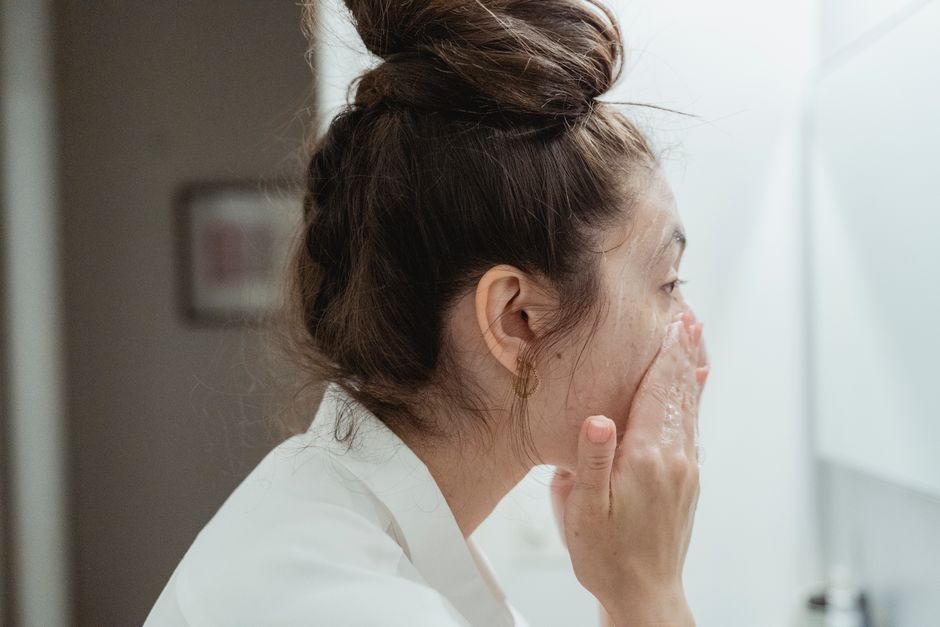
If you have rosacea, the right face wash is a gentle, fragrance-free cleanser with a slightly acidic to neutral pH. Look for labels that say “soap-free,” “non-comedogenic,” and “for sensitive skin.” Avoid anything with scrubs, alcohol, menthol, or strong acids. The goal is to remove oil, sweat, and sunscreen without stripping the skin barrier or triggering a flush.
Rosacea is a chronic inflammatory skin condition, not a hygiene problem. That distinction matters because it changes what a cleanser should do. A good face wash for rosacea does less, not more. It cleans without irritating, and it leaves the skin barrier as intact as possible.
What ingredients should you look for in a rosacea face wash?
The best ingredient list for rosacea is short. Fewer ingredients means fewer chances for irritation or a reaction. Dermatologists generally steer patients toward mild surfactant systems — the compounds that lift oil and dirt — rather than traditional soaps, which tend to be alkaline and can disrupt the skin’s acid mantle.
Ingredients that tend to suit rosacea-prone skin include:
- Glycerin — a humectant that pulls water into the outer skin layer
- Ceramides — lipids that help rebuild the skin barrier
- Mild surfactants such as cocamidopropyl betaine or sodium lauroyl methyl isethionate
- Niacinamide — some evidence supports its role in reducing redness and supporting the barrier, though it is not a cure
Niacinamide deserves a caveat. It is widely recommended and has reasonable supporting evidence for barrier support and redness, but it is not a treatment for rosacea itself. Some people with very reactive skin find it stings. Patch testing is sensible.
What to avoid is often clearer than what to seek. Fragrance is the single most common cause of cosmetic contact irritation, and “fragrance-free” is a more reliable label than “unscented” — unscented products can still contain masking fragrances.
What ingredients should you avoid if you have rosacea?
Certain ingredients reliably provoke irritation or flushing in rosacea-prone skin, and avoiding them is one of the most practical steps you can take. The list is not long.
- Fragrance and essential oils — including “natural” ones like lavender, citrus, peppermint, and eucalyptus
- Alcohol denat — drying and potentially barrier-disrupting
- Physical scrubs — walnut shells, apricot kernels, and coarse exfoliants cause micro-trauma
- Menthol, camphor, and cooling agents — these can trigger flushing
- High-concentration acids — strong AHAs and BHAs can sting and aggravate redness
- Sodium lauryl sulfate (SLS) — a harsh surfactant that can strip the barrier
One clarification worth making: “natural” and “clean” do not mean gentler. Essential oils are a frequent culprit in cosmetic irritation, and some botanical extracts are more irritating than their synthetic counterparts. For rosacea skin, a plain formulation usually beats a botanical one.
Does the pH of a face wash matter for rosacea?
Yes, pH matters, though the effect is gradual rather than immediate. Healthy skin sits at a slightly acidic pH of around 4.5 to 5.5. Traditional bar soaps are alkaline, often around pH 9 to 10, and washing with them can raise skin pH temporarily and disrupt the barrier.
For rosacea-prone skin, a cleanser close to the skin’s natural pH — roughly pH 4 to 6 — is the safer choice. Most liquid “soap-free” cleansers are formulated in this range. This is one reason dermatologists often prefer gentle liquid cleansers over bar soap for sensitive skin, though the difference in clinical outcomes for rosacea specifically has not been studied extensively.
The pH point is real but modest. It is not the single deciding factor. A fragrance-free cleanser at a good pH still beats an alkaline one, but ingredient irritation potential matters just as much.
How should you wash your face when you have rosacea?
Technique matters as much as product. Even a gentle cleanser can irritate if applied roughly or too often. The general approach dermatologists describe is simple: lukewarm water, fingertips only, and no more than twice a day.
Practical steps:
- Use lukewarm water — hot water can trigger flushing
- Apply cleanser with fingertips, no washcloth or sponge
- Keep contact brief — around 30 seconds is generally enough
- Pat dry with a soft towel rather than rubbing
- Follow with a moisturizer while skin is still slightly damp
Washing twice daily is common practice, but some people with very dry or reactive rosacea do better cleansing once at night and simply rinsing with water in the morning. This is a reasonable adjustment, not a rule. If your skin feels tight or stings after washing, the cleanser or the frequency is likely too harsh.
Do medicated or anti-redness face washes work for rosacea?
No face wash has been shown to treat rosacea itself. Cleansers remove irritants and support the barrier, but they do not resolve the underlying inflammation. This is an important line to draw, because marketing often blurs it.
Some cleansers contain ingredients like niacinamide, green tea extract, or feverfew that have modest evidence for soothing redness. That is not the same as treating rosacea. The treatments with the strongest evidence — topical metronidazole, azelaic acid, ivermectin, and oral antibiotics for certain cases — are medications, not cleansers, and they are prescribed by a clinician.
There is one useful exception to keep in mind. Some prescription and over-the-counter treatment products are themselves irritating, and a mild cleanser helps people tolerate them. In that sense, a good face wash supports treatment without being a treatment.
What type of cleanser is best — foam, cream, gel, or micellar water?
Cream and lotion cleansers are generally the gentlest option for rosacea-prone skin, especially for drier or more reactive skin. Foaming cleansers can be fine if they are formulated gently, but the foaming action itself does not make a product better or worse. Gel cleansers suit oilier skin but can be more drying.
Micellar water is a reasonable option for removing makeup or a light cleanse, but it is not ideal as a sole daily cleanser for everyone. Some micellar waters contain surfactants that can leave residue, and rinsing afterward is often recommended. For rosacea skin, a rinse-off gentle cleanser is usually the more predictable choice.
The formulation type matters less than the ingredient list. A cream cleanser full of fragrance will irritate more than a well-formulated gel. Read the label, not the texture.
The bottom line
A good face wash for rosacea is gentle, fragrance-free, close to skin pH, and free of scrubs, alcohol, and cooling agents. It cleans without stripping. It supports the skin barrier rather than challenging it. It does not claim to cure anything.
Rosacea is a condition managed over time, often with a combination of trigger avoidance, gentle skincare, sun protection, and clinician-guided treatment. A cleanser is one piece of that picture — a foundational one, but not a fix on its own. If redness, flushing, or bumps are persistent or worsening, a dermatologist can help identify the subtype and the treatment that fits it.
Frequently Asked Questions
Is Cetaphil good for rosacea?
Cetaphil makes several gentle, fragrance-free cleansers that are commonly recommended for sensitive and rosacea-prone skin. The specific product matters more than the brand, so check that the one you choose is fragrance-free and free of scrubs or strong acids.
Can I use a foaming face wash with rosacea?
Yes, if the formula is gentle and fragrance-free. Foam itself is not the problem — harsh surfactants and drying ingredients are.
Should I wash my face twice a day with rosacea?
Twice daily is common, but once at night with a water rinse in the morning is reasonable for dry or reactive skin. If your skin feels tight or stings after washing, cleanse less often or switch to a gentler product.
Does face wash make rosacea worse?
A harsh or fragranced cleanser can aggravate redness and irritation, but a gentle one should not. If a product stings or triggers flushing, stop using it and try a simpler, fragrance-free option.
