
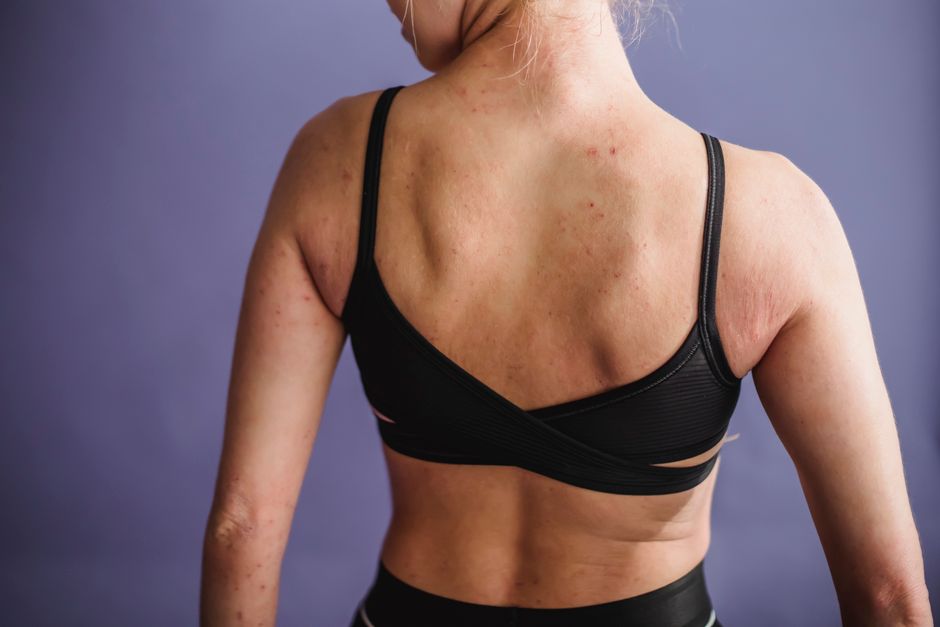
Excoriated skin is skin that has been scraped, scratched, or worn away — most often by fingernails, and most often because something underneath it itches. The word comes from the Latin for “to strip off the hide,” and that is roughly what happens: the top layer of skin, the epidermis, is physically removed in patches or lines. What you see depends entirely on how deep the damage went and how long it has been there. A fresh excoriation is a raw, red, weeping scrape. A month-old one is a flat pink or brown mark. A healed one may leave nothing at all, or a pale scar that never tans.
What Does Excoriated Skin Look Like When It Is Fresh?
A fresh excoriation looks like a scrape you would get from falling on pavement, except it usually has a shape that tells you it was made by nails. You may see straight scratch lines, small crescents, or irregular patches where someone has rubbed rather than scratched.
The surface is moist and red because the epidermis is gone and the layer beneath — the dermis — is exposed. Tiny dots of blood may appear where capillaries in the upper dermis have been broken. Clear or yellowish fluid can weep from the surface. This is serum, the liquid part of blood, not pus. Fresh excoriations sting, especially in air or water, because nerve endings in the dermis are no longer covered.
Fingernail scratches are typically shallow. They rarely go deeper than the epidermis and the very top of the dermis. That matters for healing, because damage confined to the epidermis usually heals without a scar. Once the injury reaches deeper into the dermis, scar tissue becomes more likely.
What Excoriated Skin Looks Like as It Heals
Healing follows a predictable sequence, though the timing varies widely between people and between body sites.
Within the first day or two, the raw surface dries and forms a crust. A scab is a mix of dried serum, dead cells, and blood. It is not a sign that something is wrong — it is a biological bandage. Underneath it, new epidermal cells are migrating across the wound from the edges and from hair follicles.
Over the next several days, the redness around the wound fades and the scab begins to lift at the edges. Picking it off before the skin beneath is ready re-opens the wound and increases the chance of scarring. This is one of the most common ways people turn a minor scrape into a permanent mark.
By roughly one to two weeks, most superficial excoriations have closed. The new skin is often pink or slightly shiny. It may be more sensitive to sun and to temperature than the skin around it. That pinkness can persist for weeks to months, and it is not a sign of infection.
What Do Older Excoriations and Scars Look Like?
Once the surface has closed, what remains depends on depth and on how the person’s skin heals in general.
A healed superficial excoriation often leaves a mark that is darker or lighter than the surrounding skin. In darker skin tones, this is often a brown patch called post-inflammatory hyperpigmentation. In lighter skin tones, it may be a pink or red spot that fades slowly. These color changes are not scars. They are pigment responses, and many fade over months.
A true scar forms when the dermis is damaged and the body fills the gap with collagen instead of normal skin. Excoriations that stay shallow usually do not scar. Those that are deep, repeatedly re-opened, or infected can leave:
- Flat, pale, slightly shiny marks
- Raised or thickened areas of skin
- Depressed or pitted areas
- Marks that stay visible longer than the surrounding skin
On the face, repeated picking around acne can leave a mix of these. On the arms and legs, chronic scratching from a skin condition often leaves a pattern of small, scattered marks in the same areas over and over.




Why Does Excoriated Skin Look Different From a Cut or Burn?
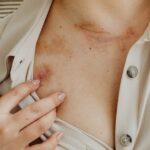
Excoriations are defined by how they are made, not by what caused the underlying problem. The damage comes from the outside — nails, a brush, a tool — rather than from heat, chemicals, or a sharp edge.
That produces a few features you would not see with other wounds:
- Irregular edges. Nails tear skin rather than slicing it cleanly, so the borders are ragged.
- Grouped or linear marks. Scratch lines often run in the same direction, following how a hand moves.
- Repeated injury in the same spot. Excoriated skin often shows a mix of fresh, healing, and healed marks side by side.
- Surrounding skin changes. If itching is the cause, the skin nearby may be dry, thickened, or discolored.
A cut from a knife or a burn from a hot pan tends to have a more uniform shape. Excoriated skin usually looks messier and more scattered.
What Causes People to Excoriate Their Skin?
Itching is the most common driver. When skin itches, scratching is a reflex, and it can strip the surface before the person realizes how much damage has been done.
Common triggers include:
- Eczema and other forms of dermatitis
- Psoriasis
- Insect bites and allergic reactions
- Dry skin, especially in winter or in older adults
- Hives
- Fungal infections
- Scabies, which causes intense itching that is often worse at night
There is also a group of conditions where the scratching is not primarily driven by a skin problem. In these cases, the skin may look normal between episodes, and the excoriations are the main finding. This pattern is seen in some mental health conditions and in body-focused repetitive behaviors. It is worth naming because it changes what kind of help is useful.
One point that is often missed: excoriated skin is a sign, not a diagnosis. Two people with identical-looking scratches can have completely different underlying causes, and the treatment depends on which one it is.
When Should Excoriated Skin Get Medical Attention?
Most superficial excoriations heal on their own. Some do not, and a few need treatment to avoid a worse outcome.
Seek medical care if you notice:
- Spreading redness, warmth, or swelling around the wound
- Thick yellow or green discharge
- Fever or chills
- A wound that is not closing after a week or two
- Increasing pain rather than improving pain
- Red streaks moving away from the wound
These can point to a bacterial infection that may need antibiotics. Skin infections can spread quickly, so it is better to have them checked early than to wait.
Also worth a conversation with a clinician: itching that does not respond to basic skin care, excoriations you cannot stop making, or wounds that keep appearing in the same place. Chronic scratching can thicken the skin over time, which makes itching worse and creates a cycle that is hard to break on your own.
How Is Excoriated Skin Treated?
Treatment has two parts: caring for the wound and addressing why it happened. Wound care alone rarely solves the problem if the itching or the scratching behavior continues.
For the wound itself, basic care is usually enough:
- Keep the area clean with gentle washing
- Cover it lightly to reduce scratching and contamination
- Keep it moist with a plain ointment, which supports healing better than letting it dry out
- Do not pick at scabs
- Protect healing skin from sun, since new skin burns and darkens more easily
For the underlying cause, what helps depends on what is driving it. If eczema or dry skin is the trigger, moisturizing regularly and treating flare-ups with the plan your clinician gives you can reduce scratching. If an infection like scabies is present, it needs specific treatment — no amount of wound care will fix it. If the scratching is driven by a mental health condition, treatment may involve therapy, medication, or both, and skin care alone is unlikely to be enough.
One caution: over-the-counter anti-itch creams are not interchangeable. Some contain ingredients that can irritate already-damaged skin, and some should not be used on broken skin at all. If you are unsure, ask a pharmacist before applying anything to an open excoriation.
Will Excoriated Skin Leave Permanent Marks?
Most superficial excoriations do not leave permanent scars. The epidermis regenerates well, and damage confined to it usually heals without a trace beyond temporary color change.
Scarring becomes more likely when the injury reaches the dermis, when the same spot is scratched repeatedly, or when the wound becomes infected. Darker skin tones are more prone to lingering pigment changes after any injury, including excoriations.
The single most effective thing a person can do to reduce scarring is to stop re-injuring the same area. That usually means treating the itch, not just resisting the urge to scratch. Itch that is not treated tends to win.
Frequently Asked Questions
What does excoriated skin look like?
It looks like raw, red, scraped skin, often in lines or irregular patches made by fingernails. Fresh excoriations may weep clear fluid or form small scabs.
How long does excoriated skin take to heal?
Most superficial excoriations close within one to two weeks. Redness or color change at the site can last for weeks to months afterward, especially in darker skin tones.
Does excoriated skin always scar?
No. Damage limited to the epidermis usually heals without a scar. Scarring is more likely when the injury reaches deeper into the dermis or when the same spot is repeatedly scratched.
When should I see a doctor for excoriated skin?
See a clinician if you notice spreading redness, warmth, pus, fever, or a wound that is not closing after a week or two. These can be signs of infection that may need treatment.
