
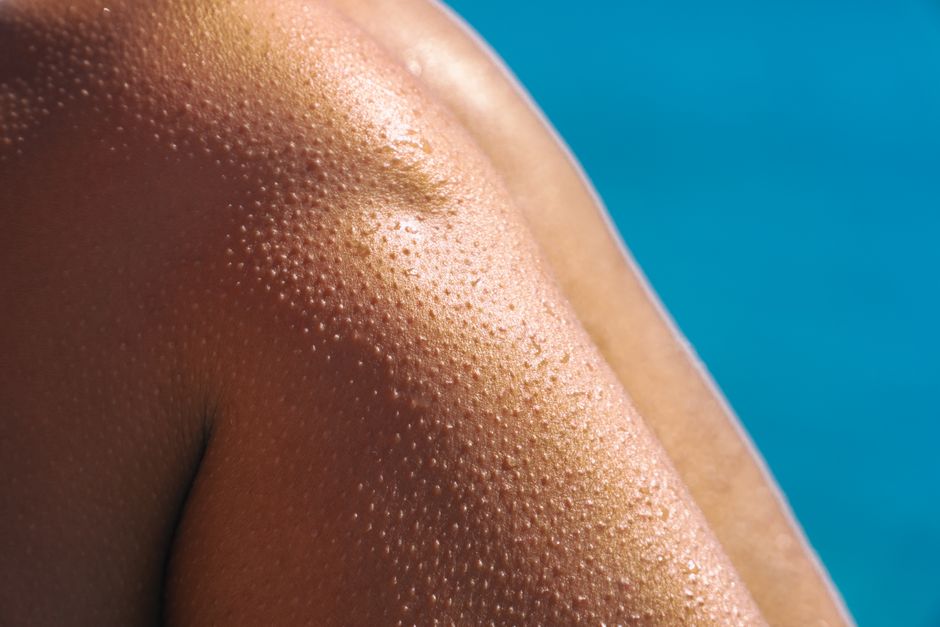
Tanning oil is a product people apply to their skin before sun exposure, usually to get a faster or deeper tan. It works mainly by helping ultraviolet (UV) light reach and penetrate the skin more efficiently, and many formulas also add oils that make skin look glossy. The important point is that tanning oil does not protect skin from UV damage. Most tanning oils have little or no sun protection, so they increase UV exposure rather than block it.
What Does Tanning Oil Do to Your Skin?
Tanning oil changes how your skin interacts with sunlight. The base oils — often mineral oil, coconut oil, or similar ingredients — spread across the skin and can increase how much UV light is transmitted into the outer layers. Some products also contain ingredients meant to speed up the appearance of a tan, though the evidence behind those additives is thin.
The tan itself is not a sign of health. It is the skin’s response to injury from UV radiation. When UV light damages DNA in skin cells, the body produces more melanin — the pigment that gives skin its color — as a partial defense. That darkening is a stress response, not a protective upgrade.
Tanning oils make this process happen faster because they let more UV light through. That is the core mechanism. Everything else — the shine, the scent, the “deep tan” marketing — is secondary.
Does Tanning Oil Protect You From the Sun?
No. This is the most important thing to understand about tanning oil. Most tanning oils contain no sunscreen ingredients at all, and even those labeled with a low SPF offer far less protection than a proper sunscreen.
Some tanning oils are marketed with an SPF number, which can create a false sense of safety. An SPF of 4 or 8 blocks only a fraction of UV rays compared with the SPF 30 or higher that dermatologists and public health agencies recommend. The American Academy of Dermatology and the CDC both advise using broad-spectrum sunscreen with SPF 30 or higher, along with protective clothing and shade.
The oil base itself does nothing to filter UV. In fact, the way oils spread and reflect light can make skin feel and look protected when it is not. That gap between perception and reality is where sunburns and long-term damage happen.
Why Do People Use Tanning Oil If It Is Risky?
People use tanning oil because it delivers what it promises: a faster, darker tan. For decades, a tanned appearance was marketed as healthy and attractive, and tanning oil became a shortcut to that look. That cultural message has faded in some places but not everywhere.
There is also a comfort factor. Oils feel moisturizing going on and give skin a sheen that many people associate with summer and outdoor living. Some users believe the oil adds moisture that protects against dryness, which is true in a narrow sense — oils can reduce water loss from the skin surface — but that has nothing to do with UV protection.
The appeal is understandable. The risk is what gets lost in the marketing.
What Are the Risks of Using Tanning Oil?
The main risk is increased UV exposure, which raises the chance of sunburn and, over time, skin damage. UV radiation is a recognized cause of skin cancer, including melanoma and the more common basal and squamous cell carcinomas. The World Health Organization classifies UV radiation as a Group 1 carcinogen — the same category as tobacco and asbestos.
Tanning oil increases UV penetration, so it works against the body’s natural defenses. Repeated sunburns, especially in younger years, are linked to a higher lifetime risk of skin cancer. Premature skin aging — wrinkles, dark spots, and thinning skin — is another well-documented result of cumulative UV exposure.
There is also the risk of eye damage. UV light can contribute to cataracts and other eye problems, and tanning oil does nothing to protect the eyes. Sunglasses with UV protection matter just as much as skin care.
One more point worth stating plainly: there is no such thing as a safe tan from UV light. A tan is visible evidence that UV radiation has already damaged skin cells. The darker the tan, the more exposure the skin has absorbed.
How Does Tanning Oil Compare With Sunscreen?
Tanning oil and sunscreen do opposite jobs. Sunscreen is formulated to absorb, scatter, or reflect UV radiation before it reaches the skin. Tanning oil is formulated to let UV through and help skin darken. They are not variations of the same product — they are built for different goals.
| Feature | Tanning Oil | Sunscreen (SPF 30+) |
|---|---|---|
| Main purpose | Speed up tanning | Block UV radiation |
| UV protection | Little to none in most formulas | Designed to filter UV |
| Effect on skin | Increases UV penetration | Reduces UV reaching skin |
| Recommended by health agencies | No | Yes, with reapplication |
Some people try to combine the two by mixing tanning oil with sunscreen. That is not a reliable strategy. Mixing products can dilute the sunscreen’s protection and make it harder to know how much coverage you actually have. If sun protection is the goal, use a dedicated broad-spectrum sunscreen as directed on the label.
Is There a Safer Way to Get a Tan?
If the goal is darker skin without UV exposure, sunless tanning products are the established alternative. These use dihydroxyacetone (DHA), a coloring agent that reacts with the outer layer of skin to produce a temporary tan. The color develops over a few hours and fades as skin cells shed, usually within about a week.
Sunless tanners are considered a safer option than UV tanning because they do not involve UV radiation. They do not, however, provide any sun protection, so sunscreen is still needed outdoors. The FDA has approved DHA for external use on the skin, and it is the active ingredient in most self-tanning lotions, sprays, and mousses.
Spray tanning raises a separate question. The FDA advises protecting the eyes, lips, and mucous membranes during spray tanning and avoiding inhaling the mist, because the safety of DHA when inhaled or exposed to those areas has not been established. That is a real caution, not a formality.
For people who want a tan look, sunless products plus a good sunscreen is the combination that public health guidance supports.
What Should You Do If You Want to Spend Time in the Sun?
The established approach is straightforward. Use broad-spectrum sunscreen with SPF 30 or higher, reapply it at least every two hours and after swimming or sweating, and seek shade during peak sun hours. Wear protective clothing, a hat, and UV-blocking sunglasses.
These steps come from major public health and dermatology organizations, and they are based on decades of evidence linking UV exposure to skin cancer and skin aging. They are not perfect — no sunscreen blocks 100% of UV — but they meaningfully reduce exposure.
Tanning oil has no role in that plan. If you already use it, the honest advice is to stop and switch to a product designed to protect rather than increase UV exposure. Check your skin regularly for new or changing spots, and see a clinician about anything that concerns you.
Frequently Asked Questions
Does tanning oil actually help you tan faster?
Yes, in the sense that it lets more UV light reach the skin, which can speed up tanning. That faster tan comes with more UV damage, not less.
Can you use tanning oil with SPF?
Some tanning oils include a low SPF, but that protection is far below the SPF 30 or higher that health agencies recommend. A low-SPF oil still leaves most UV exposure in place.
Is tanning oil bad for your skin?
It increases UV exposure, which is a recognized cause of skin cancer and premature skin aging. Most tanning oils offer little to no UV protection.
What can I use instead of tanning oil to get a tan?
Sunless tanning products containing DHA are the established alternative because they color the skin without UV radiation. They do not provide sun protection, so sunscreen is still needed outdoors.
