
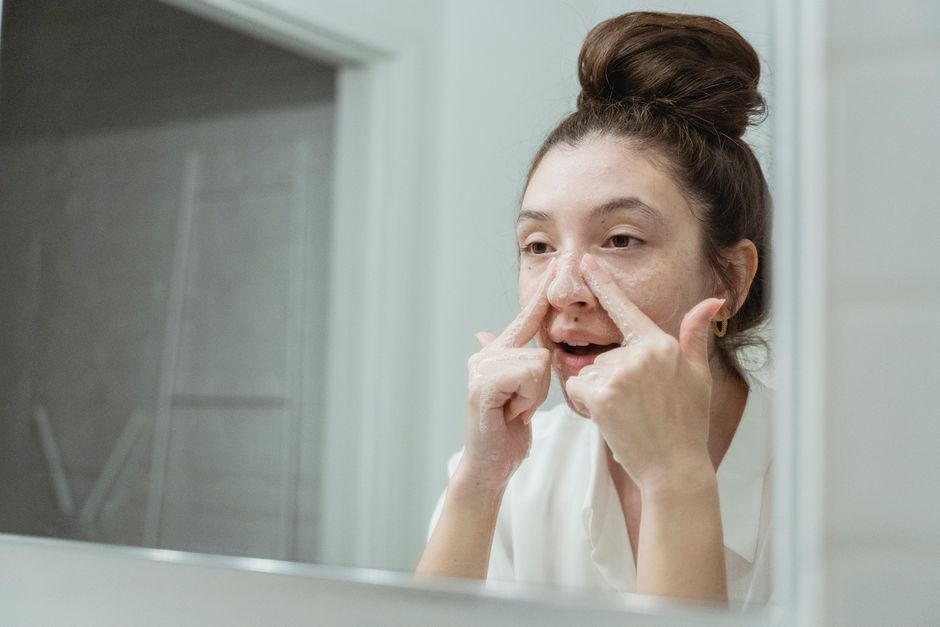
Skin congestion is a term used to describe pores that have become partially blocked by a mix of excess oil, dead skin cells, and debris. It is not a medical diagnosis. It is a cosmetic description of what is happening inside a hair follicle, the small opening in the skin that contains a sebaceous gland and a hair. When that opening narrows or fills with material, the result is what people call congested skin: blackheads, whiteheads, rough texture, and small bumps that never seem to clear.
What Does Skin Congestion Actually Mean?
Every pore on your face is the opening of a pilosebaceous unit — a hair follicle paired with a sebaceous gland. That gland produces sebum, an oily substance that travels up the follicle and out onto the skin surface. Sebum is not a flaw. It helps keep skin flexible and forms part of the skin barrier that limits water loss and blocks some microbes.
Congestion happens when this drainage system slows down or backs up. Dead corneocytes (flat, hardened skin cells) shed from the follicle lining normally mix with sebum and flow out. When shedding is uneven, or when sebum production is high, the mixture can form a plug. That plug is the congestion.
Two things matter here. First, congestion is a mechanical problem — something is physically blocking a duct. Second, it exists on a spectrum. A single blackhead is congestion. So is an entire forehead of closed bumps. Neither is dangerous. Both can be persistent.
One clarification worth making: congestion and acne are related but not identical. Acne involves inflammation and, in many cases, the bacterium Cutibacterium acnes. Congestion can exist without inflammation. A closed comedo — a whitehead — is often a non-inflammatory lesion. It can stay that way, or it can become inflamed later. Not every congested pore becomes a pimple.
What Are the Most Common Signs of Congested Skin?
Congestion tends to look different depending on whether the follicle opening stays open or closes over.
- Open comedones (blackheads). The plug is exposed to air. The dark color is not dirt — it comes from melanin pigment and oxidized lipids in the plug. This is one of the most misunderstood points in skincare.
- Closed comedones (whiteheads). Skin grows over the opening, trapping the plug. These appear as small, firm, skin-colored bumps.
- Rough or uneven texture. Skin may feel bumpy when you run a finger across it, especially on the forehead, nose, chin, and cheeks.
- Visible enlarged pores. Pores do not open and close like doors. But a follicle stretched by a plug can look larger.
- Dull appearance. A layer of dead cells and oil can scatter light unevenly, making skin look less bright.
- Small bumps that do not come to a head. These often sit under the surface for weeks.
Location offers a clue. Congestion concentrated on the forehead and central face is common in people with oily skin. Congestion along the jawline and chin in adults is often linked to hormonal shifts, though this pattern is not universal and can have other causes.
What Causes Pores to Become Blocked?
Several factors converge on the same follicle.
Sebum production. Androgens — hormones present in both men and women — drive sebaceous gland activity. Higher sebum output means more material moving through the follicle, which raises the chance of a plug forming.
Abnormal cell shedding. In congested follicles, the lining cells do not separate and shed normally. They stick together and form a microcomedone, the earliest stage of a blocked pore. This process is well established in dermatology.
Products and practices. Heavy occlusive creams, some oils, and certain cosmetics can contribute. So can skipping cleansing entirely. The relationship is dose-dependent and individual — not everyone who uses a rich moisturizer develops congestion.
Hormones. Fluctuations during the menstrual cycle, pregnancy, and conditions such as polycystic ovary syndrome can increase sebum production and change shedding patterns.
Medications. Some drugs, including certain corticosteroids and lithium, are associated with acne-like eruptions. This is a clinical observation, not a universal effect.
Environment and habits. Humidity, sweat trapped under clothing or helmets, and friction from masks or straps can contribute. So can repeatedly touching the face.
Diet is more debated. Some research suggests that high-glycemic diets and certain dairy intake may be associated with acne in some populations. The evidence is mixed, and no single food has been shown to cause congestion in everyone. Anyone claiming a specific food clears pores for all people is overstating what studies show.





How Is Skin Congestion Treated?
Treatment aims to restore normal shedding inside the follicle and keep sebum moving out. Most approaches fall into a few categories.
Topical retinoids. These are among the most studied options for comedonal acne. They normalize how follicle cells shed and help prevent new plugs. Tretinoin, adapalene, and tazarotene are prescription or, in the case of adapalene, available over the counter in some formulations. They take weeks to show effect and commonly cause dryness and irritation at first. This is expected, not a sign of failure.
Salicylic acid. A beta-hydroxy acid that is oil-soluble, meaning it can penetrate into the follicle. It helps loosen plugs. Concentrations up to 2 percent are common in over-the-counter products. It is generally well tolerated but can irritate sensitive skin.
Alpha-hydroxy acids. Glycolic and lactic acid work on the skin surface to promote exfoliation. They can improve texture and dullness. They act more on the surface than inside the pore.
Benzoyl peroxide. Reduces C. acnes and has mild comedolytic activity. More useful when inflammation is present.
Manual extraction. Performed by a dermatologist or licensed esthetician, extraction can remove existing plugs. It does not prevent new ones. Attempting extraction at home raises the risk of scarring and infection.
Oral medications. For persistent or severe cases, clinicians may prescribe oral antibiotics, hormonal therapies, or isotretinoin. These carry real risks and require medical supervision. They are not appropriate for self-treatment.
No single product clears congestion for everyone. Response varies with skin type, the cause, and how consistently a routine is followed. Most topical treatments require several weeks before improvement is visible.
What Helps Prevent Congestion From Coming Back?
Prevention is mostly about consistency rather than intensity.
- Cleanse gently twice daily. Harsh scrubbing damages the skin barrier and can worsen irritation without clearing pores.
- Use non-comedogenic products. The label means the product was tested and shown less likely to block pores, though no product is guaranteed non-comedogenic for every person.
- Remove makeup and sunscreen before bed. Leaving them on overnight gives material more time to accumulate in follicles.
- Moisturize. Dry, compromised skin can shed abnormally, which may worsen plugging.
- Introduce active ingredients slowly. Starting a retinoid and an acid at the same time often leads to irritation that people mistake for a product not working.
- Manage sweat. Shower after heavy exercise, and change out of damp clothing.
One non-obvious point: over-cleansing and over-exfoliating are common causes of worsening congestion. When the skin barrier is disrupted, it responds with inflammation and sometimes increased oil production. More is not better here.
When Should You See a Dermatologist?
See a clinician if congestion is widespread, painful, or accompanied by redness, swelling, or cysts. Deep, painful lesions can scar, and early treatment reduces that risk. Also seek care if over-the-counter products have not helped after a reasonable trial, or if you are pregnant or breastfeeding and considering any active ingredient — guidance for these groups differs, and some ingredients are not recommended.
Sudden onset of congestion in someone who never had it, especially with other symptoms such as hair thinning or irregular periods, warrants a medical evaluation. That pattern can point to a hormonal cause that topical products will not address.
Congestion is common, manageable, and rarely serious. It is also not something you can scrub away permanently. Understanding what is happening inside the follicle makes it easier to choose treatments that actually target the problem.
Frequently Asked Questions
Is skin congestion the same as acne?
No. Congestion refers to blocked pores, which can exist without inflammation. Acne involves inflammation and often the bacterium C. acnes, and congested pores can develop into acne lesions over time.
Do blackheads mean my skin is dirty?
No. The dark color comes from melanin and oxidized oils in the plug, not dirt. Over-washing will not remove them and can irritate the skin.
How long does it take to clear congested skin?
Most topical treatments take several weeks to show visible improvement, and full results often take longer. Consistency matters more than speed, and stopping early usually means the plugs return.
Can I just squeeze out congested pores at home?
It is not recommended. Home extraction can push material deeper, cause infection, and lead to scarring. Professional extraction by a dermatologist or licensed esthetician is safer.
