
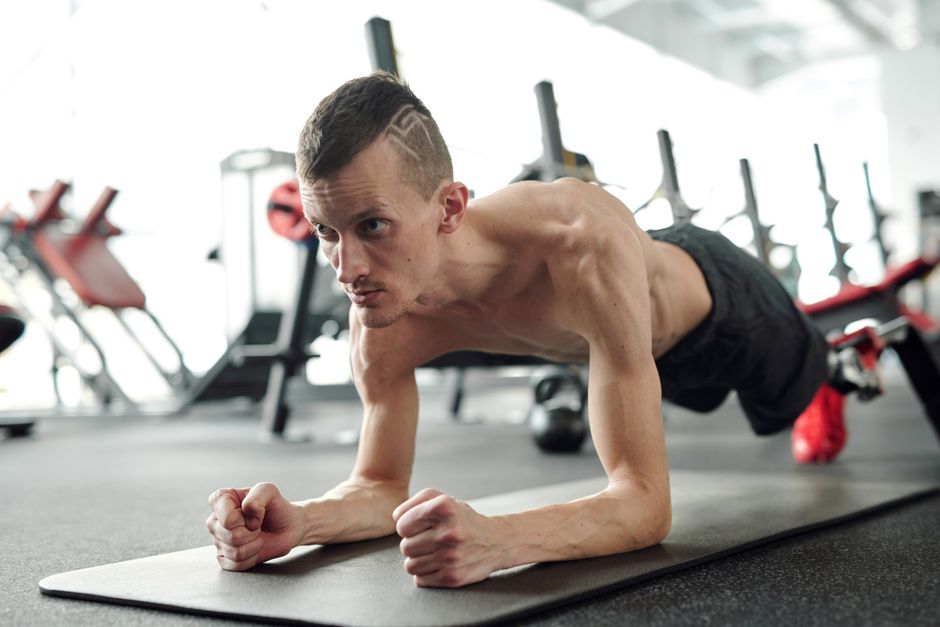
Planking works by training your core to resist movement rather than create it. When you hold a plank, the muscles of your abdomen, back, and hips contract together to keep your spine straight against gravity. That sustained tension builds stability in the trunk, which is the base every other movement in your body relies on.
It is one of the simplest exercises you can do. No equipment. No gym. A few minutes. But it is also one of the most misunderstood. People assume a plank only hits the abs. It does far more than that. It also gets oversold in ways that matter if you are training for real results.
What Does Planking Work in Your Body?
A plank trains your entire core, and your core is more than your abs. It includes the muscles that wrap around your trunk, support your spine, and stabilize your hips.
The main muscles involved:
- Rectus abdominis — the front abdominal muscle, what people call the “six-pack.”
- Transverse abdominis — the deep muscle that wraps around your waist like a corset and helps brace your spine.
- Obliques — the side muscles that resist rotation and bending.
- Erector spinae — the muscles running along your back that keep your spine straight.
- Glutes and hip muscles — they fire to keep your hips from sagging.
- Shoulders and upper back — they hold your body weight up through your arms.
So a plank is not just an ab exercise. It is a whole-body bracing drill. The muscles work together to keep your body in a straight line against gravity. That coordinated effort is the point.
Why Does Holding Still Build Strength?
Most exercises involve movement. A plank does not. That difference matters.
Holding a position against resistance is called an isometric contraction. The muscle generates force but does not change length. Research consistently shows isometric training builds strength, though often in the specific position you train. That is why a plank makes you strong at holding a plank — and why it transfers best to activities that need you to stay stable and braced.
Think about what that means in daily life. Carrying a heavy box. Pushing a stuck door. Staying upright while you catch your balance. These are bracing moments, not lifting moments. A plank trains exactly that skill.
Here is the part most people miss: a strong core is less about bending and crunching and more about resisting. Resisting your spine rounding when you lift. Resisting your trunk twisting when you carry something on one side. A plank trains that resistance directly.
What Does Planking Work That Crunches Don’t?
A crunch mostly trains the rectus abdominis through spinal flexion — curling your spine forward. A plank trains the deeper stabilizing muscles and the back muscles at the same time, while keeping your spine neutral.
That neutral-spine bracing is closer to how your core actually protects your back in real life. Crunches have their place, but they do not train the anti-movement job your core does all day.
One clarification worth knowing: a plank is not a fat-burning exercise in any meaningful sense. It builds muscular endurance and stability. It does not burn enough calories to drive weight loss on its own. If fat loss is your goal, the plank is a supporting player, not the main event.




How Long Should You Hold a Plank?
Longer is not automatically better. Once your form breaks down, the hold stops training what you want and starts stressing your lower back.
A common approach is to hold a plank with good form for a set time, then rest and repeat for a few rounds. The exact number of seconds matters less than the quality of each hold. If your hips sag or your back arches, end the set.
There is no official universal standard for how long a plank “should” be held. Different trainers use different targets. What the evidence does support is progressive difficulty: as a hold gets easy, make it harder rather than just longer. That is where the real strength gains come from.
Ways to make a plank harder without adding time:
- Lift one foot off the ground for a few seconds.
- Move to a plank on your forearms and toes from your knees.
- Add a slow reach forward with one arm.
- Try a side plank to load the obliques more directly.
Does Planking Prevent Back Pain?
This is where honesty matters. Core training is widely used in physical therapy for low back pain, and some studies suggest it can help. But the evidence is mixed, and planking specifically has not been proven in large trials to prevent back pain in healthy people.
What is well established: strong, well-coordinated core muscles help you move safely and support your spine during daily tasks. What is not established: that doing planks will guarantee you avoid back pain. Back pain has many causes, and no single exercise prevents all of them.
If you have existing back pain, talk to a clinician or physical therapist before starting a plank routine. Some back conditions make certain core exercises unhelpful or irritating. A plank is generally considered a low-risk exercise for healthy people, but “generally low-risk” is not the same as “right for everyone.”
How Do You Do a Plank With Good Form?
Form is everything with a plank. A sloppy plank trains sloppy bracing.
For a forearm plank:
- Rest on your forearms and toes. Elbows directly under your shoulders.
- Keep your body in one straight line from your head to your heels.
- Squeeze your glutes and brace your belly as if bracing for a light punch.
- Keep your neck neutral — look at the floor, not forward.
- Do not let your hips sag or hike up toward the ceiling.
If a full plank is too hard, drop to your knees. A knee plank with perfect form trains more than a full plank with a sagging back. There is no shame in the easier version — it is the smarter starting point.
Breathe the whole time. Holding your breath is a common mistake. Steady breathing while you brace is part of the skill.
Who Should Be Careful With Planking?
Planking is not right for everyone at every stage. People with certain shoulder, wrist, or low back conditions may need modifications or a different exercise entirely.
Pregnant women should check with their healthcare provider before starting or continuing a plank routine. No clinical guidelines set a universal plank protocol for pregnancy, so individual guidance from a clinician matters here.
Anyone returning from an injury, surgery, or a long break from exercise should ease in and get professional advice if unsure. The plank is simple, but simple does not mean risk-free for every body.
How Often Should You Plank?
Core muscles respond to regular training like any other muscle. A few sessions a week is a reasonable general approach for most healthy adults, but there is no single official frequency standard for planks.
More important than frequency is consistency and progression. Two or three short core sessions a week, done well, will do more than one long session you dread. Pair planks with other movements — walking, lifting, stretching — rather than relying on planks alone for your core or your fitness.
Frequently Asked Questions
What muscles does planking work?
A plank works your entire core, including the front abs, deep transverse abdominis, obliques, back muscles, glutes, and shoulders. It is a whole-body bracing exercise, not just an ab move.
How long should a beginner hold a plank?
Start with a hold you can complete with perfect form, even if that is only a short time, and build from there. There is no official universal time standard; good form matters more than duration.
Does planking burn belly fat?
No, planking does not specifically burn belly fat. It builds core strength and stability, but fat loss depends on overall diet and activity, not one exercise.
Is it better to do planks or crunches?
They train different things, so neither is strictly better. Planks train bracing and stability, while crunches train spinal flexion; many programs use both.
