
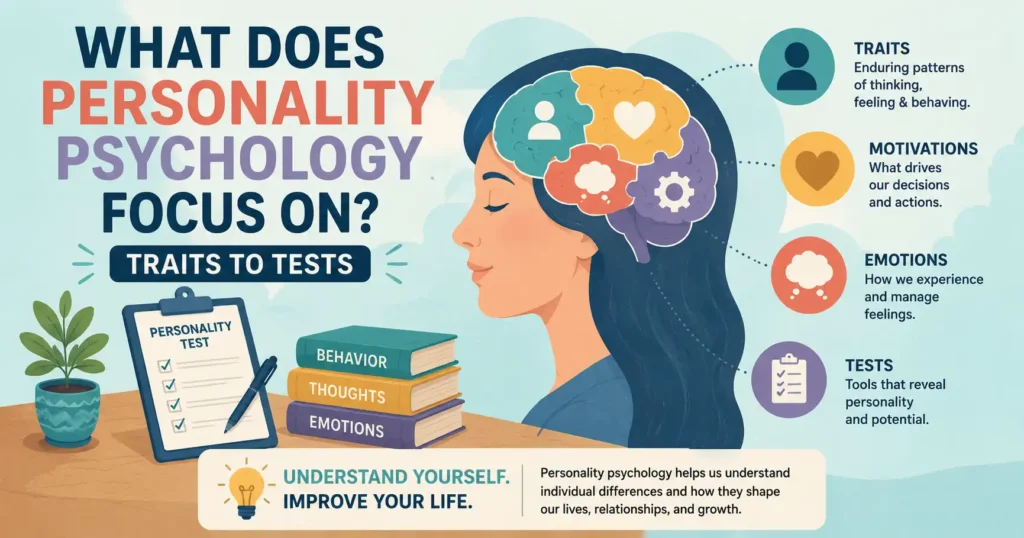
Personality psychology focuses on understanding what makes people different from one another and what stays the same about a person over time. It looks at stable patterns of thinking, feeling, and behaving that define an individual. The field uses traits as building blocks to describe personality and relies on tests to measure those traits in a reliable way. Researchers study how these traits develop, how they change, and how they affect life outcomes like relationships, work, and health.
What Are Personality Traits and Why Do They Matter?
Personality traits are consistent patterns of thoughts, feelings, and actions that show up across different situations. Think of them as the basic ingredients of who you are. The most well-studied model is called the Big Five, which includes openness, conscientiousness, extraversion, agreeableness, and neuroticism.
Research shows that these traits are surprisingly stable over a person’s lifetime. A study published in the Journal of Personality and Social Psychology found that trait levels at age 20 predicted life outcomes at age 40. That does not mean you are stuck. People do change, especially during young adulthood and in response to major life events. But the core tendency stays fairly consistent.
Traits matter because they predict real-world outcomes. Conscientiousness, for example, is one of the strongest predictors of job performance and academic success. Neuroticism is linked to a higher risk for anxiety and depression. Understanding your own traits can help you make better decisions about careers, relationships, and mental health support.
How Do Personality Tests Actually Work?
Personality tests are tools designed to measure traits in a standardized way. The most respected ones are based on decades of research. The NEO-PI-R measures the Big Five traits. The MMPI-2 is used in clinical settings to assess mental health. The Myers-Briggs Type Indicator is popular but has much weaker scientific support.
Most tests use self-report questions. You rate how much you agree with statements like “I am usually the one who starts conversations.” Your answers are compared to a large sample of other people. This gives a score that places you somewhere on a spectrum for each trait.
A good test has two key features: reliability and validity. Reliability means you get similar results if you take the test again. Validity means the test actually measures what it claims to measure. As of 2026, the Big Five tests remain the most scientifically supported option for general personality assessment. Many are available for free online from academic sources.
Key difference to understand: A personality test is not a diagnosis. It describes tendencies, not disorders. If you are worried about your mental health, a clinical interview with a psychologist is far more useful than any online quiz.
Does Personality Psychology Focus on Traits or on Tests?
The short answer is both, but for different reasons. Traits are the theoretical foundation. Tests are the practical tools used to study and apply that theory. You cannot have one without the other in modern personality psychology.
Researchers first identify which traits exist by studying how people describe themselves and others. This is called the lexical hypothesis. It assumes that important personality differences get encoded into language over time. Once traits are identified, researchers build tests to measure them accurately.
The real focus of personality psychology is understanding the structure and function of personality. Traits are the map. Tests are the compass. Neither is the destination. The goal is to explain why people behave the way they do and how that affects their lives.
Some critics argue that the field has become too focused on measurement and not enough on real human experience. That is a fair point. But without reliable measurement, personality psychology would be little more than guesswork. The best research combines strong theory with good measurement.
What Does Research on Personality Traits and Tests Show?
Decades of research have produced several clear findings. First, the Big Five traits are universal across cultures. Studies in over 50 countries have found the same five-factor structure. This suggests these traits are not just a Western idea but reflect something basic about human nature.
Second, personality traits have a strong genetic component. Twin studies show that about 40 to 60 percent of the variation in traits is due to genetics. The rest comes from environment, including parenting, culture, and life experiences. This does not mean personality is fixed. It means your starting point is partly inherited.
Third, personality traits predict important life outcomes. A meta-analysis of over 200 studies found that conscientiousness predicts job performance better than IQ in some contexts. Extraversion predicts leadership emergence. Neuroticism predicts divorce risk and mental health problems.
Fourth, personality can change with intentional effort. A 2021 study in the Journal of Personality and Social Psychology showed that people who wanted to change specific traits and practiced new behaviors actually shifted their scores over 16 weeks. This is not easy, but it is possible.
What Are the Limitations of Personality Tests?
Personality tests are useful tools, but they have real limits. The biggest problem is that they rely on self-report. People are not always honest or accurate about themselves. Someone might rate themselves as highly agreeable because they want to seem nice, even if their behavior says otherwise.
Another issue is that tests measure traits at one point in time. Your mood that day, the test setting, and even the wording of questions can affect your answers. This is why a single test score should never be treated as the final truth about who you are.
Some tests are also poorly designed. Many online personality quizzes have no scientific backing. They might be fun, but they are not reliable. Even well-known tests like the Myers-Briggs have been criticized for poor validity. Research shows that about 50 percent of people get a different type when they retake the test.
What to watch for: If a test claims to tell you everything about your career, relationships, or future, be skeptical. No personality test can do that. The best tests give you useful information about tendencies, not predictions about your destiny.
How Can You Use Personality Psychology in Your Daily Life?
Understanding your own personality traits can help you make better choices. If you know you are low in conscientiousness, you can build systems to stay organized. If you are high in neuroticism, you might benefit from stress management techniques or therapy. This is not about changing who you are. It is about working with your natural tendencies.
Personality knowledge also helps in relationships. Knowing that your partner is low in agreeableness does not mean they are a bad person. It means they might need more space to express disagreement. Understanding these differences can reduce conflict and improve communication.
At work, personality insights can guide career choices. People high in openness often thrive in creative fields. Those high in conscientiousness do well in structured roles. Extraverts tend to enjoy jobs with social interaction. Introverts may prefer quieter, independent work. These are general patterns, not rules, but they can point you in a useful direction.
If you want to take a personality test, choose one with scientific backing. The Big Five Inventory is free and well-validated. The SAPA Project offers a detailed personality report. Avoid tests that sort you into rigid categories. Look for tests that give you scores on continuous scales.
One practical step: Take a reputable test once. Read the results. Think about whether they match your experience. Then use that information as a starting point for reflection, not as a label you carry forever.
| Trait | High Score Means | Low Score Means |
|---|---|---|
| Openness | Curious, creative, open to new ideas | Prefer routine, practical, conventional |
| Conscientiousness | Organized, disciplined, reliable | Spontaneous, flexible, less structured |
| Extraversion | Outgoing, energetic, social | Reserved, quiet, enjoys solitude |
| Agreeableness | Compassionate, cooperative, trusting | Competitive, skeptical, direct |
| Neuroticism | Anxious, moody, sensitive to stress | Calm, emotionally stable, resilient |
Common Misconceptions About Personality Psychology
A big misconception is that personality is fixed and unchangeable. Current research suggests otherwise. Traits do shift over time, especially with deliberate effort and life experiences. You are not stuck with the personality you had at age 20.
Another myth is that personality tests can diagnose mental illness. They cannot. Tests like the Big Five describe normal personality variation. Clinical assessments like the MMPI-2 are designed for mental health evaluation. If you are struggling with anxiety, depression, or other symptoms, see a professional. Do not rely on a personality test.
Some people also think that personality determines everything about a person. That is not true. Situations matter. A naturally shy person can give a great public speech with practice. A conscientious person can still procrastinate on a boring task. Personality is a tendency, not a destiny.
Finally, avoid the trap of using personality types as excuses. Saying “I am an introvert so I cannot network” shuts down growth. Personality research shows that people can learn new behaviors even if they go against their natural tendencies. It takes effort, but it is possible.
Frequently Asked Questions
What does personality psychology focus on traits to tests?
Personality psychology focuses on identifying stable traits that describe people and developing tests to measure those traits reliably. The goal is to understand individual differences and predict behavior.
Are personality tests accurate?
Well-validated tests like the Big Five Inventory are reasonably accurate for measuring traits, but no test is perfect. Self-report biases and situational factors can affect results.
Can your personality change over time?
Yes, research shows that personality traits can change with intentional effort and major life experiences. Traits are relatively stable but not fixed.
What is the most scientifically supported personality test?
The Big Five personality tests are the most scientifically supported for general personality assessment. The NEO-PI-R is the gold standard in research settings.
