
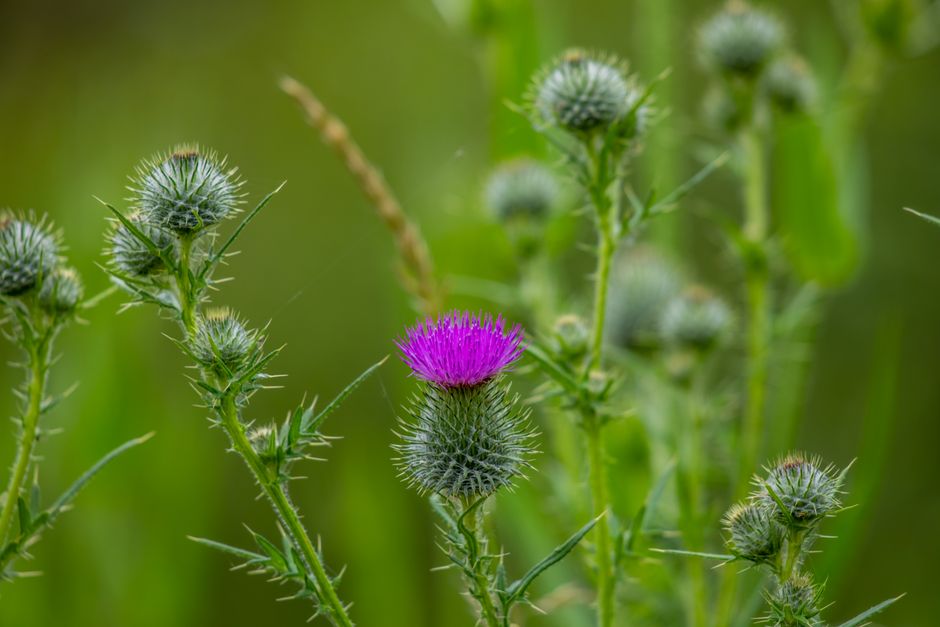
Milk thistle is a flowering plant in the daisy family, known scientifically as Silybum marianum, whose seeds contain a group of compounds called silymarin. People have used it for liver complaints for more than two thousand years, and today it is one of the most popular herbal supplements in the United States. The honest summary: silymarin has real biological activity, but the clinical evidence for most of the ways it is marketed is limited, mixed, or absent.
What Is Milk Thistle and Where Does It Come From?
Milk thistle is native to the Mediterranean region and now grows widely across Europe, North America, and Australia. It is a tall plant with distinctive white-veined leaves and purple flower heads. The white marbling on the leaves is the source of the name — an old legend held that the veins were drops of the Virgin Mary’s milk.
The medicinal part is the seed. The seed coat contains a mixture of flavonolignans — silibinin, silchristin, silidianin, and related compounds — collectively called silymarin. Most commercial extracts are standardized to a silymarin content, often around 70 to 80 percent, though labeling standards for supplements are not enforced the way drug labeling is.
Silymarin is poorly absorbed from the gut. This matters more than almost anything else about milk thistle. When you swallow a capsule, only a small fraction of the silymarin reaches your bloodstream, and researchers have spent years trying to solve this problem with formulations that dissolve better. That single fact helps explain why laboratory findings and real-world results often diverge.
What Does Milk Thistle Do in the Body?
In laboratory studies, silymarin shows several measurable effects. It acts as an antioxidant, meaning it can neutralize unstable molecules that damage cells. It also appears to stabilize cell membranes in liver cells, and it can influence some of the inflammatory signaling pathways that drive tissue injury.
These findings come largely from cells in dishes and from animal experiments. They are real findings, not marketing. But a mechanism that looks protective in a petri dish does not automatically translate into a benefit in a human being with a human liver, human absorption, and human metabolism.
One point that gets lost in the conversation: milk thistle is not a nutrient your body needs. There is no deficiency state, no recommended daily intake, and no established role for it in normal human physiology. It is a plant extract with pharmacological activity, which means it should be treated more like a drug than like a vitamin.
What Does the Evidence Say About Liver Conditions?
The evidence is genuinely mixed, and it depends heavily on which liver condition you are asking about.
For viral hepatitis, the picture is not encouraging. Several trials have tested silymarin in people with chronic hepatitis C, including a large, well-designed study conducted in the United States. That trial found no meaningful reduction in liver enzyme levels compared with placebo. Smaller studies from earlier decades had suggested possible benefit, but the better-designed research has not confirmed it.
For alcoholic liver disease, results across studies have been inconsistent. Some trials reported improvements in liver-related mortality; others found nothing. When researchers pool these trials together, the combined results generally show no clear survival benefit. That is a meaningful statement — it means the average effect across studies is close to zero.
For nonalcoholic fatty liver disease, which is now the most common chronic liver condition in the US, some smaller trials have reported modest improvements in liver enzymes and, in a few cases, in imaging measures of liver fat. These studies are generally small, short, and vary in how they measured outcomes. The evidence is not strong enough to support milk thistle as a treatment. It is also not strong enough to rule out a small effect.
For cirrhosis, the most serious form of chronic liver damage, trials have not shown a consistent survival benefit. Some clinicians still recommend it, particularly in parts of Europe, but that practice rests more on tradition and safety profile than on demonstrated effectiveness.



Is Milk Thistle Used for Anything Besides the Liver?
Milk thistle shows up in supplements marketed for other purposes. The evidence for these uses is thinner than for liver conditions.
- Diabetes and blood sugar: A few small trials have looked at silymarin in people with type 2 diabetes, with some reports of improved blood sugar markers. The studies are small and the results have not been consistently reproduced. No clinical guideline recommends it for diabetes.
- Cancer support: Silymarin has been studied as an add-on to certain chemotherapy regimens, mostly in small trials. There is no evidence it treats cancer. Some research has explored whether it affects liver toxicity from chemotherapy, but this is not established.
- Skin and inflammation: Topical and oral products make a wide range of claims. There is no large human trial supporting these uses.
- Mushroom poisoning: Intravenous silibinin, a purified form given in hospitals, has been used in some countries as part of treatment for death cap mushroom poisoning. This is a distinct pharmaceutical product, given by IV under medical supervision, and it is not the same thing as taking an oral supplement.
Is Milk Thistle Safe?
For most healthy adults, oral milk thistle appears to be reasonably well tolerated. The most commonly reported side effects are digestive — nausea, diarrhea, bloating, and occasional stomach upset. Allergic reactions are possible, particularly in people allergic to plants in the same family, which includes ragweed, chrysanthemums, marigolds, and daisies.
Two cautions deserve attention.
First, milk thistle can interact with medications. It affects some liver enzymes involved in drug metabolism, including the CYP450 system, which means it could change how quickly your body clears certain drugs. Documented interactions exist with some diabetes medications, some drugs used to lower cholesterol, and certain psychiatric and transplant medications. If you take prescription drugs, particularly ones with a narrow margin between an effective dose and a dangerous one, this is worth discussing with a pharmacist or physician before you start.
Second, milk thistle has not been established as safe in pregnancy and breastfeeding. There are no clinical guidelines for its use in these groups. Some sources describe it as likely safe based on traditional use, but that is not the same as evidence from controlled trials. The conservative position is to avoid it.
Because dietary supplements in the US are regulated differently from drugs, the actual silymarin content in a bottle may not match the label. Independent testing has found products with widely varying amounts, and some with contamination. This is a general problem with the supplement market, not unique to milk thistle, but it affects how much you can trust any given product.
Should You Take Milk Thistle?
That is a decision for you and your clinician, and the honest version of the answer depends on what you are hoping it will do.
If you have a diagnosed liver condition, milk thistle is not a substitute for treatment that has been shown to work — antiviral therapy for hepatitis, weight loss and metabolic management for fatty liver disease, alcohol cessation for alcoholic liver disease. Those interventions have real evidence behind them. Milk thistle does not.
If you are taking it for general “liver support” without a diagnosed condition, there is no established reason to expect benefit. The liver does not need a supplement to do its job in a person without liver disease.
If you are considering it alongside conventional treatment, tell your doctor. That is not a formality. The interaction potential is real, and the supplement could affect how your other medications work.
What milk thistle is not: a cure, a detox, or a replacement for addressing the underlying cause of liver stress. What it is: a plant extract with measurable biological activity, a long history of use, an incomplete evidence base, and a reasonable safety profile for most healthy adults at typical supplemental doses. That is a more modest picture than the marketing suggests. It is also more accurate.
Frequently Asked Questions
What does milk thistle do for your liver?
Milk thistle contains silymarin, which has antioxidant and anti-inflammatory effects in laboratory studies. Whether those effects produce meaningful clinical benefit in people with liver disease is not established, and the best-designed trials have generally been disappointing.
Is milk thistle safe to take every day?
For most healthy adults, oral milk thistle is generally well tolerated, with digestive upset being the most common complaint. It can interact with certain prescription medications, so check with a pharmacist or doctor if you take other drugs.
Can milk thistle cure hepatitis or fatty liver disease?
No. There is no evidence that milk thistle cures any form of hepatitis or fatty liver disease, and trials testing it for chronic hepatitis C have not shown benefit. Effective treatments for these conditions exist and should be the focus.
Does milk thistle interact with medications?
Yes, it can. Milk thistle affects liver enzymes involved in drug metabolism and has documented interactions with some diabetes drugs, cholesterol medications, and certain psychiatric and transplant drugs.
