
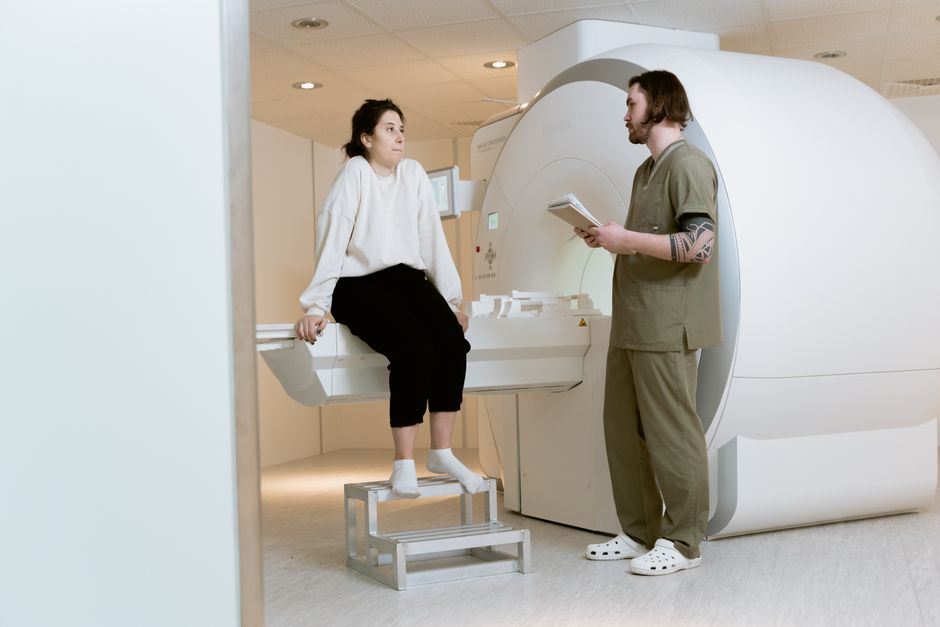
CT stands for computed tomography. It is sometimes written as computerized tomography or computed axial tomography (CAT). The “CT” in CT scan is simply the abbreviation of that full name. A CT scan uses X-rays taken from many angles around the body, and a computer combines those images into cross-sectional pictures of what is inside.
That basic answer matters because the name describes how the technology actually works. It is not a single X-ray picture. It is a computed reconstruction of many X-ray measurements. Understanding that helps explain why CT scans look different from ordinary X-rays and why they are used for certain jobs that plain films cannot do.
What Does CT Stand For in a CT Scan?
The letters stand for computed tomography. “Computed” refers to the computer processing required to build the images. “Tomography” comes from the Greek words tomos (slice) and graphia (writing or recording). Put together, tomography means imaging the body in slices.
That slice concept is the key difference. A standard chest X-ray flattens everything in the chest into one image. The ribs, lungs, heart, and blood vessels all overlap. A CT scan takes many thin cross-sectional images, usually from head to pelvis or wherever the scan is focused. A computer stacks those slices so a radiologist can look through the body layer by layer.
The term “CAT scan” was common in the 1970s and 1980s and is still heard today. It stands for computed axial tomography. The “axial” referred to the axis of rotation used in early scanners. Modern scanners can image in multiple planes, so “CT” became the preferred term. Both names describe the same technology.
Who Invented the CT Scan and Why Does It Matter?
The CT scanner was developed by Godfrey Hounsfield, an English engineer, and Allan Cormack, a South African-born physicist. They shared the 1979 Nobel Prize in Physiology or Medicine for this work. Hounsfield built the first practical clinical CT scanner in the early 1970s.
The invention mattered because it solved a real problem. Before CT, doctors could not see inside the skull or abdomen without surgery or invasive procedures. Plain X-rays could not separate overlapping structures. CT gave medicine its first non-invasive way to look at soft tissue, bone, and organs in cross-section.
Early CT scans were slow and produced low-resolution images. A head scan in the 1970s could take several minutes. Today’s scanners complete a full study in seconds. That speed matters for trauma patients, children who cannot hold still, and anyone who has trouble holding their breath.
How Does a CT Scan Actually Work?
A CT scanner is a large ring-shaped machine with an X-ray tube on one side and detectors on the other. The tube and detectors rotate around the patient. As they spin, the tube sends narrow X-ray beams through the body, and the detectors measure how much radiation passes through.
Different tissues absorb X-rays differently. Bone absorbs a lot. Air absorbs very little. Soft tissue falls in between. The scanner records these differences from hundreds of angles. A computer then uses mathematical reconstruction to calculate what the inside of the body must look like to produce those measurements.
The result is a set of grayscale images. Dense structures like bone appear white. Air appears black. Fat, muscle, and fluid appear in various shades of gray. Radiologists read these shades to identify normal anatomy and anything abnormal.
Many CT scans use a contrast dye. The dye can be swallowed, injected into a vein, or given as an enema. Contrast makes certain structures easier to see, such as blood vessels, the kidneys, or the lining of the intestines. Not every CT scan needs contrast. Whether it is used depends on what the doctor is looking for.





What Is a CT Scan Used For?
CT is one of the most versatile imaging tools in medicine. It is often the fastest way to get a clear picture of a serious problem. Common uses include:
- Evaluating head injuries and suspected strokes
- Checking for blood clots in the lungs
- Looking at the abdomen for pain, bleeding, or suspected tumors
- Assessing fractures, especially in complex areas like the spine or pelvis
- Planning and guiding certain surgeries and biopsies
- Staging some cancers before treatment
- Monitoring how a known condition changes over time
CT is especially useful in emergencies. It is fast, widely available, and can show many problems in a single study. That combination makes it a first-choice test in many trauma and acute care situations.
Is a CT Scan the Same as an MRI?
No. CT and MRI are different technologies. CT uses X-rays. MRI uses strong magnetic fields and radio waves. They produce different information and are chosen for different reasons.
| Feature | CT Scan | MRI |
|---|---|---|
| Energy source | X-rays | Magnetic fields and radio waves |
| Best for | Bone, bleeding, lungs, fast emergency imaging | Soft tissue, brain, spinal cord, joints, some organs |
| Speed | Usually minutes | Usually 30 minutes or longer |
| Radiation | Yes | No ionizing radiation |
| Metal implants | Generally safe | May be unsafe or cause image problems |
Neither test is universally better. A doctor chooses based on the question being asked, the patient’s history, and what will give the clearest answer with the least risk.
Does a CT Scan Use Radiation?
Yes. CT uses ionizing radiation, and the dose is higher than a single plain X-ray. That is the main trade-off of the technology. The dose depends on the part of the body scanned and the protocol used. A CT of the head delivers less radiation than a CT of the abdomen or pelvis.
Radiation exposure carries a small increase in lifetime cancer risk. The size of that risk at typical diagnostic doses is debated among researchers. What is not debated is that CT scans can find problems that would otherwise go undetected, and that the benefit often outweighs the risk when the scan is medically necessary.
Doctors are trained to order CT scans only when the information is likely to change care. Many hospitals use dose-reduction techniques and adjust settings for children and smaller adults. If you are concerned about radiation, it is reasonable to ask your doctor whether CT is necessary or whether another test such as ultrasound or MRI could answer the same question.
What Happens During a CT Scan?
Most CT scans are quick and do not require sedation. You lie on a table that slides into the scanner. The machine’s ring rotates around you but does not touch you. You may hear whirring or clicking sounds. You may be asked to hold your breath for short periods so the images are not blurred by movement.
If contrast is used, you may feel warmth, a metallic taste, or a brief flushing sensation when it is injected. These feelings usually pass within seconds. Some people have allergic reactions to contrast dye. If you have had a reaction before, or if you have kidney problems or certain other conditions, tell your doctor and the technologist before the scan.
After the scan, you can usually return to normal activities right away. Results are read by a radiologist and sent to your doctor, often within a day for routine scans and faster for emergencies.
Why the Name Still Matters
Knowing what CT stands for is more than trivia. The name tells you what the test does: it computes a picture from many measurements and shows the body in slices. That is why CT can reveal things plain X-rays cannot, and why it is used so often in emergencies.
It also helps you ask better questions. If your doctor recommends a CT scan, you can ask what the scan is expected to show, whether contrast is needed, and whether another test might work as well. Those are reasonable questions, and a good clinician will welcome them.
Frequently Asked Questions
What does CT stand for in a CT scan?
CT stands for computed tomography. The name describes how the images are made: a computer processes many X-ray measurements to build cross-sectional pictures of the body.
Is a CT scan the same as a CAT scan?
Yes. CAT stands for computed axial tomography, an older name for the same technology. Modern scanners can image in multiple planes, so “CT” is now the standard term.
Is a CT scan safe?
CT scans are generally considered safe when medically necessary, but they do use ionizing radiation at higher doses than a plain X-ray. The small added lifetime cancer risk is weighed against the benefit of finding or ruling out a serious problem.
How long does a CT scan take?
Most CT scans take only a few minutes once you are positioned on the table. Actual scanning time is often seconds, though setup and contrast preparation can add time.
