
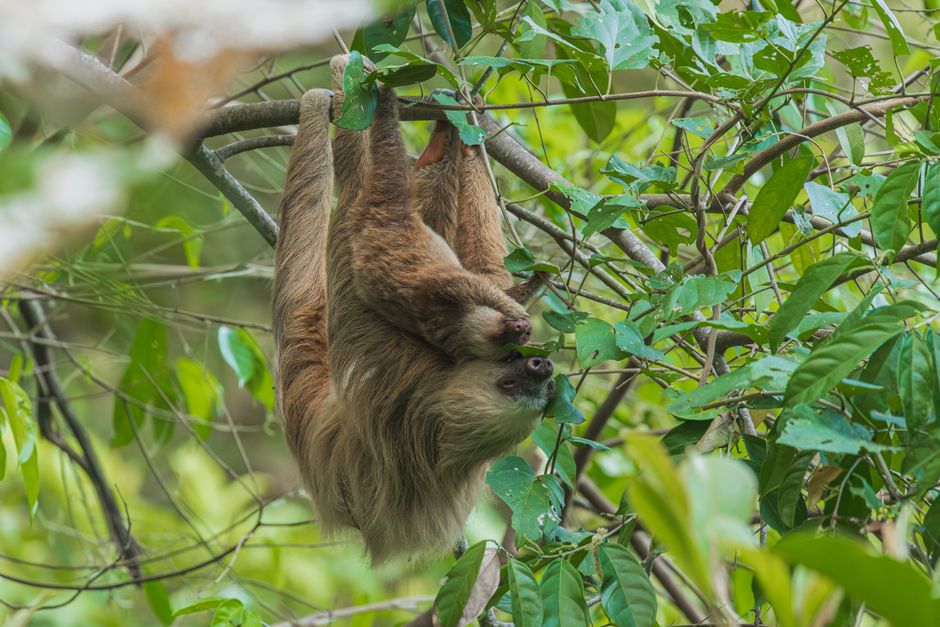
Sloths eat a very low-energy diet made up almost entirely of leaves, twigs, and buds from specific trees. In the wild, the three-toed sloth relies mostly on the leaves of the Cecropia tree, while two-toed sloths eat a wider range of leaves, fruits, and flowers. This diet is so low in calories that sloths have evolved to move incredibly slowly, sleep up to 20 hours a day, and maintain one of the slowest metabolisms of any mammal on Earth.
What Exactly Do Sloths Eat in the Wild?
Wild sloths are strict herbivores with a few notable exceptions depending on the species. The three-toed sloth, which is the slower of the two main types, eats almost exclusively leaves from the Cecropia tree. Some researchers call them “obligate folivores” because their digestive system is built for a single food source.
Two-toed sloths are more flexible. They eat leaves, but they also eat fruits, flowers, and sometimes small insects or bird eggs if they happen across them. The National Zoo in Washington D.C. reports that two-toed sloths in captivity eat a variety of vegetables, fruits, and leaf-eater biscuits to mimic this wider natural diet.
Neither type of sloth eats grass, bark, or meat as a regular part of their diet. Their stomachs are specialized to break down tough leaves using bacteria that ferment the plant material, a process that can take up to a month for a single meal to fully digest.
How Does a Leaf-Only Diet Fuel a Sloth?
The short answer is that it barely does. Leaves are extremely low in calories and nutrients compared to fruits, seeds, or animal protein. A single Cecropia leaf might contain only a few calories. For a sloth to survive on this, its body had to make radical changes.
Sloths have the lowest metabolic rate of any non-hibernating mammal. Research published in the Journal of Mammalogy found that a sloth’s metabolism can be 40 to 50 percent slower than what would be expected for an animal of its size. This means they burn energy so slowly that a handful of leaves per day can sustain them.
They also regulate their body temperature differently. While most mammals keep a steady internal temperature, sloths let theirs fluctuate with the environment. This saves energy but also means they cannot live in cold climates.
What Do Sloths Eat in Captivity vs. the Wild?
Captive sloths eat a very different diet than wild ones, and this is where many people get confused. Zoos and rescue centers cannot always find fresh Cecropia leaves, so they have to improvise with what is available and nutritionally balanced.
A typical captive diet for a two-toed sloth includes:
- Chopped leafy greens like kale, romaine lettuce, and collard greens
- Fruits like apples, bananas, grapes, and melon
- Vegetables like carrots, sweet potatoes, and green beans
- High-fiber biscuits made for leaf-eating animals
- Small amounts of cooked eggs or lean meat for protein
Three-toed sloths are much harder to keep in captivity because their wild diet is so specific. Many zoos have stopped trying to keep three-toed sloths because they often refuse to eat substitute foods and develop digestive problems. The San Diego Zoo notes that three-toed sloths in their care require constant access to fresh Cecropia leaves shipped in from Florida.





What Does Research Show About Sloth Digestion?
Sloth digestion is one of the most unusual processes in the animal kingdom. Their stomach has multiple compartments, similar to a cow’s, where bacteria break down tough cellulose. But unlike a cow, a sloth takes 30 to 50 days to fully digest a single meal.
This slow digestion is not a choice — it is a necessity. Because leaves are so low in nutrients, the sloth’s body extracts every possible molecule of energy from each bite. The longer food stays in the digestive tract, the more time bacteria have to break it down.
A 2014 study in the journal Physiological and Biochemical Zoology found that sloths can lose up to one-third of their body weight between bowel movements. They only defecate once a week on average, and when they do, it is a major event. They climb down from the trees to the ground, dig a hole, and cover their waste. This behavior is still not fully understood by researchers, though some theories suggest it helps fertilize the trees they live in.
What Are the Biggest Myths About What Sloths Eat?
There are several viral claims about sloth diets that are simply not true. One of the most common is that sloths eat only eucalyptus leaves, like koalas. This is false. Sloths do not eat eucalyptus at all, and if they did, it would likely be toxic to them because eucalyptus contains compounds that only koalas can process.
Another myth is that sloths eat fruit as their main food source. While two-toed sloths do eat some fruit in the wild, it makes up a small part of their diet. Fruit is higher in sugar and calories than leaves, but sloths simply do not encounter enough of it in the rainforest canopy to rely on it.
A third myth is that sloths can eat human food like bread, rice, or cooked vegetables. This is dangerous. Sloth digestive systems are not designed for processed foods. Feeding a sloth bread or cooked grains can cause bloating, constipation, and even death. The only safe diet for a sloth is what its body evolved to handle — leaves, and for two-toed sloths, raw fruits and vegetables in small amounts.
How Does Sloth Diet Compare to Other Slow Animals?
Sloths are not the only animals that survive on a low-energy leaf diet. Koalas, pandas, and some species of monkeys also eat mostly leaves. But the sloth is unique in how extreme its adaptations are.
| Animal | Main Food | Daily Calories | Digestion Time |
|---|---|---|---|
| Three-toed sloth | Cecropia leaves | ~150-200 | 30-50 days |
| Koala | Eucalyptus leaves | ~200-300 | 10-20 days |
| Giant panda | Bamboo | ~1,500-2,000 | 10-20 hours |
| Howler monkey | Leaves and fruit | ~500-800 | 1-2 days |
What stands out from this comparison is that sloths eat far fewer calories than any other leaf-eating mammal of similar size. A howler monkey weighs about the same as a sloth but eats three to four times as many calories per day. This is why sloths move so slowly — their body literally cannot afford to waste energy.
What Happens When a Sloth Cannot Find Its Preferred Food?
In the wild, sloths are tied to specific trees. Three-toed sloths have been observed refusing to move from a Cecropia tree even when food runs low. Some researchers believe this is because their gut bacteria are specifically adapted to digest Cecropia leaves, and switching to another leaf type would cause digestive upset.
Two-toed sloths have more flexibility. If their favorite fruit tree is out of season, they will eat other leaves, flowers, or even small insects. But even they have limits. During droughts or deforestation events, sloths can starve because the trees they depend on die or are cut down.
This is a major concern for conservation. The International Union for Conservation of Nature (IUCN) lists several sloth species as threatened or vulnerable, largely due to habitat loss. Without their specific food trees, sloths simply cannot survive in an area, even if other trees remain.
Can Sloths Eat Anything Besides Leaves?
Yes, but only in very small amounts and only for two-toed sloths. Three-toed sloths are so specialized that any deviation from their leaf diet can cause health problems. Two-toed sloths, on the other hand, have been observed eating bird eggs, insects, and even small lizards in the wild.
These protein sources are rare in the sloth’s natural diet. They make up less than 5 percent of what a two-toed sloth eats in a year. The energy gained from eating an insect or egg is small, but it can provide nutrients like protein and fat that leaves lack.
In captivity, zookeepers sometimes add cooked eggs or lean meat to a two-toed sloth’s diet to prevent protein deficiency. This is a carefully measured supplement, not a main food. Never feed a pet sloth or a rescue sloth meat without veterinary guidance.
Frequently Asked Questions
Do sloths eat fruit in the wild?
Two-toed sloths eat small amounts of fruit when they find it, but three-toed sloths eat almost none. Fruit is not the main part of any wild sloth’s diet.
Can sloths eat bananas or apples?
Captive two-toed sloths can eat small pieces of banana or apple as treats. Three-toed sloths should not eat these fruits because their digestive system cannot handle the sugar.
How often does a sloth need to eat?
Wild sloths eat small amounts throughout the day and night. They do not have set meal times. In captivity, they are usually fed once or twice daily.
What happens if a sloth eats meat?
Two-toed sloths can digest small amounts of protein from insects or eggs without harm. Three-toed sloths cannot digest meat and may become sick if they eat it.
